Semmler-Behnke Manuela, Takenaka Shinji, Fertsch Steffanie, Wenk Alexander, Seitz Jürgen, Mayer Paula, Oberdörster Günter, Kreyling Wolfgang G
GSF - National Research Center for Environment and Health, Institute of Inhalation Biology, Neuherberg/Munich, Germany.
Environ Health Perspect. 2007 May;115(5):728-33. doi: 10.1289/ehp.9685. Epub 2007 Feb 6.
There is ongoing discussion that inhaled nanoparticles (NPs, < 100 nm) may translocate from epithelial deposition sites of the lungs to systemic circulation.
We studied the disappearance of NPs from the epithelium by sequential lung retention and clearance and bronchoalveolar lavage (BAL) measurements in healthy adult Wistar Kyoto (WKY) rats at various times over 6 months after administration of a single 60- to 100-min intratracheal inhalation of iridium-192 ((192)Ir)-radiolabeled NPs. A complete (192)Ir balance of all organs, tissues, excretion, remaining carcass, and BAL was performed at each time point.
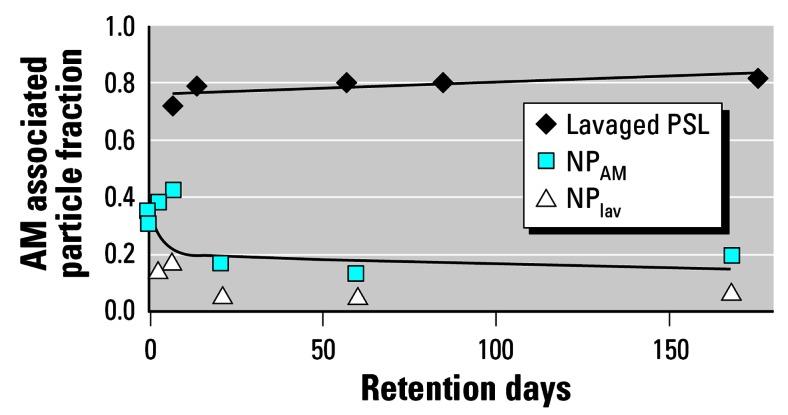
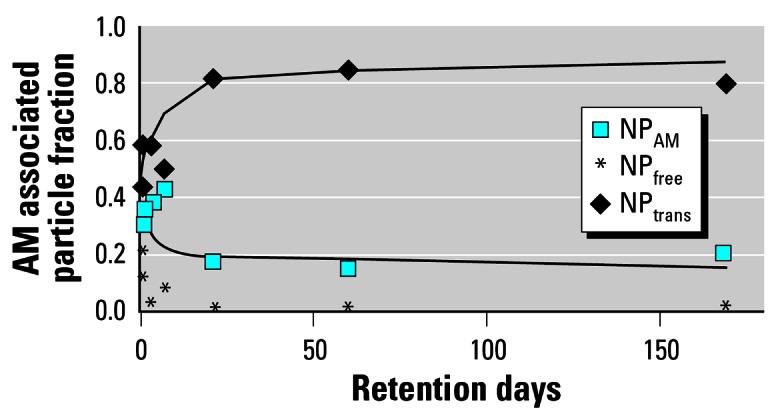
Directly after inhalation we found free NPs in the BAL; later, NPs were predominantly associated with alveolar macropages (AMs). After 3 weeks, lavageable NP fractions decreased to 0.06 of the actual NP lung burden. This is in stark contrast to the AM-associated fraction of micron-sized particles reported in the literature. These particles remained constant at about 0.8 throughout a 6-month period. Three weeks after inhalation, 80% of the retained Ir NPs was translocated into epithelium and interstitium.
There is a strong size-selective difference in particle immobilization. Furthermore, AM-mediated NP transport to the larynx originates not only from the NP fraction retained on the epithelium but also from NPs being reentrained from the interstitium to the luminal side of epithelium. We conclude that NPs are much less phagocytized by AMs than large particles but are effectively removed from the lung surface into the interstitium. Even from these interstitial sites, they undergo AM-mediated long-term NP clearance to the larynx.
关于吸入的纳米颗粒(NPs,<100 nm)是否可能从肺部上皮沉积部位转移至体循环的讨论仍在继续。
我们通过在健康成年Wistar Kyoto(WKY)大鼠单次气管内吸入铱 - 192(¹⁹²Ir)放射性标记的纳米颗粒60至100分钟后的6个月内不同时间点进行连续的肺滞留和清除以及支气管肺泡灌洗(BAL)测量,研究纳米颗粒从上皮的消失情况。在每个时间点对所有器官、组织、排泄物、剩余尸体和BAL进行完整的¹⁹²Ir平衡分析。
吸入后立即在BAL中发现游离的纳米颗粒;之后,纳米颗粒主要与肺泡巨噬细胞(AMs)相关。3周后,可灌洗的纳米颗粒部分降至实际肺内纳米颗粒负荷的0.06。这与文献中报道的微米级颗粒与AMs相关部分形成鲜明对比。这些颗粒在6个月期间一直保持在约0.8的恒定水平。吸入3周后,80%保留的铱纳米颗粒转移至上皮和间质。
在颗粒固定方面存在强烈的尺寸选择性差异。此外,AMs介导的纳米颗粒向喉部的转运不仅源于保留在上皮的纳米颗粒部分,还源于从间质重新进入上皮腔侧的纳米颗粒。我们得出结论,纳米颗粒被AMs吞噬的程度远低于大颗粒,但能有效地从肺表面清除到间质中。即使从这些间质部位,它们也会经历AMs介导的长期纳米颗粒向喉部的清除过程。