Babich Olga, Reeves John, Shirokov Roman
Department of Pharmacology and Physiology, University of Medicine and Dentistry of New Jersey, New Jersey Medical School, Newark, NJ 07103, USA.
J Gen Physiol. 2007 Jun;129(6):461-75. doi: 10.1085/jgp.200709733.
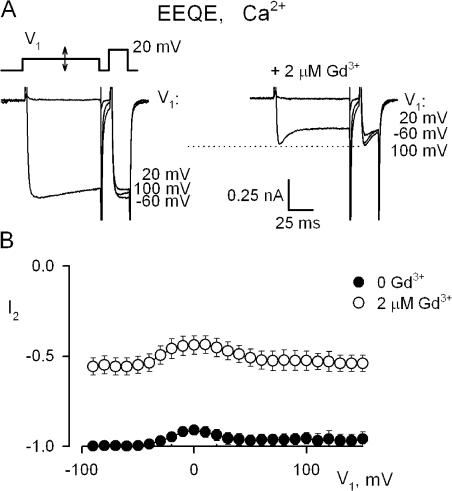
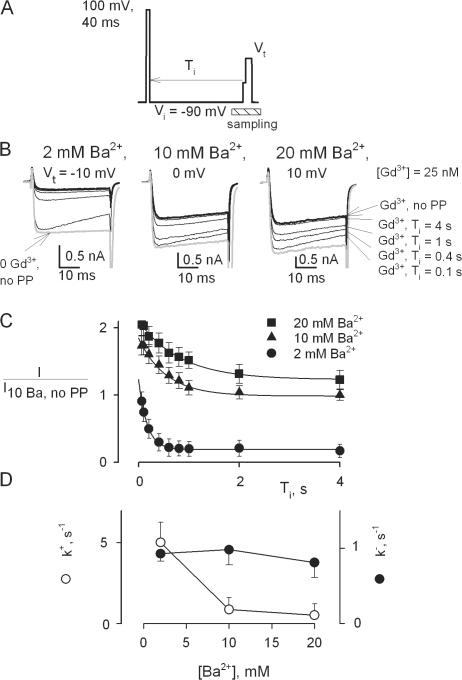
Using the lanthanide gadolinium (Gd(3+)) as a Ca(2+) replacing probe, we investigated the voltage dependence of pore blockage of Ca(V)1.2 channels. Gd(+3) reduces peak currents (tonic block) and accelerates decay of ionic current during depolarization (use-dependent block). Because diffusion of Gd(3+) at concentrations used (<1 microM) is much slower than activation of the channel, the tonic effect is likely to be due to the blockage that occurred in closed channels before depolarization. We found that the dose-response curves for the two blocking effects of Gd(3+) shifted in parallel for Ba(2+), Sr(2+), and Ca(2+) currents through the wild-type channel, and for Ca(2+) currents through the selectivity filter mutation EEQE that lowers the blocking potency of Gd(3+). The correlation indicates that Gd(3+) binding to the same site causes both tonic and use-dependent blocking effects. The apparent on-rate for the tonic block increases with the prepulse voltage in the range -60 to -45 mV, where significant gating current but no ionic current occurs. When plotted together against voltage, the on-rates of tonic block (-100 to -45 mV) and of use-dependent block (-40 to 40 mV) fall on a single sigmoid that parallels the voltage dependence of the gating charge. The on-rate of tonic block by Gd(3+) decreases with concentration of Ba(2+), indicating that the apparent affinity of the site to permeant ions is about 1 mM in closed channels. Therefore, we propose that at submicromolar concentrations, Gd(3+) binds at the entry to the selectivity locus and that the affinity of the site for permeant ions decreases during preopening transitions of the channel.
我们使用镧系元素钆(Gd(3+))作为钙离子替代探针,研究了Ca(V)1.2通道孔道堵塞的电压依赖性。Gd(+3)会降低峰值电流(强直阻滞),并在去极化过程中加速离子电流的衰减(使用依赖性阻滞)。由于所用浓度(<1 microM)的Gd(3+)扩散速度远慢于通道激活速度,因此强直效应可能是由于去极化前在关闭通道中发生的堵塞所致。我们发现,对于通过野生型通道的Ba(2+)、Sr(2+)和Ca(2+)电流,以及通过降低Gd(3+)阻滞效力的选择性过滤器突变EEQE的Ca(2+)电流,Gd(3+)的两种阻滞效应的剂量反应曲线平行移动。这种相关性表明,Gd(3+)与同一位点的结合会导致强直和使用依赖性阻滞效应。在-60至-45 mV范围内,强直阻滞的表观结合速率随预脉冲电压增加,在此范围内会出现显著的门控电流但无离子电流。当将强直阻滞(-100至-4 mV)和使用依赖性阻滞(-40至40 mV)的结合速率与电压一起绘制时,它们落在一条与门控电荷的电压依赖性平行的单一S形曲线上。Gd(3+)引起的强直阻滞结合速率随Ba(2+)浓度降低,表明该位点对通透离子的表观亲和力在关闭通道中约为1 mM。因此,我们提出,在亚微摩尔浓度下,Gd(3+)在选择性位点入口处结合,并且在通道预开放转变过程中,该位点对通透离子的亲和力降低。