Sharan Shyam K, Kuznetsov Sergey G
Mouse Cancer Genetics Program, Center for Cancer Research, National Cancer Institute, Frederick, Maryland 21702, USA.
Cell Div. 2007 Jun 4;2:15. doi: 10.1186/1747-1028-2-15.
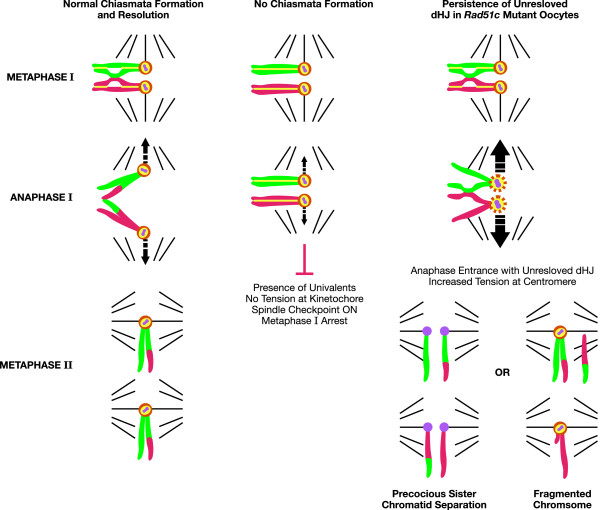
DNA double strand breaks are efficiently repaired by homologous recombination. One of the last steps of this process is resolution of Holliday junctions that are formed at the sites of genetic exchange between homologous DNA. Although various resolvases with Holliday junctions processing activity have been identified in bacteriophages, bacteria and archaebacteria, eukaryotic resolvases have been elusive. Recent biochemical evidence has revealed that RAD51C and XRCC3, members of the RAD51-like protein family, are involved in Holliday junction resolution in mammalian cells. However, purified recombinant RAD51C and XRCC3 proteins have not shown any Holliday junction resolution activity. In addition, these proteins did not reveal the presence of a nuclease domain, which raises doubts about their ability to function as a resolvase. Furthermore, oocytes from infertile Rad51C mutant mice exhibit precocious separation of sister chromatids at metaphase II, a phenotype that reflects a defect in sister chromatid cohesion, not a lack of Holliday junction resolution. Here we discuss a model to explain how a Holliday junction resolution defect can lead to sister chromatid separation in mouse oocytes. We also describe other recent in vitro and in vivo evidence supporting a late role for RAD51C in homologous recombination in mammalian cells, which is likely to be resolution of the Holliday junction.
DNA双链断裂可通过同源重组有效地修复。该过程的最后步骤之一是在同源DNA之间的基因交换位点形成的霍利迪连接体的拆分。尽管在噬菌体、细菌和古细菌中已鉴定出具有霍利迪连接体加工活性的各种解离酶,但真核生物的解离酶一直难以捉摸。最近的生化证据表明,RAD51样蛋白家族的成员RAD51C和XRCC3参与哺乳动物细胞中霍利迪连接体的拆分。然而,纯化的重组RAD51C和XRCC3蛋白并未表现出任何霍利迪连接体拆分活性。此外,这些蛋白未显示出核酸酶结构域的存在,这使人对它们作为解离酶发挥功能的能力产生怀疑。此外,不育的Rad51C突变小鼠的卵母细胞在中期II表现出姐妹染色单体过早分离,这种表型反映了姐妹染色单体黏连缺陷,而非缺乏霍利迪连接体拆分。在这里,我们讨论一个模型,以解释霍利迪连接体拆分缺陷如何导致小鼠卵母细胞中的姐妹染色单体分离。我们还描述了其他最近的体外和体内证据,支持RAD51C在哺乳动物细胞同源重组中的后期作用,这可能是霍利迪连接体的拆分。