Miyasaka Kyoko, Kanai Setsuko, Ohta Minoru, Sekime Ayako, Akimoto Saeko, Takiguchi Soichi, Funakoshi Akihiro
Department of Clinical Physiology, Tokyo Metropolitan Institute of Gerontology, 35-2 Sakaecho Itabashiku 173-0015, Tokyo, Japan.
Nutr Metab (Lond). 2007 Jun 5;4:14. doi: 10.1186/1743-7075-4-14.
The frequency of Japanese subjects over 20 years old with metabolic syndrome is 45.6% in men but just 16.7% in women. The reason why Japanese male subjects are more susceptible to metabolic syndrome than women is unknown. One possibility is the higher frequency of Japanese male subjects (40-70 years old) who had a drinking habit (67%), while that of female subjects was only 25%. In addition, daily fat intake was markedly increased in Japanese subjects (from 9% to 25%), and cholesterol cholelithiasis is one of the most rapidly increasing digestive diseases during the past 50 years. The object of this study is to examine whether a potential sex-related risk factor exists in the manifestation of metabolic syndrome as well as gallstone formation.
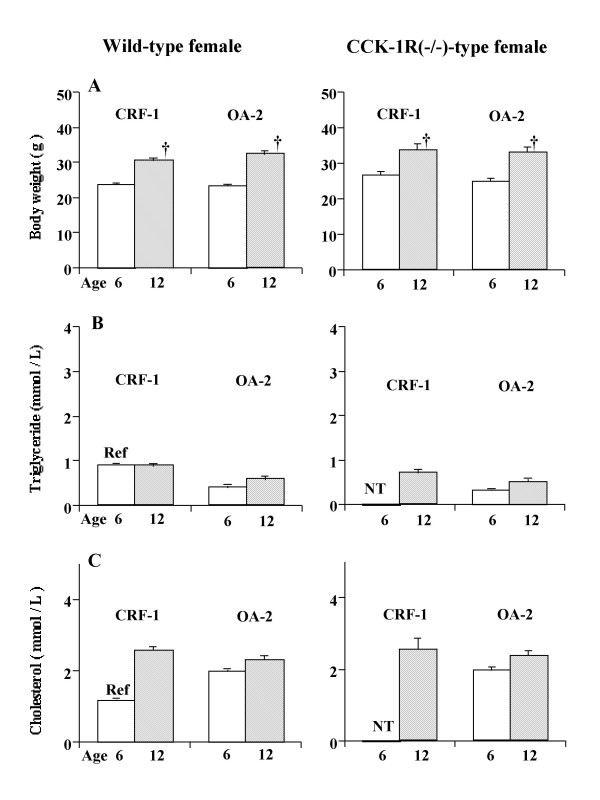
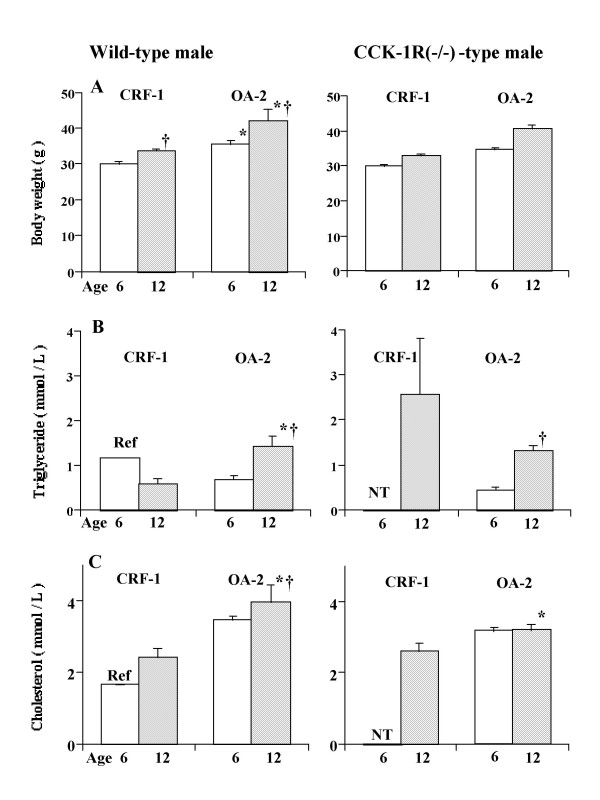
Gallbladder dysmotility accerelates gallstone formation and gallbladder contraction depends on cholecystokinin (CCK) and its receptor (CCK-1R). We developed CCK-1R gene knockout (-/-) mice. The effects of the fat- and protein- enriched diet OA-2 on body weight, hyperlipidemia, and frequencies of sludge and gallstone formation were examined, and compared between wild-type and CCK-1R(-/-) male and female mice. The OA-2 diet contains slightly higher protein and fat (7.9 % fat and 27.6 % protein) compared with a standard diet (CRF-1) (5.6 % fat and 22.6 % protein), but their total energies are similar. After weaning, CRF-1 was provided until 3 months of age in all animals. Administration of an OA-2 diet was started when age-matched CCK-1R(-/-) and wild-type male and female mice reached maturity, at 3 months of age. Administration of CRF-1 was continued in the rest of the animals. Mice were sacrificed by guillotine at 6 and 12 months of age and the blood was collected to measure plasma levels of triglyceride and cholesterol. The gallbladder was removed and classified as normal (clear gallbladder), clouded (sludge formation), and/or containing gallstone formations.
As long as CRF-1 was provided, the frequency of sludge and/or gallstone formation in CCK-1R(-/-) male mice was 3 of 8 (35%) and 4 of 9 (45%) in females at 12 months of age, whereas no gallstone formation was observed at 6 months of age. On the other hand, male mice fed OA-2 increased their body weight and plasma lipid concentrations, compared with those fed CRF-1 regardless of genotype. Under the OA-2 diet, sludge and gallstone formation was observed at 6 months of age, not only in CCK-1R(-/-) male mice but also in wild-type male mice. In contrast, parameters in female mice did not differ between the two diets.
Male mice were more susceptible to protein- and fat-enriched diet-induced obesity than female mice, and hyper-nutritional status accelerated sludge and gallstone formation in male mice.
20岁以上日本代谢综合征患者的频率,男性为45.6%,而女性仅为16.7%。日本男性比女性更容易患代谢综合征的原因尚不清楚。一种可能性是日本男性(40 - 70岁)有饮酒习惯的频率较高(67%),而女性只有25%。此外,日本受试者的每日脂肪摄入量显著增加(从9%增至25%),胆固醇结石是过去50年中增长最快的消化系统疾病之一。本研究的目的是检查在代谢综合征以及胆结石形成的表现中是否存在潜在的性别相关风险因素。
胆囊运动障碍会加速胆结石形成,而胆囊收缩取决于胆囊收缩素(CCK)及其受体(CCK - 1R)。我们培育了CCK - 1R基因敲除(-/-)小鼠。研究了富含脂肪和蛋白质的OA - 2饮食对体重、高脂血症以及胆汁淤积和胆结石形成频率的影响,并在野生型和CCK - 1R(-/-)雄性和雌性小鼠之间进行比较。与标准饮食(CRF - 1)(5.6%脂肪和22.6%蛋白质)相比,OA - 2饮食的蛋白质和脂肪含量略高(7.9%脂肪和27.6%蛋白质),但它们的总能量相似。断奶后,所有动物均喂食CRF - 1直至3个月大。当年龄匹配的CCK - 1R(-/-)和野生型雄性和雌性小鼠在3个月大达到成熟时,开始给予OA - 2饮食。其余动物继续喂食CRF - 1。在6个月和12个月大时,通过断头台处死小鼠并采集血液以测量血浆甘油三酯和胆固醇水平。取出胆囊并分类为正常(胆囊清晰)、浑浊(胆汁淤积形成)和/或含有胆结石形成。
只要提供CRF - 1,12个月大时CCK - 1R(-/-)雄性小鼠胆汁淤积和/或胆结石形成的频率为8只中的3只(35%),雌性为9只中的4只(45%),而在6个月大时未观察到胆结石形成。另一方面,与喂食CRF - 1的小鼠相比,无论基因型如何,喂食OA - 2的雄性小鼠体重和血浆脂质浓度都会增加。在OA - 2饮食下,6个月大时不仅在CCK - 1R(-/-)雄性小鼠中,而且在野生型雄性小鼠中都观察到了胆汁淤积和胆结石形成。相比之下,两种饮食下雌性小鼠的各项参数没有差异。
雄性小鼠比雌性小鼠更容易受到富含蛋白质和脂肪的饮食诱导的肥胖影响,高营养状态加速了雄性小鼠的胆汁淤积和胆结石形成。