Frey Daniel, Kambach Christian, Steinmetz Michel O, Jaussi Rolf
Biomolecular Research, Paul Scherrer Institut, Villigen, Switzerland.
BMC Biotechnol. 2007 Jun 12;7:31. doi: 10.1186/1472-6750-7-31.
Many structural biology- and high-throughput laboratories experience the acquisition of multiple cDNAs from different sources as a rather time- and resource-consuming procedure. The techniques presented here solve these problems.
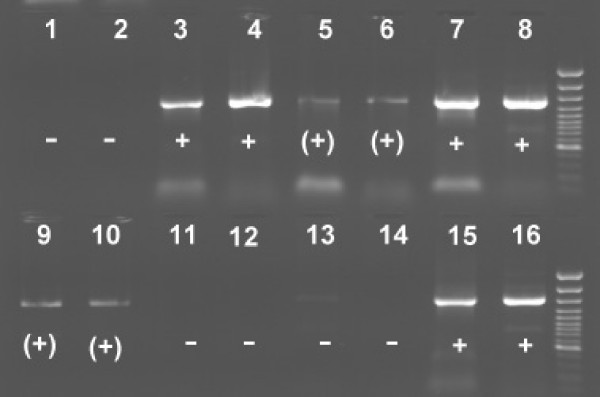
An advanced target cDNA amplification procedure employing RNA- or cDNA-derived pseudolibraries circumvents the usual DNA transfection during library establishment. A small sample of reverse transcribed ss- or ds-cDNA or DNA from a pre-existing library is multiplied by in vitro rolling circle ramification amplification. The resulting cDNA pseudolibrary serves as a template for numerous highly efficient PCR amplifications and permits production and analysis of target cDNAs on an automated liquid handling workstation.
The overall efficiency of the simple protocol collection approaches 100% for targets from libraries with low complexity such as Drosophila and yields >80% of amplicons up to 3 kb size in the case of human cDNA.
许多结构生物学和高通量实验室都发现,从不同来源获取多个cDNA是一个相当耗时且耗费资源的过程。本文介绍的技术解决了这些问题。
一种先进的靶标cDNA扩增程序,利用RNA或cDNA衍生的假文库,在文库构建过程中规避了常规的DNA转染。一小份来自预先存在文库的逆转录单链或双链cDNA或DNA,通过体外滚环分支扩增进行扩增。所得的cDNA假文库作为众多高效PCR扩增的模板,并允许在自动化液体处理工作站上生产和分析靶标cDNA。
对于来自低复杂性文库(如果蝇文库)的靶标,该简单方案的总体效率接近100%;对于人类cDNA,在3 kb大小的情况下,扩增子产量超过80%。