Fagnani Matthew, Barash Yoseph, Ip Joanna Y, Misquitta Christine, Pan Qun, Saltzman Arneet L, Shai Ofer, Lee Leo, Rozenhek Aviad, Mohammad Naveed, Willaime-Morawek Sandrine, Babak Tomas, Zhang Wen, Hughes Timothy R, van der Kooy Derek, Frey Brendan J, Blencowe Benjamin J
Banting and Best Department of Medical Research, Centre for Cellular and Biomolecular Research, University of Toronto, 160 College Street, Toronto, Ontario, Canada, M5S 3E1.
Genome Biol. 2007;8(6):R108. doi: 10.1186/gb-2007-8-6-r108.
Alternative splicing (AS) functions to expand proteomic complexity and plays numerous important roles in gene regulation. However, the extent to which AS coordinates functions in a cell and tissue type specific manner is not known. Moreover, the sequence code that underlies cell and tissue type specific regulation of AS is poorly understood.
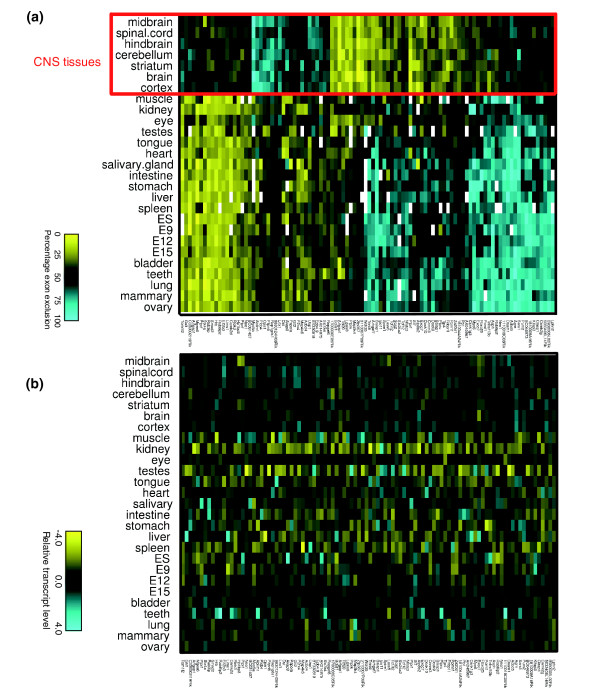
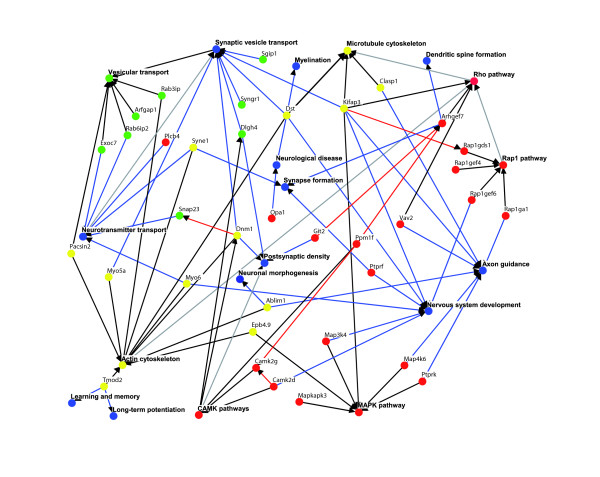
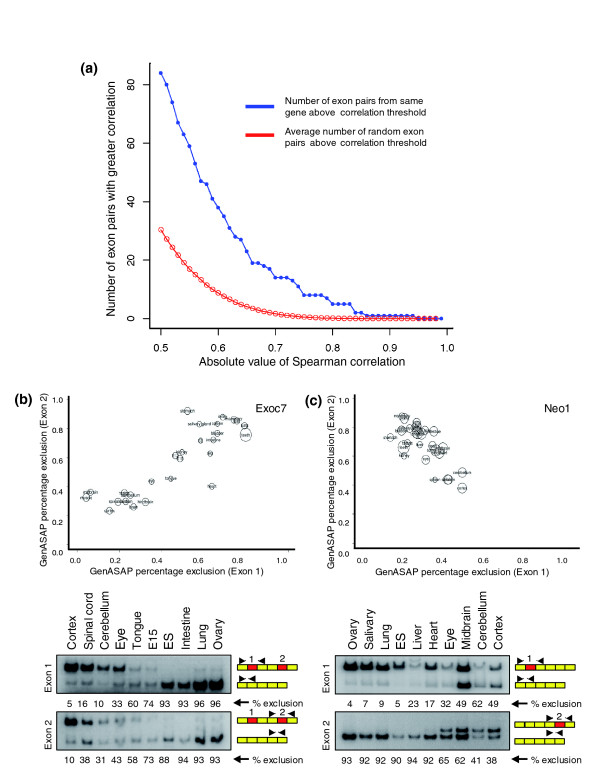
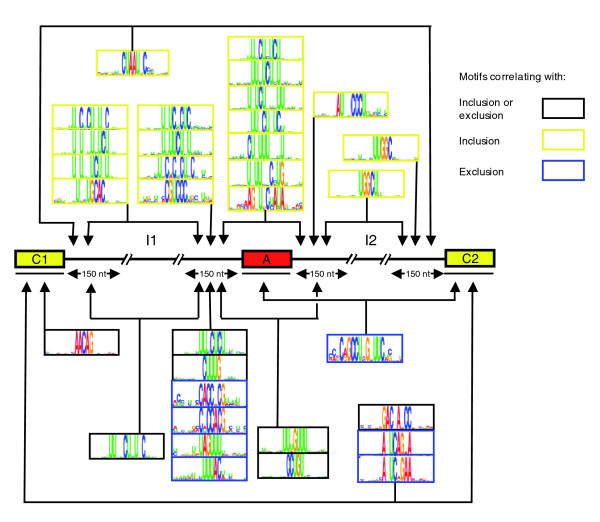
Using quantitative AS microarray profiling, we have identified a large number of widely expressed mouse genes that contain single or coordinated pairs of alternative exons that are spliced in a tissue regulated fashion. The majority of these AS events display differential regulation in central nervous system (CNS) tissues. Approximately half of the corresponding genes have neural specific functions and operate in common processes and interconnected pathways. Differential regulation of AS in the CNS tissues correlates strongly with a set of mostly new motifs that are predominantly located in the intron and constitutive exon sequences neighboring CNS-regulated alternative exons. Different subsets of these motifs are correlated with either increased inclusion or increased exclusion of alternative exons in CNS tissues, relative to the other profiled tissues.
Our findings provide new evidence that specific cellular processes in the mammalian CNS are coordinated at the level of AS, and that a complex splicing code underlies CNS specific AS regulation. This code appears to comprise many new motifs, some of which are located in the constitutive exons neighboring regulated alternative exons. These data provide a basis for understanding the molecular mechanisms by which the tissue specific functions of widely expressed genes are coordinated at the level of AS.
可变剪接(AS)的作用是增加蛋白质组的复杂性,并在基因调控中发挥众多重要作用。然而,AS以细胞和组织类型特异性方式协调功能的程度尚不清楚。此外,对于AS细胞和组织类型特异性调控背后的序列编码了解甚少。
通过定量AS微阵列分析,我们鉴定出大量广泛表达的小鼠基因,这些基因包含单个或成对协调的可变外显子,它们以组织调控的方式进行剪接。这些AS事件中的大多数在中枢神经系统(CNS)组织中表现出差异调控。大约一半的相应基因具有神经特异性功能,并在共同的过程和相互连接的途径中发挥作用。CNS组织中AS的差异调控与一组主要为新的基序密切相关,这些基序主要位于与CNS调控的可变外显子相邻的内含子和组成型外显子序列中。相对于其他分析的组织,这些基序的不同子集与CNS组织中可变外显子的包含增加或排除增加相关。
我们的研究结果提供了新的证据,表明哺乳动物CNS中的特定细胞过程在AS水平上是协调的,并且复杂的剪接编码是CNS特异性AS调控的基础。这个编码似乎包含许多新的基序,其中一些位于与受调控的可变外显子相邻的组成型外显子中。这些数据为理解广泛表达基因的组织特异性功能在AS水平上协调的分子机制提供了基础。