Kim Youngjo, Kipreos Edward T
Department of Cellular Biology, University of Georgia, Athens, GA 30602-2607, USA.
Cell Div. 2007 Jun 12;2:18. doi: 10.1186/1747-1028-2-18.
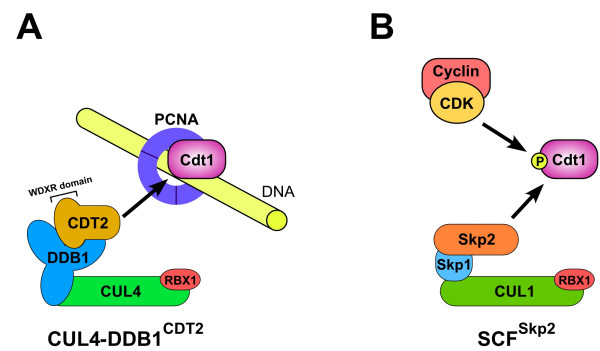
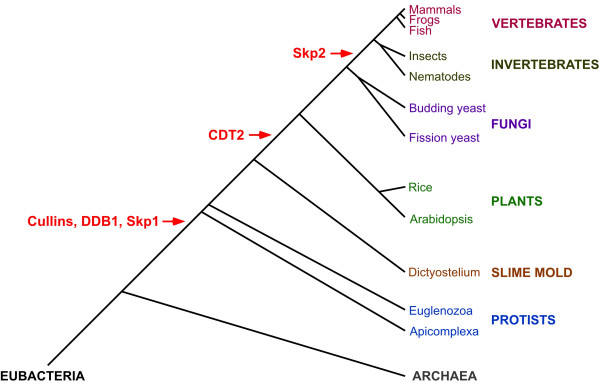
In eukaryotes, DNA replication is strictly regulated so that it occurs only once per cell cycle. The mechanisms that prevent excessive DNA replication are focused on preventing replication origins from being reused within the same cell cycle. This regulation involves the temporal separation of the formation of the pre-replicative complex (pre-RC) from the initiation of DNA replication. The replication licensing factors Cdt1 and Cdc6 recruit the presumptive replicative helicase, the Mcm2-7 complex, to replication origins in late M or G1 phase to form pre-RCs. In fission yeast and metazoa, the Cdt1 licensing factor is degraded at the start of S phase by ubiquitin-mediated proteolysis to prevent the reassembly of pre-RCs. In humans, two E3 complexes, CUL4-DDB1CDT2 and SCFSkp2, are redundantly required for Cdt1 degradation. The two E3 complexes use distinct mechanisms to target Cdt1 ubiquitination. Current data suggests that CUL4-DDB1CDT2-mediated degradation of Cdt1 is S-phase specific, while SCFSkp2-mediated Cdt1 degradation occurs throughout the cell cycle. The degradation of Cdt1 by the CUL4-DDB1CDT2 E3 complex is an evolutionarily ancient pathway that is active in fungi and metazoa. In contrast, SCFSkp2-mediated Cdt1 degradation appears to have arisen relatively recently. A role for Skp2 in Cdt1 degradation has only been demonstrated in humans, and the pathway is not conserved in yeast, invertebrates, or even among other vertebrates.
在真核生物中,DNA复制受到严格调控,使得每个细胞周期仅发生一次。防止DNA过度复制的机制主要集中在防止复制起点在同一细胞周期内被重复使用。这种调控涉及复制前复合体(pre-RC)形成与DNA复制起始的时间分离。复制许可因子Cdt1和Cdc6在M期末期或G1期将假定的复制解旋酶Mcm2-7复合体招募到复制起点,以形成pre-RCs。在裂殖酵母和后生动物中,Cdt1许可因子在S期开始时通过泛素介导的蛋白水解作用被降解,以防止pre-RCs的重新组装。在人类中,Cdt1降解需要两个E3复合体CUL4-DDB1CDT2和SCFSkp2冗余发挥作用。这两个E3复合体使用不同的机制靶向Cdt1泛素化。目前的数据表明,CUL4-DDB1CDT2介导的Cdt1降解具有S期特异性,而SCFSkp2介导的Cdt1降解在整个细胞周期中都有发生。CUL4-DDB1CDT2 E3复合体介导的Cdt1降解是一条在真菌和后生动物中都活跃的古老进化途径。相比之下,SCFSkp2介导的Cdt1降解似乎是相对较新出现的。Skp2在Cdt1降解中的作用仅在人类中得到证实,该途径在酵母、无脊椎动物甚至其他脊椎动物中都不保守。