Clark Katie A, Krysan Patrick J
Genome Center of Wisconsin and Department of Horticulture, 1575 Linden Drive, University of Wisconsin-Madison, Madison, WI 53706, USA.
Plant Methods. 2007 Jun 12;3:8. doi: 10.1186/1746-4811-3-8.
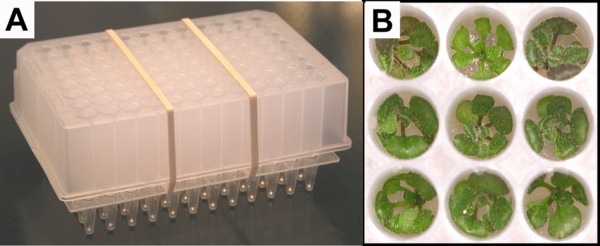
We previously developed a high-throughput system called 'Ice-Cap' for growing Arabidopsis seedlings in a 96-well format and rapidly collecting tissue for subsequent DNA extraction and genotyping. While the originally described Ice-Cap method is an effective tool for high-throughput genotyping, one shortcoming of the first version of Ice-Cap is that optimal seedling growth is highly dependent on specific environmental conditions. Here we describe several technical improvements to the Ice-Cap method that make it much more robust and provide a detailed protocol for implementing the method.
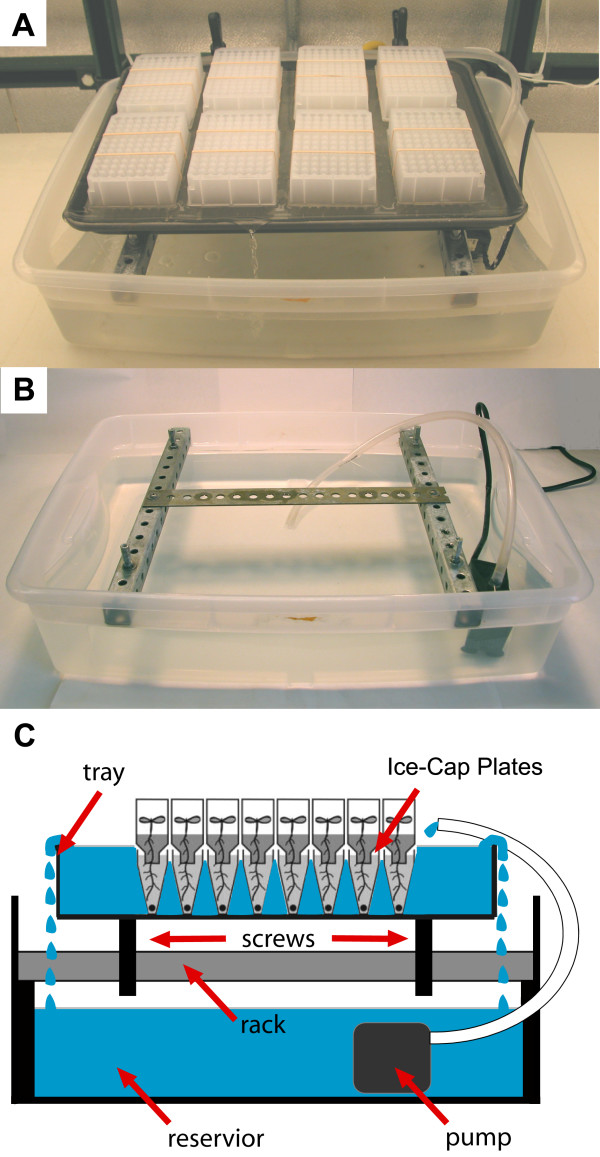
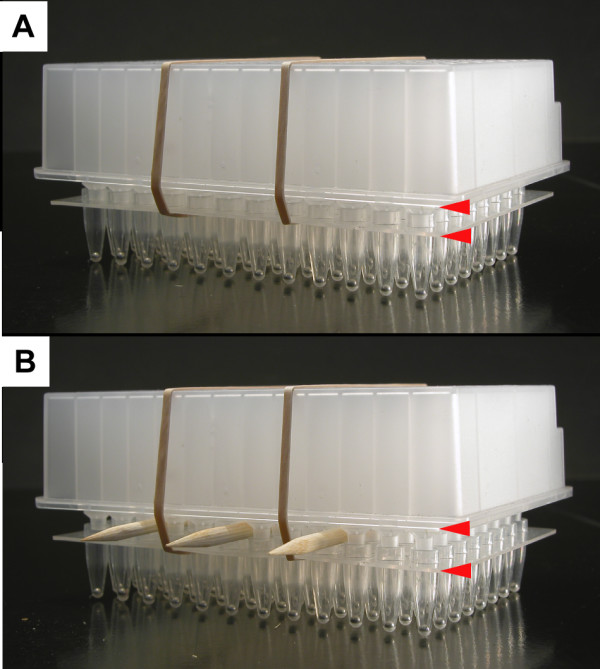
The key innovation underlying Ice-Cap 2.0 is the development of a continuous watering system. The addition of the watering system allows the seedling growth plates to be incubated without a lid for the duration of the growth period, which in turn allows for much more uniform and robust seedling growth than was observed using the original method. We also determined that inserting wooden skewers between the upper and lower plates prior to tissue harvest made it easier to separate the plates following freezing. Seedlings grown using the Ice-Cap 2.0 method remain viable in the Ice-Cap plates twice as long as seedlings grown using the original method.
The continuous watering system that we have developed provides an effective solution to the problem of sub-optimal seedling growth that can be encountered when using the originally described Ice-Cap system. This novel watering system and several additional modifications to the Ice-Cap procedure have improved the robustness and utility of the method.
我们之前开发了一种名为“Ice-Cap”的高通量系统,用于以96孔板形式培养拟南芥幼苗,并快速收集组织用于后续的DNA提取和基因分型。虽然最初描述的Ice-Cap方法是高通量基因分型的有效工具,但Ice-Cap第一版的一个缺点是最佳幼苗生长高度依赖于特定的环境条件。在此,我们描述了对Ice-Cap方法的几项技术改进,使其更加稳健,并提供了实施该方法的详细方案。
Ice-Cap 2.0的关键创新在于开发了一种连续浇水系统。添加浇水系统后,幼苗生长板在生长期间无需加盖培养,这反过来又使得幼苗生长比使用原始方法更加均匀和健壮。我们还确定,在收获组织之前在上板和下板之间插入木签,使得冷冻后更容易分离板。使用Ice-Cap 2.0方法培养的幼苗在Ice-Cap板中存活的时间是使用原始方法培养的幼苗的两倍。
我们开发的连续浇水系统为使用最初描述的Ice-Cap系统时可能遇到的幼苗生长不理想问题提供了有效的解决方案。这种新颖的浇水系统以及对Ice-Cap程序的其他几项改进提高了该方法的稳健性和实用性。