Department of Genetics, University of Silesia, Katowice, Poland.
J Appl Genet. 2011 Nov;52(4):371-90. doi: 10.1007/s13353-011-0061-1. Epub 2011 Sep 13.
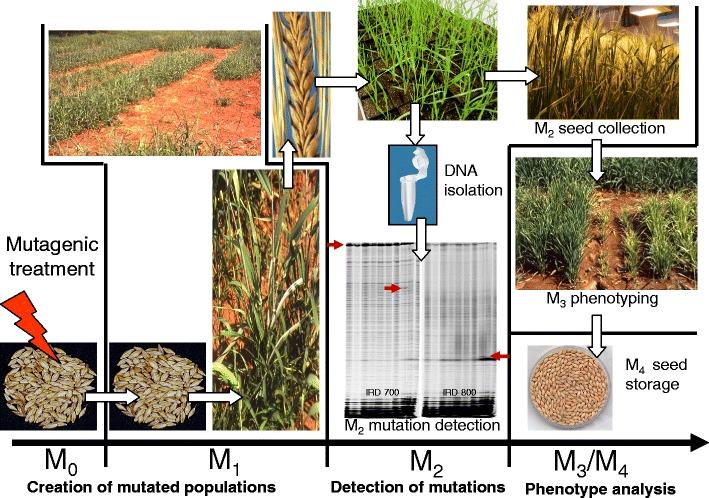
Recent advances in large-scale genome sequencing projects have opened up new possibilities for the application of conventional mutation techniques in not only forward but also reverse genetics strategies. TILLING (Targeting Induced Local Lesions IN Genomes) was developed a decade ago as an alternative to insertional mutagenesis. It takes advantage of classical mutagenesis, sequence availability and high-throughput screening for nucleotide polymorphisms in a targeted sequence. The main advantage of TILLING as a reverse genetics strategy is that it can be applied to any species, regardless of its genome size and ploidy level. The TILLING protocol provides a high frequency of point mutations distributed randomly in the genome. The great mutagenic potential of chemical agents to generate a high rate of nucleotide substitutions has been proven by the high density of mutations reported for TILLING populations in various plant species. For most of them, the analysis of several genes revealed 1 mutation/200-500 kb screened and much higher densities were observed for polyploid species, such as wheat. High-throughput TILLING permits the rapid and low-cost discovery of new alleles that are induced in plants. Several research centres have established a TILLING public service for various plant species. The recent trends in TILLING procedures rely on the diversification of bioinformatic tools, new methods of mutation detection, including mismatch-specific and sensitive endonucleases, but also various alternatives for LI-COR screening and single nucleotide polymorphism (SNP) discovery using next-generation sequencing technologies. The TILLING strategy has found numerous applications in functional genomics. Additionally, wide applications of this throughput method in basic and applied research have already been implemented through modifications of the original TILLING strategy, such as Ecotilling or Deletion TILLING.
近年来,大规模基因组测序项目的进展为传统突变技术的应用开辟了新的可能性,不仅在正向遗传学策略中,而且在反向遗传学策略中也是如此。TILLING(靶向诱导基因组局部突变)是十年前作为插入突变的替代方法而开发的。它利用经典的诱变、序列可用性和高通量筛选靶向序列中的核苷酸多态性。TILLING 作为反向遗传学策略的主要优势在于,它可以应用于任何物种,而与基因组大小和倍性水平无关。TILLING 方案提供了随机分布在基因组中的点突变的高频率。化学诱变剂产生高核苷酸替换率的巨大诱变潜力已被各种植物物种中 TILLING 群体报告的高突变密度所证明。对于大多数物种,对几个基因的分析显示筛选出 1 个突变/200-500kb,而多倍体物种(如小麦)的突变密度更高。高通量 TILLING 允许快速、低成本地发现植物中诱导的新等位基因。几个研究中心已经为各种植物物种建立了 TILLING 公共服务。最近,TILLING 程序的趋势依赖于生物信息学工具的多样化、新的突变检测方法,包括错配特异性和敏感内切酶,以及使用下一代测序技术进行 LI-COR 筛选和单核苷酸多态性(SNP)发现的各种替代方法。TILLING 策略在功能基因组学中得到了广泛应用。此外,通过对原始 TILLING 策略进行修改,如 Ecotilling 或 Deletion TILLING,该高通量方法已在基础和应用研究中得到广泛应用。