Szumlinski Karen K, Ary Alexis W, Lominac Kevin D, Klugmann Matthias, Kippin Tod E
Department of Psychology, Neuroscience Research Institute, University of California at Santa Barbara, Santa Barbara, CA 93106-9660, USA.
Neuropsychopharmacology. 2008 May;33(6):1365-78. doi: 10.1038/sj.npp.1301473. Epub 2007 Jun 13.
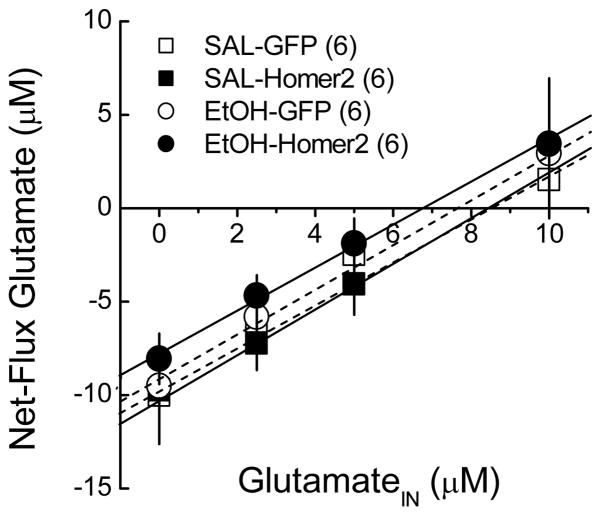
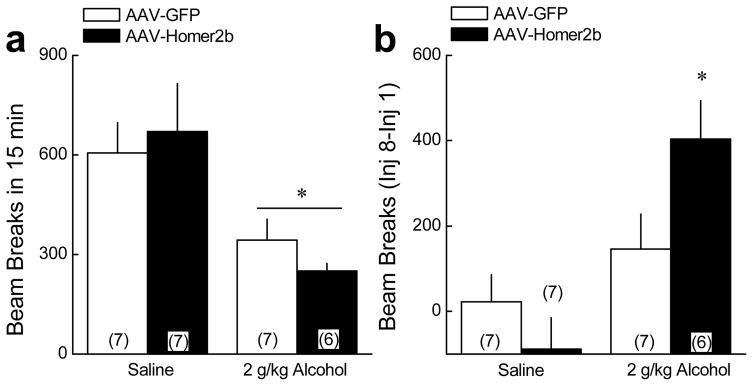
Homer proteins are integral components of the postsynaptic density that are necessary for alcohol-induced neuroplasticity within the nucleus accumbens (NAC). In this report, we describe the effects of chronic alcohol consumption upon NAC Homer expression and investigate the functional consequences of mimicking the alcohol-induced changes in Homer expression vis-à-vis alcohol-induced changes in NAC neurochemistry and behavior. Chronic alcohol consumption under continuous access (3 months; daily intake approximately 11.2+/-1.5 g/kg/day) produced a robust increase in NAC Homer2 protein levels that was apparent at 2 days, 2 weeks, and 2 months following withdrawal from alcohol drinking. The increased Homer2 expression was accompanied by a less enduring elevation in total mGluR1 and NR2b levels that were evident at 2 days and 2 weeks but not at the 2-month time point. Mimicking the alcohol-induced increase in Homer2 levels by viral transfection of NAC neurons in alcohol-preferring C57BL/6J inbred mice enhanced behavioral output for alcohol reinforcement and increased alcohol intake under both preprandial and postprandial conditions. Moreover, NAC Homer2 overexpression facilitated the expression of an alcohol-conditioned place preference, as well as the development of motor tolerance. Finally, NAC Homer2 overexpression facilitated NAC glutamate and dopamine release following an acute alcohol injection and augmented alcohol-induced dopamine and glutamate sensitization, but did not affect NAC gamma-aminobutyric acid levels. Thus, an upregulation in NAC mGluR-Homer2-N-methyl-D-aspartic acid receptor signaling appears to be an important molecular adaptation to alcohol that promotes neuroplasticity facilitating motivational drive for alcohol and the development of alcoholism-related behaviors.
荷马蛋白是突触后致密区的重要组成部分,对于伏隔核(NAC)内酒精诱导的神经可塑性是必需的。在本报告中,我们描述了长期饮酒对NAC荷马蛋白表达的影响,并研究了模拟酒精诱导的荷马蛋白表达变化相对于酒精诱导的NAC神经化学和行为变化的功能后果。持续摄入酒精(3个月;每日摄入量约为11.2±1.5 g/kg/天)导致NAC荷马2蛋白水平显著升高,在戒酒2天、2周和2个月后均明显可见。荷马2表达的增加伴随着总代谢型谷氨酸受体1(mGluR1)和NR2b水平的短暂升高,在2天和2周时明显,但在2个月时不明显。通过对偏好酒精的C57BL/6J近交系小鼠的NAC神经元进行病毒转染来模拟酒精诱导的荷马2水平升高,增强了酒精强化的行为输出,并增加了餐前和餐后条件下的酒精摄入量。此外,NAC荷马2过表达促进了酒精条件性位置偏好的表达以及运动耐受性的发展。最后,NAC荷马2过表达促进了急性酒精注射后NAC谷氨酸和多巴胺的释放,并增强了酒精诱导的多巴胺和谷氨酸致敏,但不影响NACγ-氨基丁酸水平。因此,NAC中代谢型谷氨酸受体-荷马2-N-甲基-D-天冬氨酸受体信号的上调似乎是对酒精的一种重要分子适应性变化,它促进神经可塑性,增强对酒精的动机驱动以及与酒精成瘾相关行为的发展。