Kile Molly L, Houseman E Andres, Breton Carrie V, Smith Thomas, Quamruzzaman Quazi, Rahman Mahmuder, Mahiuddin Golam, Christiani David C
Harvard School of Public Health, Boston, Massachusetts 02115, USA.
Environ Health Perspect. 2007 Jun;115(6):889-93. doi: 10.1289/ehp.9462. Epub 2007 Feb 20.
Millions of people in Bangladesh are at risk of chronic arsenic toxicity from drinking contaminated groundwater, but little is known about diet as an additional source of As exposure.
We employed a duplicate diet survey to quantify daily As intake in 47 women residing in Pabna, Bangladesh. All samples were analyzed for total As, and a subset of 35 samples were measured for inorganic arsenic (iAs) using inductively coupled plasma mass spectrometry equipped with a dynamic reaction cell.
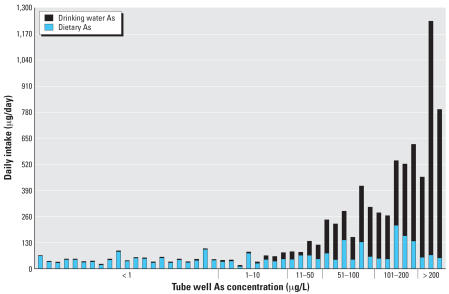
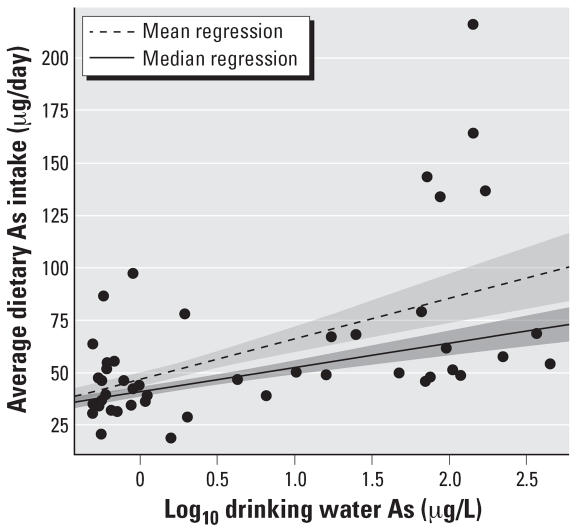
Median daily total As intake was 48 microg As/day [interquartile range (IQR), 33-67) from food and 4 microg As/day (IQR, 2-152) from drinking water. On average, iAs comprised 82% of the total As detected in dietary samples. After adjusting for the estimated inorganic fraction, 34% [95% confidence interval (CI), 21-49%] of all participants exceeded the World Health Organization's provisional tolerable daily intake (PTDI) of 2.1 microg As/kg-day. Two of the 33 women who used a well with < 50 microg As/L exceeded this recommendation.
When drinking water concentrations exceeded the Bangladesh drinking water standard of 50 microg As/L, ingested water was the dominant source of exposure. However, as drinking water As concentrations decrease, the relative contribution of dietary As sources becomes more important to ingested dose. The combined intake from both diet and drinking water can cause some individuals to exceed the PTDI in spite of using a tube well that contains < 50 microg As/L.
孟加拉国数百万人口因饮用受污染的地下水而面临慢性砷中毒风险,但对于饮食作为砷暴露的额外来源却知之甚少。
我们采用双份膳食调查来量化居住在孟加拉国帕布纳的47名女性的每日砷摄入量。所有样本均分析总砷含量,对35个样本的子集使用配备动态反应池的电感耦合等离子体质谱法测量无机砷(iAs)。
食物中的每日总砷摄入量中位数为48微克/天[四分位间距(IQR),33 - 67],饮用水中的为4微克/天(IQR,2 - 152)。平均而言,iAs占膳食样本中检测到的总砷的82%。在对估计的无机部分进行调整后,所有参与者中有34%[95%置信区间(CI),21 - 49%]超过了世界卫生组织2.1微克砷/千克·天的暂定每日耐受摄入量(PTDI)。使用砷含量<50微克/升水井的33名女性中有两名超过了该建议值。
当饮用水浓度超过孟加拉国50微克/升的饮用水标准时,摄入的水是主要的暴露源。然而,随着饮用水中砷浓度降低,膳食砷源对摄入剂量的相对贡献变得更为重要。尽管使用的管井中砷含量<50微克/升,但饮食和饮用水的联合摄入量仍可能导致一些个体超过PTDI。