Wasserman Gail A, Liu Xinhua, Parvez Faruque, Ahsan Habibul, Factor-Litvak Pam, van Geen Alexander, Slavkovich Vesna, LoIacono Nancy J, Cheng Zhongqi, Hussain Iftikhar, Momotaj Hassina, Graziano Joseph H
Department of Psychiatry, College of Physicians and Surgeons, Columbia University, New York, New York, USA.
Environ Health Perspect. 2004 Sep;112(13):1329-33. doi: 10.1289/ehp.6964.
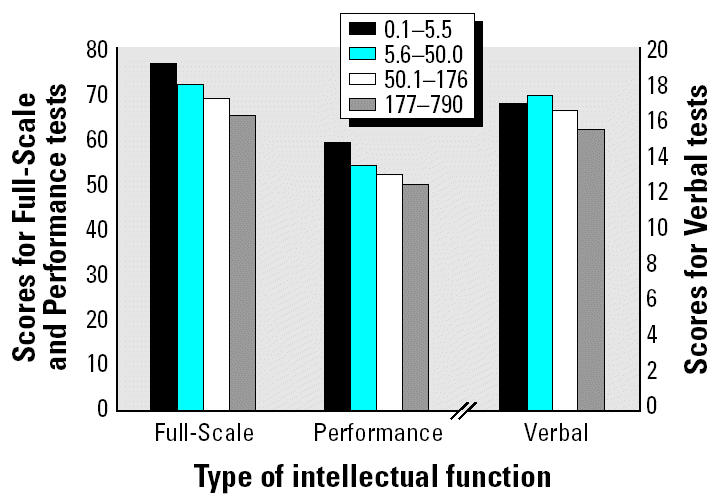
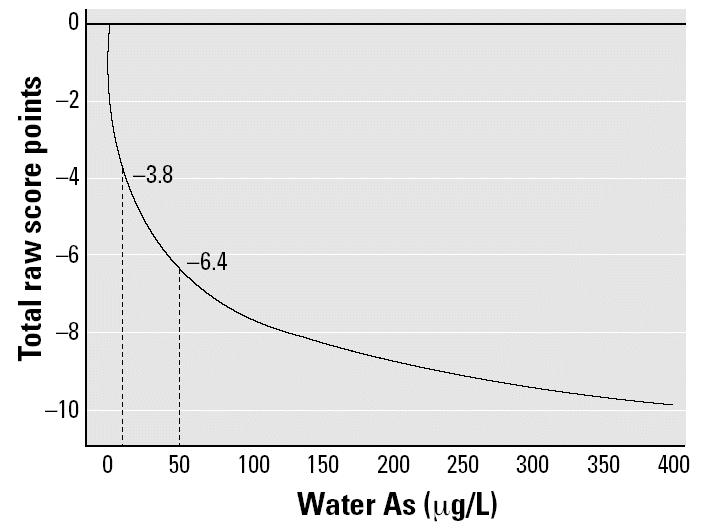
Exposure to arsenic has long been known to have neurologic consequences in adults, but to date there are no well-controlled studies in children. We report results of a cross-sectional investigation of intellectual function in 201 children 10 years of age whose parents participate in our ongoing prospective cohort study examining health effects of As exposure in 12,000 residents of Araihazar, Bangladesh. Water As and manganese concentrations of tube wells at each child's home were obtained by surveying all wells in the study region. Children and mothers came to our field clinic, where children received a medical examination in which weight, height, and head circumference were measured. Children's intellectual function on tests drawn from the Wechsler Intelligence Scale for Children, version III, was assessed by summing weighted items across domains to create Verbal, Performance, and Full-Scale raw scores. Children provided urine specimens for measuring urinary As and creatinine and were asked to provide blood samples for measuring blood lead and hemoglobin concentrations. Exposure to As from drinking water was associated with reduced intellectual function after adjustment for sociodemographic covariates and water Mn. Water As was associated with reduced intellectual function, in a dose-response manner, such that children with water As levels > 50 microg/L achieved significantly lower Performance and Full-Scale scores than did children with water As levels < 5.5 microg/L. The association was generally stronger for well-water As than for urinary As.
长期以来,人们都知道砷暴露会对成年人产生神经方面的影响,但迄今为止,还没有针对儿童的严格对照研究。我们报告了对201名10岁儿童智力功能进行横断面调查的结果,这些儿童的父母参与了我们正在进行的前瞻性队列研究,该研究旨在调查孟加拉国阿拉伊扎尔12000名居民砷暴露的健康影响。通过对研究区域内所有水井进行调查,获取了每个孩子家中管井水的砷和锰浓度。儿童和母亲来到我们的现场诊所,在那里儿童接受了体格检查,测量了体重、身高和头围。根据韦氏儿童智力量表第三版对儿童进行智力功能测试,通过对各领域加权项目求和得出言语、操作和全量表原始分数。儿童提供尿液样本以测量尿砷和肌酐,并被要求提供血液样本以测量血铅和血红蛋白浓度。在对社会人口统计学协变量和水中锰进行调整后,饮用水中的砷暴露与智力功能下降有关。水砷与智力功能下降呈剂量反应关系,水砷水平>50微克/升的儿童的操作和全量表分数显著低于水砷水平<5.5微克/升的儿童。井水砷与智力功能的关联通常比尿砷更强。