An Ping, Wang Li Hua, Hutcheson-Dilks Holli, Nelson George, Donfield Sharyne, Goedert James J, Rinaldo Charles R, Buchbinder Susan, Kirk Gregory D, O'Brien Stephen J, Winkler Cheryl A
Laboratory of Genomic Diversity, Science Applications International Corporation-Frederick, National Cancer Institute-Frederick, Frederick, Maryland, United States of America.
PLoS Pathog. 2007 Jun;3(6):e88. doi: 10.1371/journal.ppat.0030088.
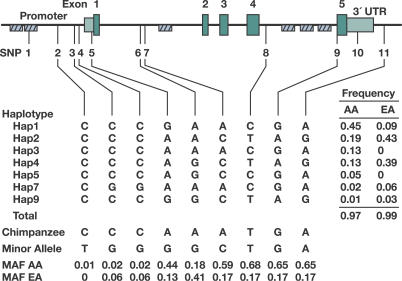
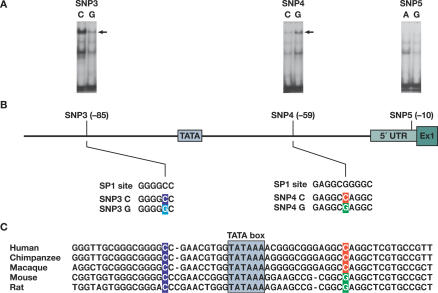
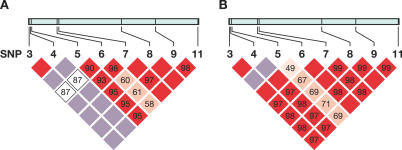
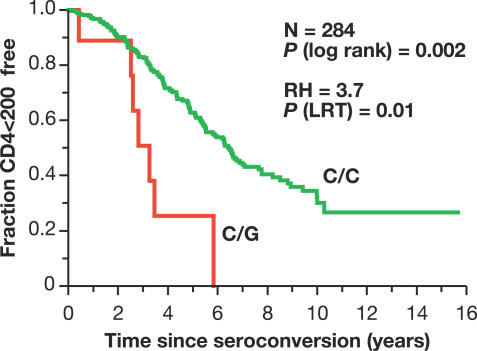
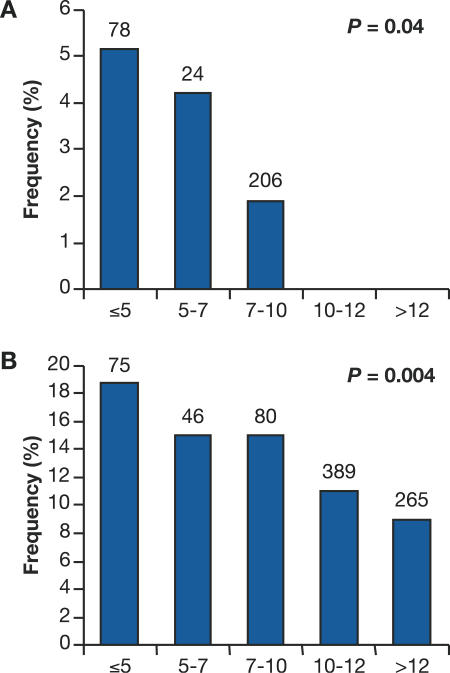
Human cyclophilin A, or CypA, encoded by the gene peptidyl prolyl isomerase A (PPIA), is incorporated into the HIV type 1 (HIV-1) virion and promotes HIV-1 infectivity by facilitating virus uncoating. We examined the effect of single nucleotide polymorphisms (SNPs) and haplotypes within the PPIA gene on HIV-1 infection and disease progression in five HIV-1 longitudinal history cohorts. Kaplan-Meier survival statistics and Cox proportional hazards model were used to assess time to AIDS outcomes. Among eight SNPs tested, two promoter SNPs (SNP3 and SNP4) in perfect linkage disequilibrium were associated with more rapid CD4(+) T-cell loss (relative hazard = 3.7, p = 0.003) in African Americans. Among European Americans, these alleles were also associated with a significant trend to more rapid progression to AIDS in a multi-point categorical analysis (p = 0.005). Both SNPs showed differential nuclear protein-binding efficiencies in a gel shift assay. In addition, one SNP (SNP5) located in the 5' UTR previously shown to be associated with higher ex vivo HIV-1 replication was found to be more frequent in HIV-1-positive individuals than in those highly exposed uninfected individuals. These results implicate regulatory PPIA polymorphisms as a component of genetic susceptibility to HIV-1 infection or disease progression, affirming the important role of PPIA in HIV-1 pathogenesis.
人类亲环素A(CypA)由肽基脯氨酰异构酶A(PPIA)基因编码,可整合到1型人类免疫缺陷病毒(HIV-1)病毒体中,并通过促进病毒脱壳来增强HIV-1的感染性。我们在五个HIV-1纵向病史队列中研究了PPIA基因内单核苷酸多态性(SNP)和单倍型对HIV-1感染及疾病进展的影响。采用Kaplan-Meier生存统计和Cox比例风险模型评估艾滋病结局发生时间。在检测的8个SNP中,处于完全连锁不平衡状态的两个启动子SNP(SNP3和SNP4)与非裔美国人更快的CD4(+) T细胞损失相关(相对风险=3.7,p=0.003)。在欧裔美国人中,在多点分类分析中这些等位基因也与更快进展至艾滋病的显著趋势相关(p=0.005)。在凝胶迁移试验中,这两个SNP均显示出不同的核蛋白结合效率。此外,先前已证明位于5'非翻译区(5' UTR)且与更高的体外HIV-1复制相关的一个SNP(SNP5),在HIV-1阳性个体中比在高暴露未感染个体中更为常见。这些结果表明PPIA调控多态性是HIV-1感染或疾病进展遗传易感性的一个组成部分,证实了PPIA在HIV-1发病机制中的重要作用。