Kohalmy Krisztina, Tamási Viola, Kóbori László, Sárváry Eniko, Pascussi Jean-Marc, Porrogi Pálma, Rozman Damjana, Prough Russell A, Meyer Urs A, Monostory Katalin
Chemical Research Center, Hungarian Academy of Sciences, Budapest, Hungary.
Drug Metab Dispos. 2007 Sep;35(9):1495-501. doi: 10.1124/dmd.107.016303. Epub 2007 Jun 25.
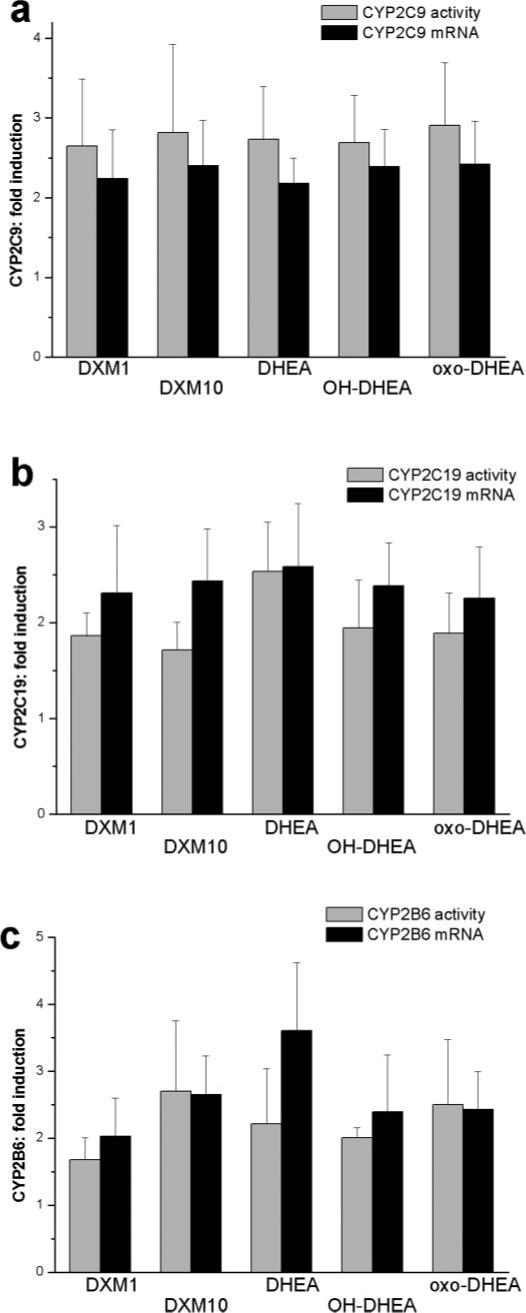
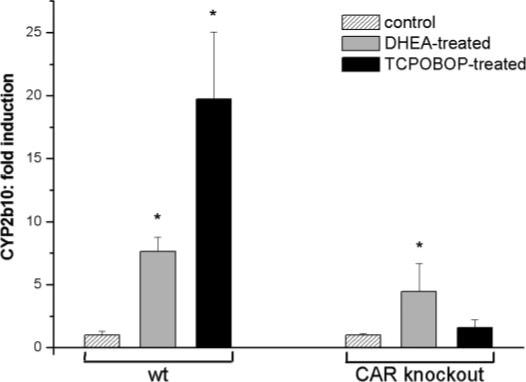
Dehydroepiandrosterone (DHEA), the major precursor of androgens and estrogens, has several beneficial effects on the immune system, on memory function, and in modulating the effects of diabetes, obesity, and chemical carcinogenesis. Treatment of rats with DHEA influences expression of cytochrome P450 (P450) genes, including peroxisome proliferator-activated receptor alpha (PPAR alpha)- and pregnane X receptor (PXR)-mediated induction of CYP4As and CYP3A23, and suppression of CYP2C11. DHEA treatment elevated the expression and activities of CYP3A4, CYP2C9, CYP2C19, and CYP2B6 in primary cultures of human hepatocytes. Induction of CYP3A4 in human hepatocytes was consistent with studies in rats, but induction of CYP2Cs was unexpected. The role of PXR in this response was studied in transient transfection assays. DHEA activated hPXR in a concentration-dependent manner. Because CYP2B6 induction by DHEA in human hepatocytes might involve either PXR or constitutive androstane receptor (CAR) activation, we performed experiments in primary hepatocytes from CAR knockout mice and observed that CAR was required for maximal induction of Cyp2b10 by DHEA. Furthermore, CAR-mediated Cyp2b10 induction by DHEA was inhibited by the inverse agonist of CAR, androstanol (5 alpha-androstan-3 alpha-ol). Further evidence for CAR activation was provided by cytoplasmic/nuclear transfer of CAR upon DHEA treatment. Elucidation of CAR activation and subsequent induction of CYP2B6 by DHEA presented an additional mechanism by which the sterol can modify the expression of P450s. The effect of DHEA on the activation of the xenosensors PPAR alpha, PXR, and CAR, and the consequent potential for adverse drug/toxicant interactions should be considered in humans treated with this nutriceutical agent.
脱氢表雄酮(DHEA)是雄激素和雌激素的主要前体,对免疫系统、记忆功能以及调节糖尿病、肥胖症和化学致癌作用具有多种有益影响。用DHEA处理大鼠会影响细胞色素P450(P450)基因的表达,包括过氧化物酶体增殖物激活受体α(PPARα)和孕烷X受体(PXR)介导的CYP4A和CYP3A23的诱导,以及CYP2C11的抑制。DHEA处理可提高人肝细胞原代培养物中CYP3A4、CYP2C9、CYP2C19和CYP2B6的表达及活性。人肝细胞中CYP3A4的诱导与大鼠研究结果一致,但CYP2C的诱导出乎意料。在瞬时转染实验中研究了PXR在此反应中的作用。DHEA以浓度依赖的方式激活hPXR。由于DHEA在人肝细胞中诱导CYP2B6可能涉及PXR或组成型雄甾烷受体(CAR)的激活,我们在CAR基因敲除小鼠的原代肝细胞中进行了实验,观察到DHEA最大程度诱导Cyp2b10需要CAR。此外,CAR的反向激动剂雄甾醇(5α-雄甾烷-3α-醇)可抑制DHEA介导的CAR对Cyp2b10的诱导。DHEA处理后CAR的细胞质/细胞核转移提供了CAR激活的进一步证据。DHEA激活CAR并随后诱导CYP2B6的阐明提出了一种固醇可改变P450表达的额外机制。在用这种营养剂治疗的人类中,应考虑DHEA对异生素传感器PPARα、PXR和CAR激活的影响以及随之而来的药物/毒物相互作用的可能性。