Pritchard-Jones R O, Dunn D B A, Qiu Y, Varey A H R, Orlando A, Rigby H, Harper S J, Bates D O
Microvascular Research Laboratories, Department of Physiology, Preclinical Veterinary School, University of Bristol, Bristol, UK.
Br J Cancer. 2007 Jul 16;97(2):223-30. doi: 10.1038/sj.bjc.6603839. Epub 2007 Jun 26.
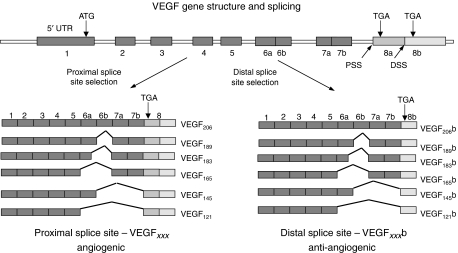
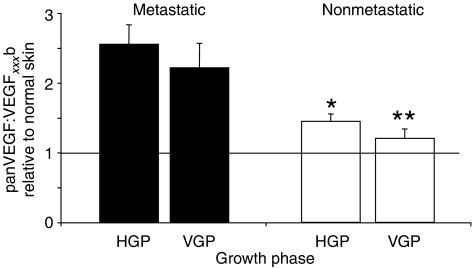
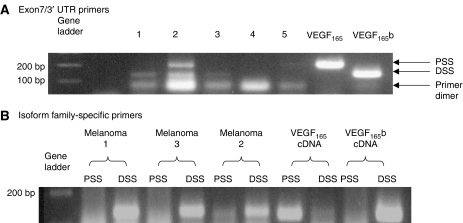
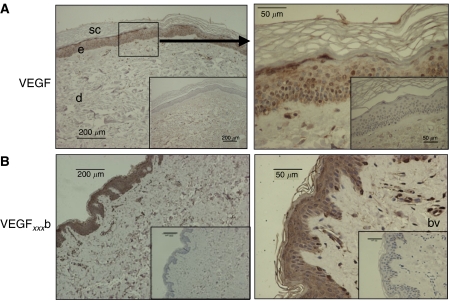
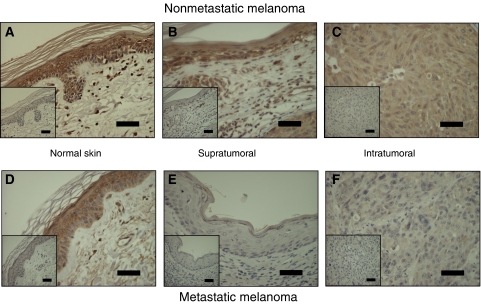
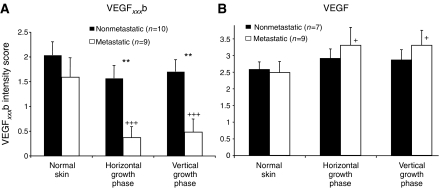
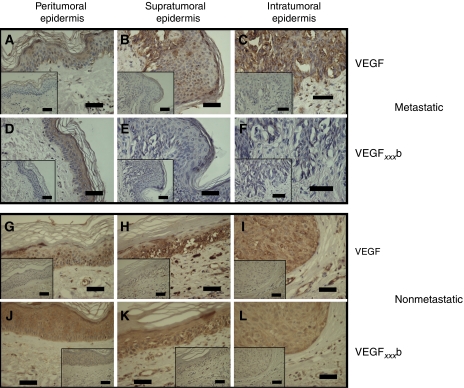
Malignant melanoma is the most lethal of the skin cancers and the UK incidence is rising faster than that of any other cancer. Angiogenesis - the growth of new vessels from preexisting vasculature - is an absolute requirement for tumour survival and progression beyond a few hundred microns in diameter. We previously described a class of anti-angiogenic isoforms of VEGF, VEGF(xxx)b, that inhibit tumour growth in animal models, and are downregulated in some cancers, but have not been investigated in melanoma. To determine whether VEGF(xxx)b expression was altered in melanoma, PCR and immunohistochemistry of archived human tumour samples were used. In normal epidermis and in a proportion of melanoma samples, VEGF(xxx)b staining was seen. Some melanomas had much weaker staining. Subsequent examination revealed that expression was significantly reduced in primary melanoma samples (both horizontal and vertical growth phases) from patients who subsequently developed tumour metastasis compared with those who did not (analysis of variance (ANOVA) P<0.001 metastatic vs nonmetastatic), irrespective of tumour thickness, while the surrounding epidermis showed no difference in expression. Staining for total VEGF expression showed staining in metastatic and nonmetastatic melanomas, and normal epidermis. An absence of VEGF(xxx)b expression appears to predict metastatic spread in patients with primary melanoma. These results suggest that there is a switch in splicing as part of the metastatic process, from anti-angiogenic to pro-angiogenic VEGF isoforms. This may form part of a wider metastatic splicing phenotype.
恶性黑色素瘤是最致命的皮肤癌,在英国其发病率的上升速度比其他任何癌症都要快。血管生成——即从已有的脉管系统中生长出新的血管——是肿瘤存活以及直径超过几百微米后继续发展的绝对必要条件。我们之前描述了一类VEGF的抗血管生成亚型,即VEGF(xxx)b,它在动物模型中可抑制肿瘤生长,并且在某些癌症中表达下调,但尚未在黑色素瘤中进行研究。为了确定VEGF(xxx)b在黑色素瘤中的表达是否发生改变,我们对存档的人类肿瘤样本进行了PCR和免疫组化检测。在正常表皮以及部分黑色素瘤样本中,可观察到VEGF(xxx)b染色。一些黑色素瘤的染色要弱得多。随后的检查发现,与未发生肿瘤转移的患者相比,随后发生肿瘤转移的患者的原发性黑色素瘤样本(水平和垂直生长期)中,VEGF(xxx)b的表达显著降低(方差分析(ANOVA),转移组与非转移组相比P<0.001),与肿瘤厚度无关,而周围表皮的表达没有差异。总VEGF表达的染色在转移性和非转移性黑色素瘤以及正常表皮中均可见。VEGF(xxx)b表达缺失似乎可预测原发性黑色素瘤患者的转移扩散。这些结果表明,作为转移过程的一部分,存在从抗血管生成的VEGF亚型向促血管生成的VEGF亚型的剪接转换。这可能构成更广泛的转移剪接表型的一部分。