Terashvili Maia, Wu Hsiang-en, Moore Rachel M, Harder David R, Tseng Leon F
Department of Anesthesiology, Medical College of Wisconsin, Milwaukee, WI 53226, USA.
Eur J Pharmacol. 2007 Sep 24;571(1):1-7. doi: 10.1016/j.ejphar.2007.05.033. Epub 2007 Jun 5.
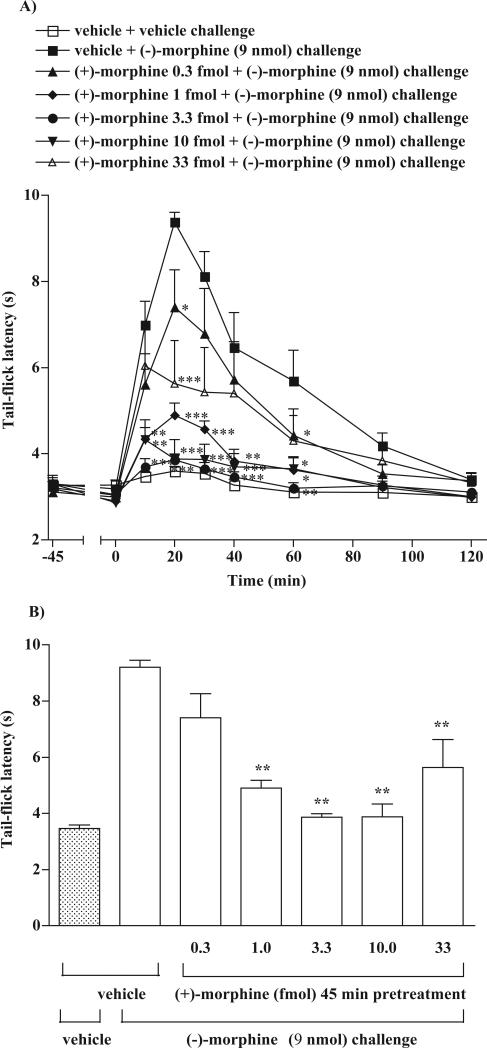
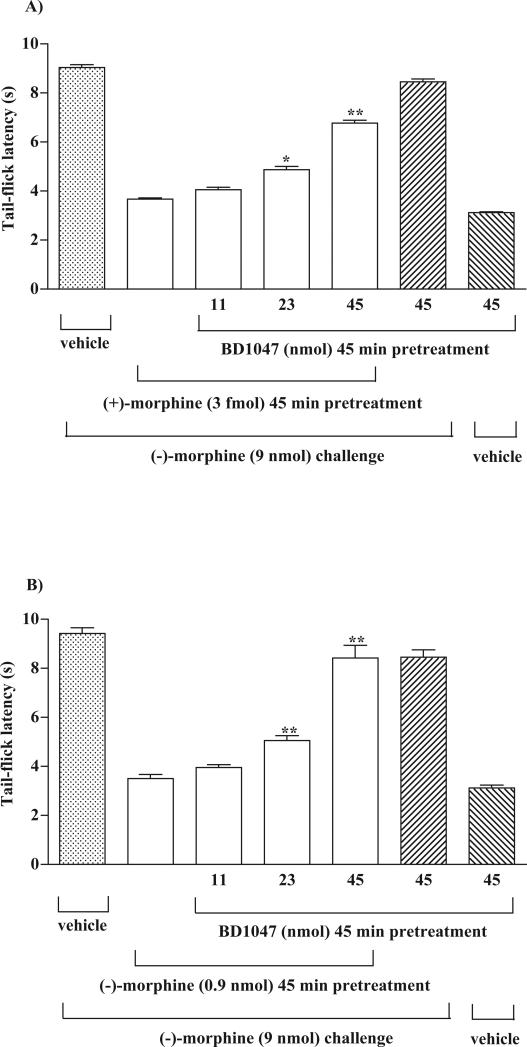
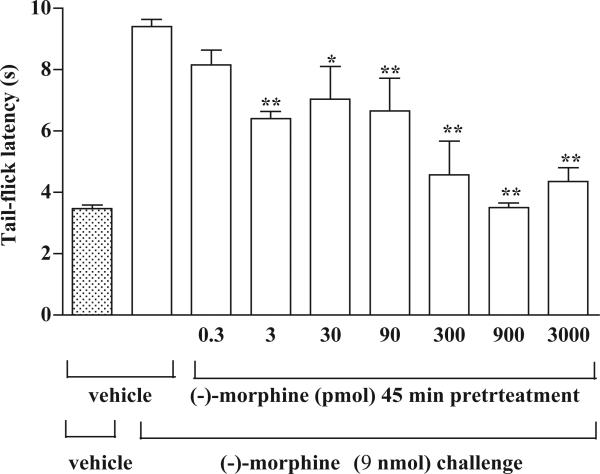
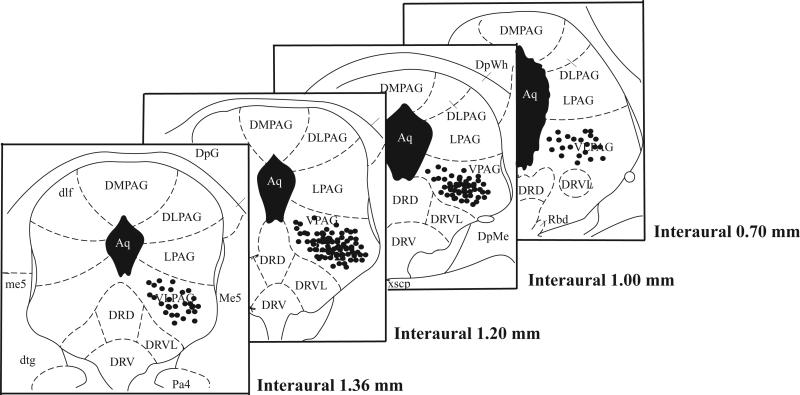
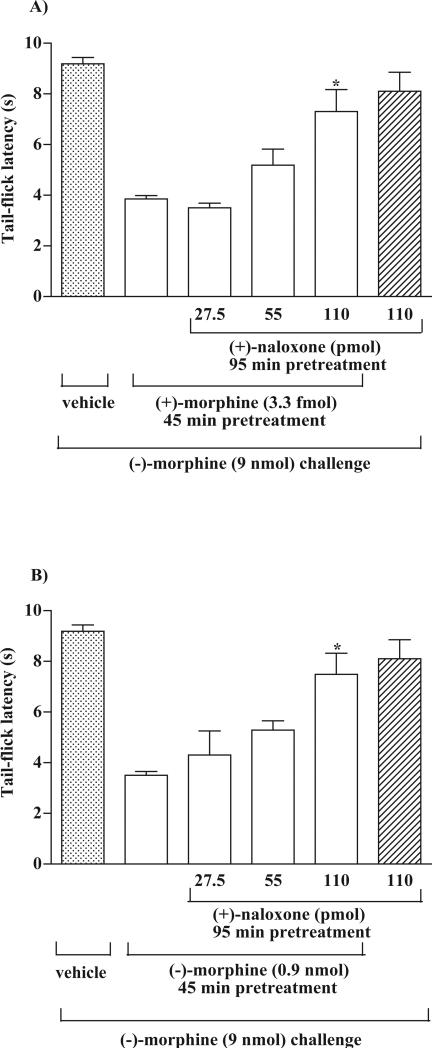
We have previously demonstrated that (+)-morphine and (-)-morphine pretreated spinally for 45 min stereoselectively attenuates the tail-flick inhibition produced by (-)-morphine given spinally in the mouse. The present study is then undertaken to determine if the same phenomenon observed in the mouse spinal cord can also take place in the ventral periaqueductal gray of the rat. Pretreatment with (+)-morphine for 45 min at 0.3 to 3.3 fmol dose-dependently attenuated the tail-flick inhibition produced by (-)-morphine (9 nmol) given into the ventral periaqueductal gray. Likewise, pretreatment with (-)-morphine for 45 min at a higher dose (3-900 pmol), which given alone did not affect the baseline tail-flick latency, also dose-dependently attenuated the tail-flick inhibition produced by (-)-morphine. Thus, (+)-morphine is approximately 270,000-fold more potent than (-)-morphine in attenuating the (-)-morphine-produced tail-flick inhibition. The attenuation of the (-)-morphine-produced tail-flick inhibition induced by (+)-morphine or (-)-morphine was dose-dependently reversed by (+)-naloxone (27.5 to 110 pmol) pretreatment for 50 min given into the ventral periaqueductal gray. Pretreatment with the sigma receptor antagonist BD1047 (N-[2-(3,4-dichlorophenyl)ethyl]-N-methyl-2-(dimethylamino)ethylamine dihydrobromide) (11-45 nmol) for 45 min given into the ventral periaqueductal gray also reversed dose-dependently the attenuation of the (-)-morphine-produced tail-flick inhibition induced by (+)-morphine or (-)-morphine, indicating that the effects are mediated by the activation of the sigma receptors. Since (+)-morphine, (-)-morphine and (+)-naloxone do not have any affinity for the naloxone-inaccessible sigma receptors, we therefore propose that (+)-morphine and (-)-morphine attenuate the (-)-morphine-produced tail-flick inhibition via the activation of the naloxone-sensitive sigma receptor originally proposed by Tsao and Su [Tsao, L.T., Su, T.P., 1997. Naloxone-sensitive, haloperidol-sensitive, (3)H-SKF-1047-binding protein partially purified from rat liver and rat brain membranes: an opioid/sigma receptor. Synapse 25, 117-124].
我们之前已经证明,(+)-吗啡和(-)-吗啡经脊髓预处理45分钟后,能立体选择性地减弱小鼠脊髓注射(-)-吗啡所产生的甩尾抑制作用。本研究旨在确定在小鼠脊髓中观察到的相同现象是否也会在大鼠腹侧导水管周围灰质中发生。以0.3至3.3飞摩尔的剂量用(+)-吗啡预处理45分钟,能剂量依赖性地减弱向腹侧导水管周围灰质注射(-)-吗啡(9纳摩尔)所产生的甩尾抑制作用。同样,以较高剂量(3 - 900皮摩尔)用(-)-吗啡预处理45分钟,单独使用时并不影响基线甩尾潜伏期,也能剂量依赖性地减弱(-)-吗啡所产生的甩尾抑制作用。因此,在减弱(-)-吗啡所产生的甩尾抑制作用方面,(+)-吗啡的效力比(-)-吗啡强约270,000倍。向腹侧导水管周围灰质注射(+)-纳洛酮(27.5至110皮摩尔)预处理50分钟,能剂量依赖性地逆转由(+)-吗啡或(-)-吗啡诱导的(-)-吗啡所产生的甩尾抑制作用的减弱。向腹侧导水管周围灰质注射西格玛受体拮抗剂BD1047(N-[2-(3,4-二氯苯基)乙基]-N-甲基-2-(二甲基氨基)乙胺二氢溴化物)(11 - 45纳摩尔)预处理45分钟,也能剂量依赖性地逆转由(+)-吗啡或(-)-吗啡诱导的(-)-吗啡所产生的甩尾抑制作用的减弱,这表明这些作用是由西格玛受体的激活介导的。由于(+)-吗啡、(-)-吗啡和(+)-纳洛酮对纳洛酮不可及的西格玛受体没有任何亲和力,因此我们提出,(+)-吗啡和(-)-吗啡通过激活曹和苏最初提出的纳洛酮敏感的西格玛受体[曹,L.T.,苏,T.P.,1997。从大鼠肝脏和大鼠脑膜中部分纯化的纳洛酮敏感、氟哌啶醇敏感、[(3)H](+)-SKF-1047结合蛋白:一种阿片样物质/西格玛受体。《突触》25,117 - 124]来减弱(-)-吗啡所产生的甩尾抑制作用。