DeRubertis F R, Craven P
J Clin Invest. 1976 Feb;57(2):435-43. doi: 10.1172/JCI108294.
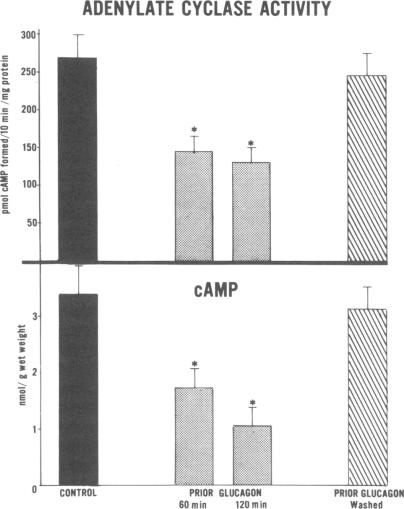
Hormone-induced desensitization of hormonal regulation of cyclic AMP (cAMP) content has been described in a number of tissues. In the present study, we examined responses of rat liver to glucagon after periods of sustained exposure to the hormone in vivo and in vitro. In intact anesthetized rats infused with glucagon (50 ng/min) for 1 h or more and in liver slices incubated with the hormone (10 muM) for this period, hepatic cAMP responsiveness to glucagon was significantly blunted compared with that of tissue exposed to the hormone for shorter periods. The reduction in hepatic cAMP responsiveness to glucagon appeared to be fully expressed by 2 h. With the doses of hormone employed, the sequential alterations in hepatic responsiveness seemed to be limited to the cAMP system, since other parameters of glucagon action did not wane with time. Diminished hepatic cAMP responsiveness during sustained hormonal exposure could not be attributed to decreased glucagon availability, accelerated extracellular release of cAMP, hepatic ATP depletion, or enhanced phosphodiesterase activity. Studies in vitro suggested that modulation of the cAMP response occurred at the level of adenylate cyclase (AC). During sustained exposure of hepatic slices to glucagon, reductions in glucagon-responsive AC correlated temporally with those in cAMP and both changes were reversible. Alterations in glucagon-responsive AC were demonstrated over a wide range of ATP (10 muM-0.1 mM) and glucagon (10 nM-5 MM) concentrations in the cyclase reaction mixture, and appeared to be a noncompetitive phenomenon relative to glucagon. Maximal NaF-responsive AC did not fall concomitantly with time. Thus, the reduction in glucagon-responsive AC was probably not related to a reduction in the catalytic unit of the enzyme, but could have been due to an alteration in glucagon binding to its receptor sites, or in the coupling mechanism involved in transmission of the hormonal signal to the catalytic unit.
激素诱导的环磷酸腺苷(cAMP)含量激素调节脱敏现象已在许多组织中有所描述。在本研究中,我们检测了大鼠肝脏在体内和体外持续暴露于该激素一段时间后对胰高血糖素的反应。在完整的麻醉大鼠中输注胰高血糖素(50纳克/分钟)1小时或更长时间,以及在此期间将肝脏切片与该激素(10微摩尔)一起孵育,与暴露于该激素较短时间的组织相比,肝脏对胰高血糖素的cAMP反应性明显减弱。肝脏对胰高血糖素的cAMP反应性降低似乎在2小时时完全表现出来。在所使用的激素剂量下,肝脏反应性的顺序变化似乎仅限于cAMP系统,因为胰高血糖素作用的其他参数并未随时间减弱。持续激素暴露期间肝脏cAMP反应性降低不能归因于胰高血糖素可用性降低、cAMP细胞外释放加速、肝脏ATP消耗或磷酸二酯酶活性增强。体外研究表明,cAMP反应的调节发生在腺苷酸环化酶(AC)水平。在肝脏切片持续暴露于胰高血糖素期间,胰高血糖素反应性AC的降低在时间上与cAMP的降低相关,并且这两种变化都是可逆的。在环化酶反应混合物中,在广泛的ATP(10微摩尔 - 0.1毫摩尔)和胰高血糖素(10纳摩尔 - 5毫摩尔)浓度范围内都证明了胰高血糖素反应性AC的变化,并且相对于胰高血糖素而言似乎是一种非竞争性现象。最大的氟化钠反应性AC并未随时间同时下降。因此,胰高血糖素反应性AC的降低可能与该酶催化单位的减少无关,但可能是由于胰高血糖素与其受体位点结合的改变,或者是由于激素信号传递到催化单位所涉及的偶联机制的改变。