Wong Patrick S, Matsumura Fumio
Center for Health and the Environment-John Muir Institute of the Environment, Department of Environmental Toxicology, University of California, Davis, CA 95616, USA.
BMC Cancer. 2007 Jul 17;7:130. doi: 10.1186/1471-2407-7-130.
Exposure to beta-Hexachlorocyclohexane (beta-HCH), a contaminant of the hexachlorohexane pesticide lindane, has been implicated as a risk factor in the development of breast cancers in epidemiological studies. Previous studies in our laboratory have demonstrated the ability of beta-HCH to elicit its actions via a ligand-independent activation of the estrogen receptor through increased c-Neu (= erbB2 or HER-2) expression and kinase activation in both the BG-1 and MCF-7 cell lines. In addition, long term exposure (33 passages) to beta-HCH was shown to promote the selection of MCF-7 cells which exhibit a more metastatic phenotype.
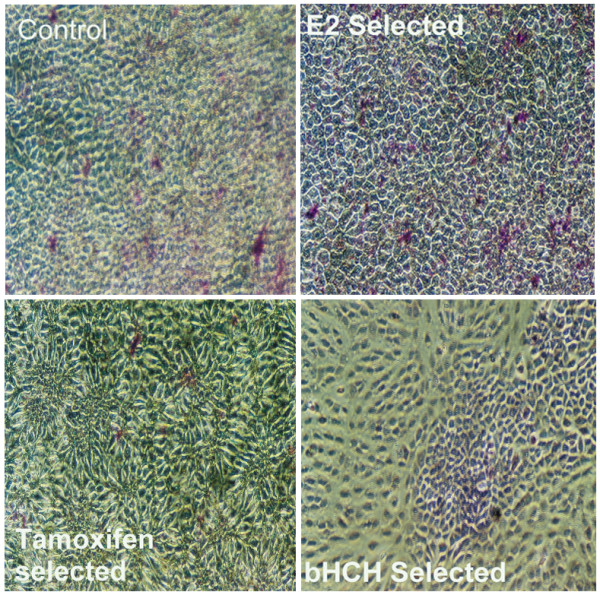
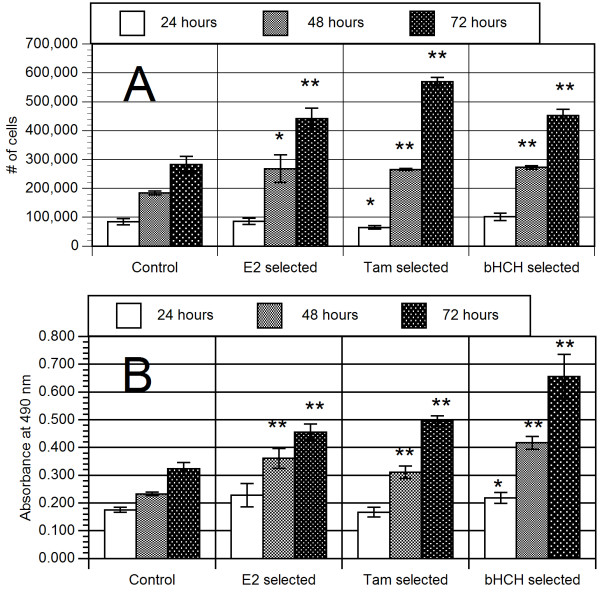
In this current study, we decided to investigate the long-term effects of beta-HCH in both the MCF10AT1 cell line which was derived from a normal epithelial cell line by stably transfecting a mutated c-Ha-ras and a MMTV-Neu mouse model for mammary cancer in vivo. MCF10AT1 cells were exposed for 20 passages with beta-HCH, 4-OH-Tamoxifen (Tam), or 17-beta-estradiol (E2) after which cells were analyzed for proliferation rates and mRNA expression by RT-PCR. In our in vivo studies, MMTV-Neu mice were injected with beta-HCH and observed for tumor formation over a 70 week period.
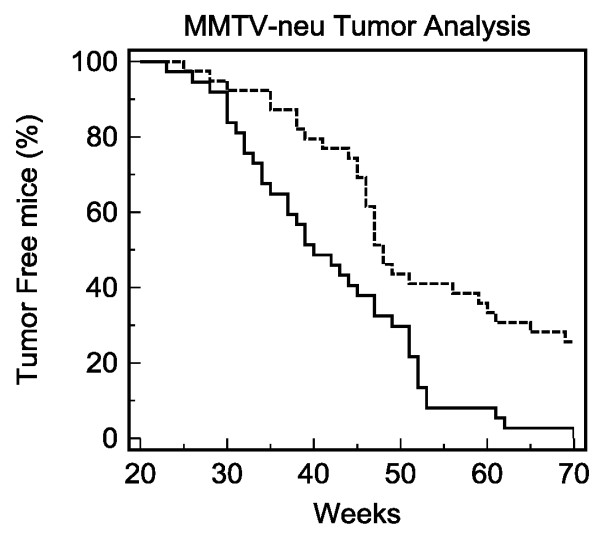
beta-HCH and Tam selected MCF10AT1 cells demonstrated increased mRNA expression of MMP-13 (collagenase-3) a marker of increased invasiveness. beta-HCH treatment was also seen to increase the expression in a number of proto-oncogenes (c-Neu, Cyclin D1, p27), cell status markers (Met-1, CK19), and the inflammatory marker NFkappaB. Previous studies, have demonstrated the role of these markers as evidence of malignant transformations, and further illustrate the ability of beta-HCH to be carcinogenic. To demonstrate beta-HCH's tumorigenic properties in an in vivo system, we used an MMTV-Neu mouse model.MMTV-Neu is a c-Neu overexpressing strain which has been shown to spontaneously develop mammary tumors at later stages of aging. In this experiment, beta-HCH exposure was shown to both accelerate the appearance (8 weeks for median tumor-free period) and incidence (25% increase at the end of the test period) of tumors when compared to control mice receiving only the corn-oil vehicle.
Based upon these results, it was concluded that beta-HCH does act as a breast cancer promoter which exerts its tumorigenic activity via increased c-Neu expression.
β-六氯环己烷(β-HCH)是六氯环己烷农药林丹的一种污染物,在流行病学研究中被认为是乳腺癌发生的一个风险因素。我们实验室之前的研究表明,β-HCH能够通过增加c-Neu(=erbB2或HER-2)表达以及在BG-1和MCF-7细胞系中激活激酶,以不依赖配体的方式激活雌激素受体,从而发挥其作用。此外,长期暴露于β-HCH(33代)可促进对具有更强转移表型的MCF-7细胞的选择。
在本研究中,我们决定研究β-HCH对MCF10AT1细胞系和MMTV-Neu小鼠乳腺癌体内模型的长期影响。MCF10AT1细胞系由正常上皮细胞系通过稳定转染突变的c-Ha-ras获得。MCF10AT1细胞用β-HCH、4-羟基他莫昔芬(Tam)或17-β-雌二醇(E2)处理20代,之后通过RT-PCR分析细胞的增殖率和mRNA表达。在我们的体内研究中,给MMTV-Neu小鼠注射β-HCH,并在70周内观察肿瘤形成情况。
β-HCH和Tam处理后的MCF10AT1细胞显示出MMP-13(胶原酶-3)的mRNA表达增加,MMP-13是侵袭性增加的一个标志物。还发现β-HCH处理可增加多种原癌基因(c-Neu、细胞周期蛋白D1、p27)、细胞状态标志物(Met-1、细胞角蛋白19)以及炎症标志物NFκB的表达。先前的研究已证明这些标志物在恶性转化中的作用,进一步说明了β-HCH的致癌能力。为了在体内系统中证明β-HCH的致瘤特性,我们使用了MMTV-Neu小鼠模型。MMTV-Neu是一种c-Neu过表达的品系,已证明在衰老后期会自发发生乳腺肿瘤。在本实验中,与仅接受玉米油载体的对照小鼠相比,β-HCH暴露显示出可加速肿瘤的出现(中位无瘤期约为8周)和发生率(测试期结束时增加约25%)。
基于这些结果,得出结论:β-HCH确实作为一种乳腺癌促进剂,通过增加c-Neu表达发挥其致瘤活性。