Sánchez Juan A, Aguilar Catalina, Dorado Daniel, Manrique Nelson
Laboratorio de Biología Molecular Marina-BIOMMAR, Departamento de Ciencias Biológicas-Facultad de Ciencias, Universidad de los Andes, Bogotá, Colombia.
BMC Evol Biol. 2007 Jul 24;7:122. doi: 10.1186/1471-2148-7-122.
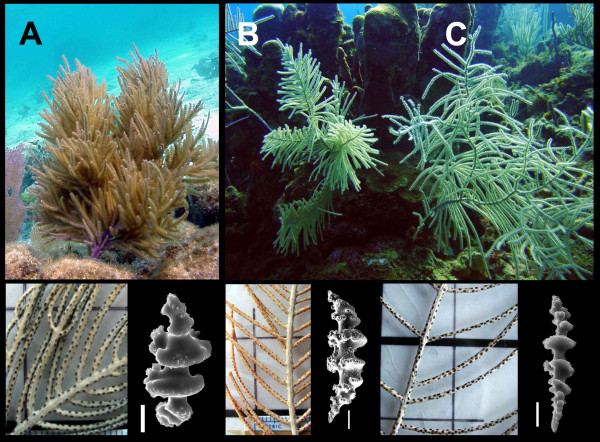
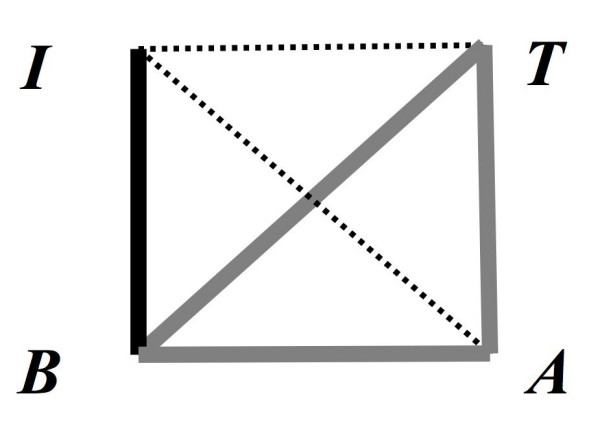
Colonial invertebrates such as corals exhibit nested levels of modularity, imposing a challenge to the depiction of their morphological evolution. Comparisons among diverse Caribbean gorgonian corals suggest decoupling of evolution at the polyp vs. branch/internode levels. Thus, evolutionary change in polyp form or size (the colonial module sensu stricto) does not imply a change in colony form (constructed of modular branches and other emergent features). This study examined the patterns of morphological integration at the intraspecific level. Pseudopterogorgia bipinnata (Verrill) (Octocorallia: Gorgoniidae) is a Caribbean shallow water gorgonian that can colonize most reef habitats (shallow/exposed vs. deep/protected; 1-45 m) and shows great morphological variation.
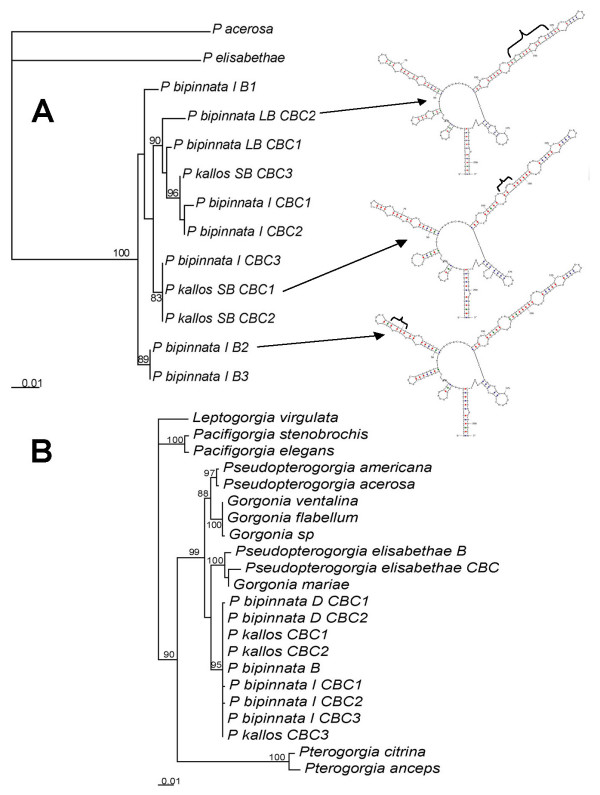
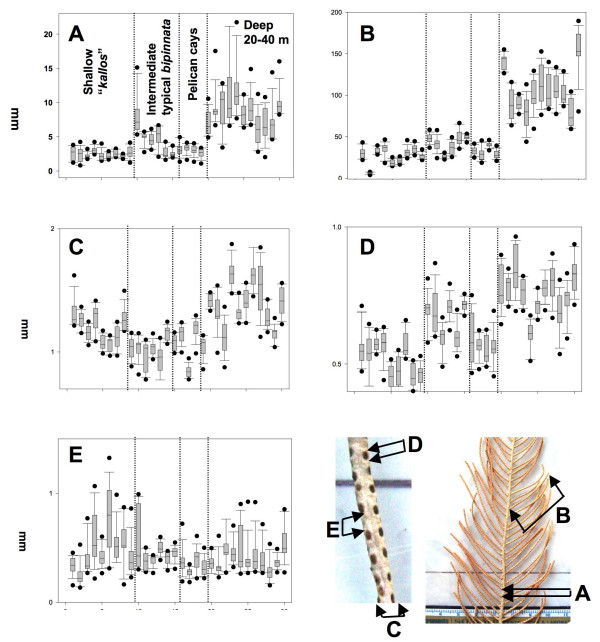
To characterize the genotype/environment relationship and phenotypic plasticity in P. bipinnata, two microsatellite loci, mitochondrial (MSH1) and nuclear (ITS) DNA sequences, and (ITS2) DGGE banding patterns were initially compared among the populations present in the coral reefs of Belize (Carrie Bow Cay), Panama (Bocas del Toro), Colombia (Cartagena) and the Bahamas (San Salvador). Despite the large and discrete differentiation of morphotypes, there was no concordant genetic variation (DGGE banding patterns) in the ITS2 genotypes from Belize, Panama and Colombia. ITS1-5.8S-ITS2 phylogenetic analysis afforded evidence for considering the species P. kallos (Bielschowsky) as the shallow-most morphotype of P. bipinnata from exposed environments. The population from Carrie Bow Cay, Belize (1-45 m) was examined to determine the phenotypic integration of modular features such as branch thickness, polyp aperture, inter-polyp distance, internode length and branch length. Third-order partial correlation coefficients suggested significant integration between polypar and colonial traits. Some features did not change at all despite 10-fold differences in other integrated features. More importantly, some colonial features showed dependence on modular features.
Consequently, module integration in gorgonian corals can be shifted, switched or canalized along lineages. Modular marine organisms such as corals are variations on a single theme: their modules can couple or decouple, allowing them to adapt to all marine benthic environments.
诸如珊瑚之类的群体无脊椎动物呈现出嵌套层次的模块化,这对描述它们的形态进化提出了挑战。对不同加勒比柳珊瑚的比较表明,息肉与分支/节间水平的进化出现了解耦。因此,息肉形态或大小(严格意义上的群体模块)的进化变化并不意味着群体形态(由模块化分支和其他涌现特征构成)的变化。本研究考察了种内水平的形态整合模式。双羽拟软柳珊瑚(Verrill)(八放珊瑚亚纲:柳珊瑚科)是一种加勒比浅海柳珊瑚,能在大多数珊瑚礁生境(浅海/暴露与深海/受保护;1 - 45米)中定殖,并表现出巨大的形态变异。
为了表征双羽拟软柳珊瑚的基因型/环境关系和表型可塑性,最初对伯利兹(卡里鲍礁)、巴拿马(博卡斯德尔托罗)、哥伦比亚(卡塔赫纳)和巴哈马(圣萨尔瓦多)珊瑚礁中存在的种群,比较了两个微卫星位点、线粒体(MSH1)和核(ITS)DNA序列以及(ITS2)变性梯度凝胶电泳条带模式。尽管形态型存在大的离散差异,但来自伯利兹、巴拿马和哥伦比亚的ITS2基因型中没有一致的遗传变异(变性梯度凝胶电泳条带模式)。ITS1 - 5.8S - ITS2系统发育分析提供了证据,可将卡罗斯拟软柳珊瑚(Bielschowsky)视为来自暴露环境的双羽拟软柳珊瑚最浅的形态型。对来自伯利兹卡里鲍礁(1 - 45米)的种群进行了考察,以确定诸如分支厚度、息肉孔径、息肉间距离、节间长度和分支长度等模块化特征的表型整合。三阶偏相关系数表明息肉和群体特征之间存在显著整合。尽管其他整合特征存在10倍差异,但有些特征根本没有变化。更重要的是,一些群体特征表现出对模块化特征的依赖性。
因此,柳珊瑚的模块整合可以沿着谱系发生转移、转换或受限。诸如珊瑚之类的模块化海洋生物是基于单一主题的变体:它们的模块可以耦合或解耦,使它们能够适应所有海洋底栖环境。