Manuel Douglas G, Lim Jenny J Y, Tanuseputro Peter, Stukel Therésè A
Institute for Clinical Evaluative Sciences, G106-2075 Bayview Avenue, Toronto, Ontario, M4N 3M5, Canada.
BMC Public Health. 2007 Jul 24;7:174. doi: 10.1186/1471-2458-7-174.
Health administrative data are increasingly used to examine disease occurrence. However, health administrative data are typically available for a limited number of years - posing challenges for estimating disease prevalence and incidence. The objective of this study is to estimate the prevalence of people previously hospitalized with an acute myocardial infarction (AMI) using 17 years of hospital data and to create a registry of people with myocardial infarction.
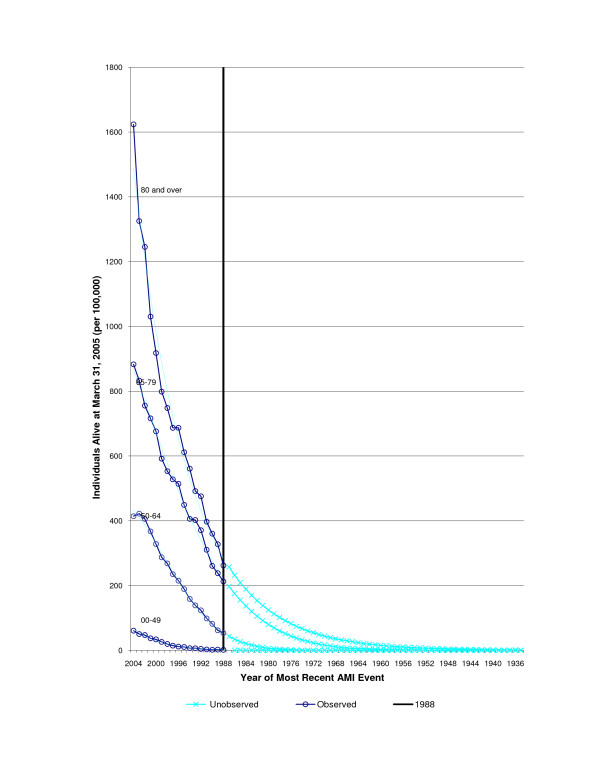
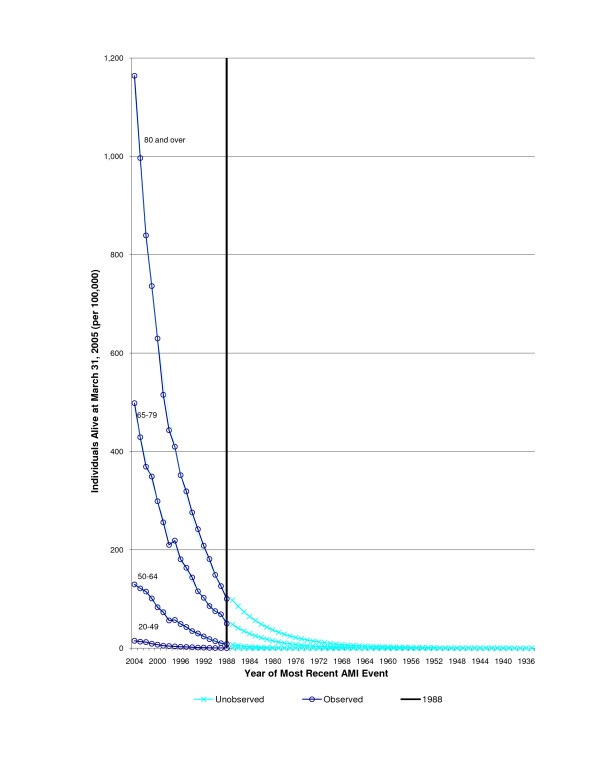
Myocardial infarction prevalence in Ontario 2004 was estimated using four methods: 1) observed hospital admissions from 1988 to 2004; 2) observed (1988 to 2004) and extrapolated unobserved events (prior to 1988) using a "back tracing" method using Poisson models; 3) DisMod incidence-prevalence-mortality model; 4) self-reported heart disease from the population-based Canadian Community Health Survey (CCHS) in 2000/2001. Individual respondents of the CCHS were individually linked to hospital discharge records to examine the agreement between self-report and hospital AMI admission.
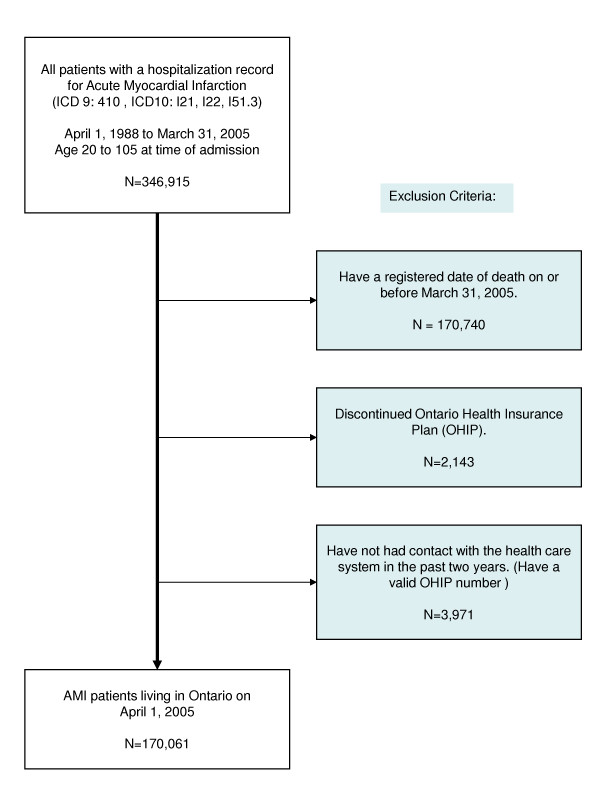
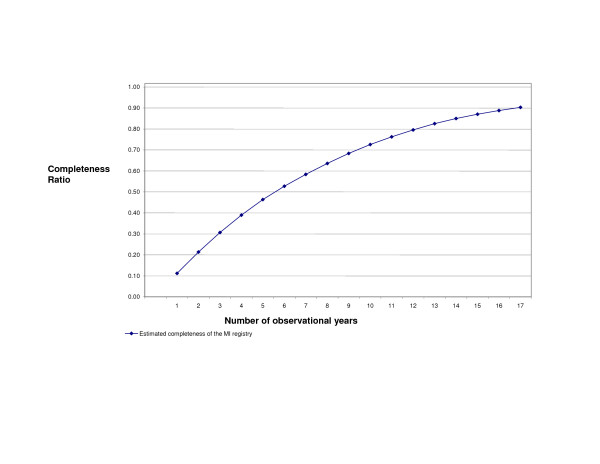
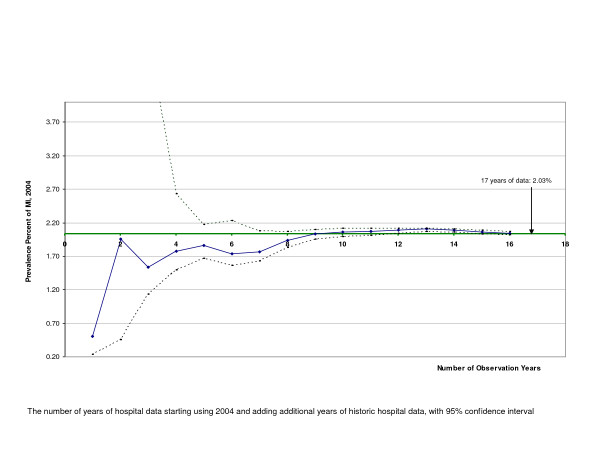
170,061 Ontario residents who were alive on March 31, 2004, and over age 20 years survived an AMI hospital admission between 1988 to 2004 (cumulative incidence 1.8%). This estimate increased to 2.03% (95% CI 2.01 to 2.05) after adding extrapolated cases that likely occurred before 1988. The estimated prevalence appeared stable with 5 to 10 years of historic hospital data. All 17 years of data were needed to create a reasonably complete registry (90% of estimated prevalent cases). The estimated prevalence using both DisMod and self-reported "heart attack" was higher (2.5% and 2.7% respectively). There was poor agreement between self-reported "heart attack" and the likelihood of having an observed AMI admission (sensitivity = 63.5%, positive predictive value = 54.3%).
Estimating myocardial infarction prevalence using a limited number of years of hospital data is feasible, and validity increases when unobserved events are added to observed events. The "back tracing" method is simple, reliable, and produces a myocardial infarction registry with high estimated "completeness" for jurisdictions with linked hospital data.
卫生行政数据越来越多地用于研究疾病发生情况。然而,卫生行政数据通常仅在有限的年份内可用,这给估计疾病患病率和发病率带来了挑战。本研究的目的是利用17年的医院数据估计既往因急性心肌梗死(AMI)住院患者的患病率,并建立心肌梗死患者登记册。
采用四种方法估计2004年安大略省的心肌梗死患病率:1)观察1988年至2004年的医院入院情况;2)使用泊松模型的“回溯”方法观察(1988年至2004年)并推断未观察到的事件(1988年之前);3)DisMod发病率-患病率-死亡率模型;4)2000/2001年基于人群的加拿大社区健康调查(CCHS)中的自我报告心脏病情况。CCHS的个体受访者与医院出院记录进行单独关联,以检查自我报告与医院AMI入院之间的一致性。
2004年3月31日仍在世且年龄超过20岁的170,061名安大略省居民在1988年至2004年期间因AMI住院存活(累积发病率1.8%)。在加入1988年之前可能发生的推断病例后,这一估计值增至2.03%(95%CI 2.01至2.05)。使用5至10年的历史医院数据时,估计患病率似乎稳定。需要所有17年的数据才能建立一个合理完整的登记册(估计患病率病例的90%)。使用DisMod和自我报告的“心脏病发作”估计的患病率更高(分别为2.5%和2.7%)。自我报告的“心脏病发作”与观察到的AMI入院可能性之间的一致性较差(敏感性=63.5%,阳性预测值=54.3%)。
使用有限年份的医院数据估计心肌梗死患病率是可行的,当将未观察到的事件添加到观察到的事件中时,有效性会提高。“回溯”方法简单、可靠,对于有链接医院数据的司法管辖区,可产生估计“完整性”较高的心肌梗死登记册。