Luan Deyan, Zai Michael, Varner Jeffrey D
Department of Chemical and Biomolecular Engineering, Cornell University, Ithaca, New York, USA.
PLoS Comput Biol. 2007 Jul;3(7):e142. doi: 10.1371/journal.pcbi.0030142.
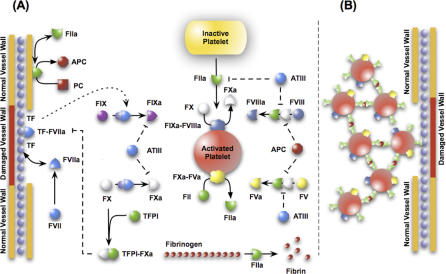
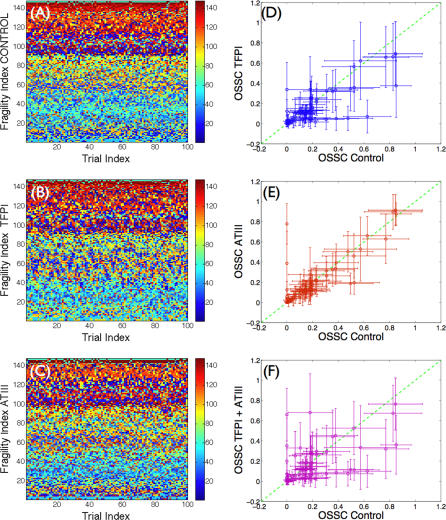
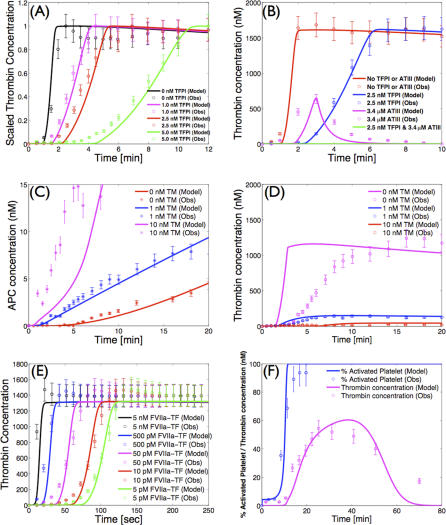
The role that mechanistic mathematical modeling and systems biology will play in molecular medicine and clinical development remains uncertain. In this study, mathematical modeling and sensitivity analysis were used to explore the working hypothesis that mechanistic models of human cascades, despite model uncertainty, can be computationally screened for points of fragility, and that these sensitive mechanisms could serve as therapeutic targets. We tested our working hypothesis by screening a model of the well-studied coagulation cascade, developed and validated from literature. The predicted sensitive mechanisms were then compared with the treatment literature. The model, composed of 92 proteins and 148 protein-protein interactions, was validated using 21 published datasets generated from two different quiescent in vitro coagulation models. Simulated platelet activation and thrombin generation profiles in the presence and absence of natural anticoagulants were consistent with measured values, with a mean correlation of 0.87 across all trials. Overall state sensitivity coefficients, which measure the robustness or fragility of a given mechanism, were calculated using a Monte Carlo strategy. In the absence of anticoagulants, fluid and surface phase factor X/activated factor X (fX/FXa) activity and thrombin-mediated platelet activation were found to be fragile, while fIX/FIXa and fVIII/FVIIIa activation and activity were robust. Both anti-fX/FXa and direct thrombin inhibitors are important classes of anticoagulants; for example, anti-fX/FXa inhibitors have FDA approval for the prevention of venous thromboembolism following surgical intervention and as an initial treatment for deep venous thrombosis and pulmonary embolism. Both in vitro and in vivo experimental evidence is reviewed supporting the prediction that fIX/FIXa activity is robust. When taken together, these results support our working hypothesis that computationally derived points of fragility of human relevant cascades could be used as a rational basis for target selection despite model uncertainty.
机械数学建模和系统生物学在分子医学和临床开发中所起的作用仍不确定。在本研究中,我们运用数学建模和敏感性分析来探究一个工作假设,即尽管存在模型不确定性,但人类级联反应的机械模型仍可通过计算筛选出脆弱点,并且这些敏感机制可作为治疗靶点。我们通过筛选一个从文献中开发并验证的、对凝血级联反应研究充分的模型来检验我们的工作假设。然后将预测的敏感机制与治疗文献进行比较。该模型由92种蛋白质和148种蛋白质 - 蛋白质相互作用组成,使用从两种不同的静态体外凝血模型生成的21个已发表数据集进行验证。在存在和不存在天然抗凝剂的情况下模拟的血小板活化和凝血酶生成曲线与测量值一致,所有试验的平均相关性为0.87。使用蒙特卡罗策略计算了整体状态敏感性系数,该系数衡量给定机制的稳健性或脆弱性。在没有抗凝剂的情况下,发现液相和表面相因子X/活化因子X(fX/FXa)活性以及凝血酶介导的血小板活化是脆弱的,而fIX/FIXa和fVIII/FVIIIa的活化和活性是稳健的。抗fX/FXa和直接凝血酶抑制剂都是重要的抗凝剂类别;例如,抗fX/FXa抑制剂已获得美国食品药品监督管理局(FDA)批准,用于预防手术干预后的静脉血栓栓塞以及作为深静脉血栓形成和肺栓塞的初始治疗。本文综述了体外和体内实验证据,支持fIX/FIXa活性稳健这一预测。综上所述,这些结果支持了我们的工作假设,即尽管存在模型不确定性,但通过计算得出的人类相关级联反应的脆弱点仍可作为靶点选择的合理依据。