Gu Jiande, Xie Yaoming, Schaefer Henry F
Drug Design & Discovery Center, State Key Laboratory of Drug Research, Shanghai Institute of Materia Medica, Shanghai Institutes for Biological Sciences, CAS, Shanghai 201203, PR China.
Nucleic Acids Res. 2007;35(15):5165-72. doi: 10.1093/nar/gkm135. Epub 2007 Jul 27.
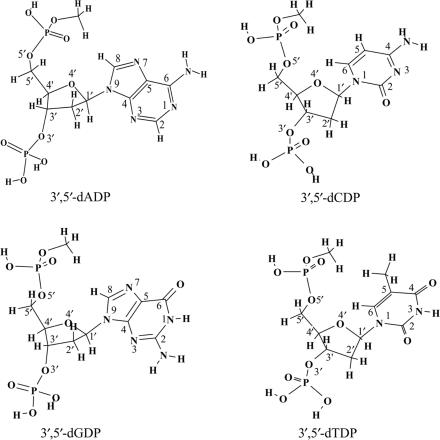
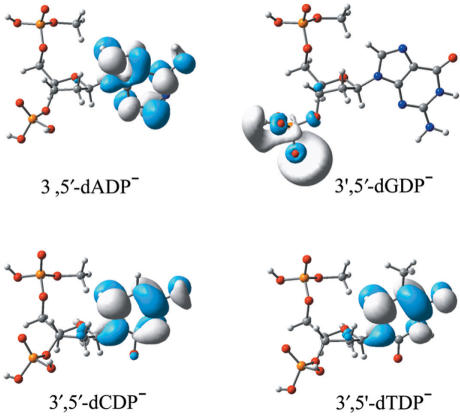
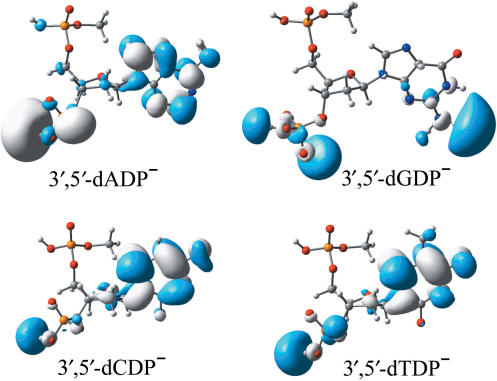
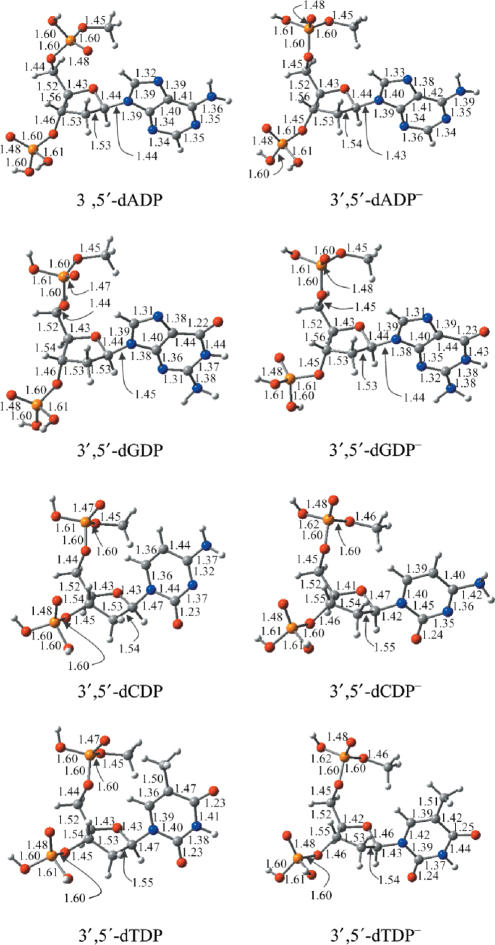
The 2'-deoxyguanosine-3',5'-diphosphate, 2'-deoxyadenosine-3',5'-diphosphate, 2'-deoxycytidine-3',5'-diphosphate and 2'-deoxythymidine-3',5'-diphosphate systems are the smallest units of a DNA single strand. Exploring these comprehensive subunits with reliable density functional methods enables one to approach reasonable predictions of the properties of DNA single strands. With these models, DNA single strands are found to have a strong tendency to capture low-energy electrons. The vertical attachment energies (VEAs) predicted for 3',5'-dTDP (0.17 eV) and 3',5'-dGDP (0.14 eV) indicate that both the thymine-rich and the guanine-rich DNA single strands have the ability to capture electrons. The adiabatic electron affinities (AEAs) of the nucleotides considered here range from 0.22 to 0.52 eV and follow the order 3',5'-dTDP > 3',5'-dCDP > 3',5'-dGDP > 3',5'-dADP. A substantial increase in the AEA is observed compared to that of the corresponding nucleic acid bases and the corresponding nucleosides. Furthermore, aqueous solution simulations dramatically increase the electron attracting properties of the DNA single strands. The present investigation illustrates that in the gas phase, the excess electron is situated both on the nucleobase and on the phosphate moiety for DNA single strands. However, the distribution of the extra negative charge is uneven. The attached electron favors the base moiety for the pyrimidine, while it prefers the 3'-phosphate subunit for the purine DNA single strands. In contrast, the attached electron is tightly bound to the base fragment for the cytidine, thymidine and adenosine nucleotides, while it almost exclusively resides in the vicinity of the 3'-phosphate group for the guanosine nucleotides due to the solvent effects. The comparatively low vertical detachment energies (VDEs) predicted for 3',5'-dADP(-) (0.26 eV) and 3',5'-dGDP(-) (0.32 eV) indicate that electron detachment might compete with reactions having high activation barriers such as glycosidic bond breakage. However, the radical anions of the pyrimidine nucleotides with high VDE are expected to be electronically stable. Thus the base-centered radical anions of the pyrimidine nucleotides might be the possible intermediates for DNA single-strand breakage.
2'-脱氧鸟苷-3',5'-二磷酸、2'-脱氧腺苷-3',5'-二磷酸、2'-脱氧胞苷-3',5'-二磷酸和2'-脱氧胸苷-3',5'-二磷酸系统是DNA单链的最小单位。用可靠的密度泛函方法研究这些综合亚基能够对DNA单链的性质进行合理预测。利用这些模型发现,DNA单链具有捕获低能电子的强烈倾向。预测的3',5'-dTDP(0.17 eV)和3',5'-dGDP(0.14 eV)的垂直附着能表明,富含胸腺嘧啶和富含鸟嘌呤的DNA单链都有捕获电子的能力。这里考虑的核苷酸的绝热电子亲和势(AEA)范围为0.22至0.52 eV,顺序为3',5'-dTDP > 3',5'-dCDP > 3',5'-dGDP > 3',5'-dADP。与相应的核酸碱基和相应的核苷相比,观察到AEA有显著增加。此外,水溶液模拟显著增强了DNA单链的电子吸引性质。本研究表明,在气相中,DNA单链的多余电子位于核碱基和磷酸部分。然而,额外负电荷的分布是不均匀的。附着的电子在嘧啶中倾向于碱基部分,而在嘌呤DNA单链中它更倾向于3'-磷酸亚基。相比之下,对于胞苷、胸苷和腺苷核苷酸,附着的电子紧密结合在碱基片段上,而由于溶剂效应,对于鸟苷核苷酸,它几乎完全位于3'-磷酸基团附近。预测的3',5'-dADP(-)(0.26 eV)和3',5'-dGDP(-)(0.32 eV)的相对较低的垂直脱离能(VDE)表明,电子脱离可能与具有高活化能垒的反应(如糖苷键断裂)竞争。然而,具有高VDE的嘧啶核苷酸的自由基阴离子预计在电子上是稳定的。因此,嘧啶核苷酸以碱基为中心的自由基阴离子可能是DNA单链断裂的可能中间体。