Losina Elena, Yazdanpanah Yazdan, Deuffic-Burban Sylvie, Wang Bingxia, Wolf Lindsey L, Messou Eugène, Gabillard Delphine, Seyler Catherine, Freedberg Kenneth A, Anglaret Xavier
Department of Biostatistics and Epidemiology, Boston University School of Public Health, Boston, MA, USA.
Antivir Ther. 2007;12(4):543-51.
Studies in developed countries have shown highly active antiretroviral therapy (HAART) decreases incidence of severe opportunistic diseases (ODs) in HIV-infected patients beyond that which is expected from changes in CD4+ T-cell count.
To estimate the independent impact of HAART on reducing ODs and mortality in Côte d'Ivoire.
Within two longitudinal studies of HIV-infected adults (1996-2003), we identified time on 'cotrimoxazole alone' and 'HAART plus cotrimoxazole' WHO stage 3-4 defining events and severe malaria were divided into those preventable and not preventable with cotrimoxazole. Incidence of ODs by CD4 count stratum was estimated using incidence density analysis. CD4+ T-cell count at time of OD was estimated using linear interpolation. Using Poisson regression, we estimated the effect of HAART on OD incidence and mortality by CD4 count stratum.
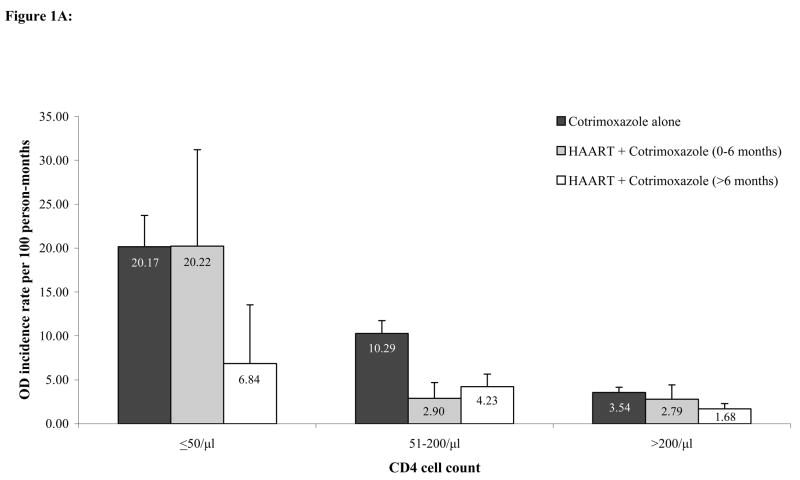
Totals of 446 and 135 adults were followed during 6,216 and 3,412 person-months in the cotrimoxazole alone and HAART plus cotrimoxazole periods, respectively. There was a CD4+ T-cell-independent risk reduction for ODs and mortality during the HAART plus cotrimoxazole period compared with cotrimoxazole alone, which varied by time on HAART, CD4 count stratum and OD type. It was mainly seen after 6 months on HAART and for ODs not preventable by cotrimoxazole. The HAART effect differed significantly by CD4 count stratum (P=0.02), but was significant in all strata after 6 months on HAART.
In these sub-Saharan African adults, HAART initiation reduced ODs and mortality beyond that which was expected through the HAART-induced CD4+ T-cell increase. Further studies should examine practical implications of this independent 'HAART effect' on clinical outcomes in patients on HAART.
发达国家的研究表明,高效抗逆转录病毒疗法(HAART)降低了HIV感染患者严重机会性疾病(ODs)的发病率,其降低幅度超过了CD4+T细胞计数变化所预期的水平。
评估HAART对降低科特迪瓦ODs发病率和死亡率的独立影响。
在两项针对HIV感染成年人的纵向研究(1996 - 2003年)中,我们确定了使用“单独的复方新诺明”和“HAART加复方新诺明”的时间,将世界卫生组织3 - 4期定义事件和严重疟疾分为可通过复方新诺明预防和不可预防的两类。使用发病密度分析按CD4计数分层估算ODs的发病率。通过线性插值法估算OD发生时的CD4+T细胞计数。使用泊松回归,我们按CD4计数分层估算了HAART对OD发病率和死亡率的影响。
在单独使用复方新诺明和HAART加复方新诺明期间,分别有446名和135名成年人接受了6216和3412人月的随访。与单独使用复方新诺明相比,在HAART加复方新诺明期间,ODs和死亡率存在与CD4+T细胞无关的风险降低,这因接受HAART的时间、CD4计数分层和OD类型而异。主要在接受HAART 6个月后以及对于复方新诺明不可预防的ODs中观察到这种情况。HAART的效果在不同CD4计数分层之间有显著差异(P = 0.02),但在接受HAART 6个月后在所有分层中均显著。
在这些撒哈拉以南非洲成年人中,开始使用HAART降低了ODs发病率和死亡率,其降低幅度超过了HAART诱导的CD4+T细胞增加所预期的水平。进一步的研究应探讨这种独立的“HAART效应”对接受HAART治疗患者临床结局的实际影响。