Hehenkamp Wouter J K, Volkers Nicole A, Bartholomeus Wouter, de Blok Sjoerd, Birnie Erwin, Reekers Jim A, Ankum Willem M
Department of Gynaecology, Academic Medical Centre Amsterdam, Meibergdreef 9, 1105 AZ, Amsterdam, The Netherlands.
Cardiovasc Intervent Radiol. 2007 Sep-Oct;30(5):866-75. doi: 10.1007/s00270-007-9121-7.
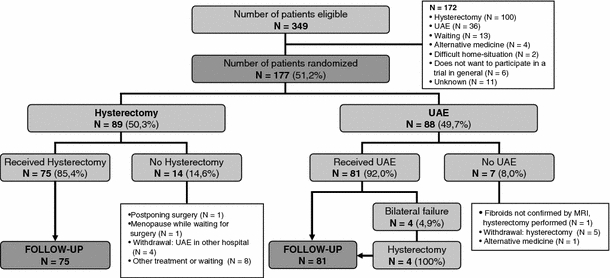
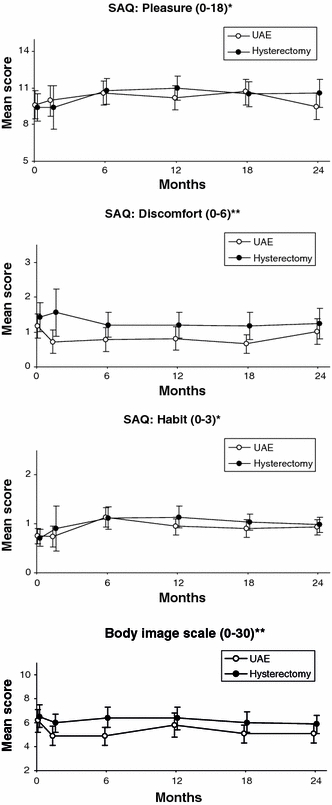
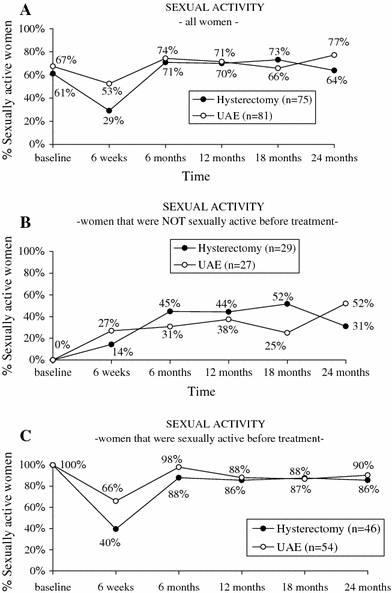
In this paper the effect of uterine artery embolization (UAE) on sexual functioning and body image is investigated in a randomized comparison to hysterectomy for symptomatic uterine fibroids. The EMbolization versus hysterectoMY (EMMY) trial is a randomized controlled study, conducted at 28 Dutch hospitals. Patients were allocated hysterectomy (n = 89) or UAE (n = 88). Two validated questionnaires (the Sexual Activity Questionnaire [SAQ] and the Body Image Scale [BIS]) were completed by all patients at baseline, 6 weeks, and 6, 12, 18, and 24 months after treatment. Repeated measurements on SAQ scores revealed no differences between the groups. There was a trend toward improved sexual function in both groups at 2 years, although this failed to reach statistical significance except for the dimensions discomfort and habit in the UAE arm. Overall quality of sexual life deteriorated in a minority of cases at all time points, with no significant differences between the groups (at 24 months: UAE, 29.3%, versus hysterectomy, 23.5%; p = 0.32). At 24 months the BIS score had improved in both groups compared to baseline, but the change was only significant in the UAE group (p = 0.009). In conclusion, at 24 months no differences in sexuality and body image were observed between the UAE and the hysterectomy group. On average, both after UAE and hysterectomy sexual functioning and body image scores improved, but significantly so only after UAE.
在本文中,针对有症状子宫肌瘤患者,通过与子宫切除术进行随机对照比较,研究了子宫动脉栓塞术(UAE)对性功能和身体意象的影响。栓塞术与子宫切除术(EMMY)试验是一项在28家荷兰医院开展的随机对照研究。患者被分配接受子宫切除术(n = 89)或UAE(n = 88)。所有患者在基线、6周以及治疗后6、12、18和24个月时完成两份经过验证的问卷(性活动问卷[SAQ]和身体意象量表[BIS])。对SAQ评分的重复测量显示两组之间无差异。两组在2年时性功能均有改善趋势,不过除UAE组的不适和习惯维度外,均未达到统计学显著性。在所有时间点,少数病例的总体性生活质量下降,两组之间无显著差异(24个月时:UAE组为29.3%,子宫切除组为23.5%;p = 0.32)。与基线相比,两组在24个月时BIS评分均有所改善,但仅在UAE组变化显著(p = 0.009)。总之,在24个月时,UAE组和子宫切除组在性方面和身体意象上未观察到差异。平均而言,UAE和子宫切除术后性功能和身体意象评分均有所改善,但仅在UAE术后改善显著。