Davoodpour Padideh, Landström Maréne, Welsh Michael
Department of Medical Cell Biology, Uppsala University, Uppsala, Sweden.
BMC Cancer. 2007 Aug 15;7:161. doi: 10.1186/1471-2407-7-161.
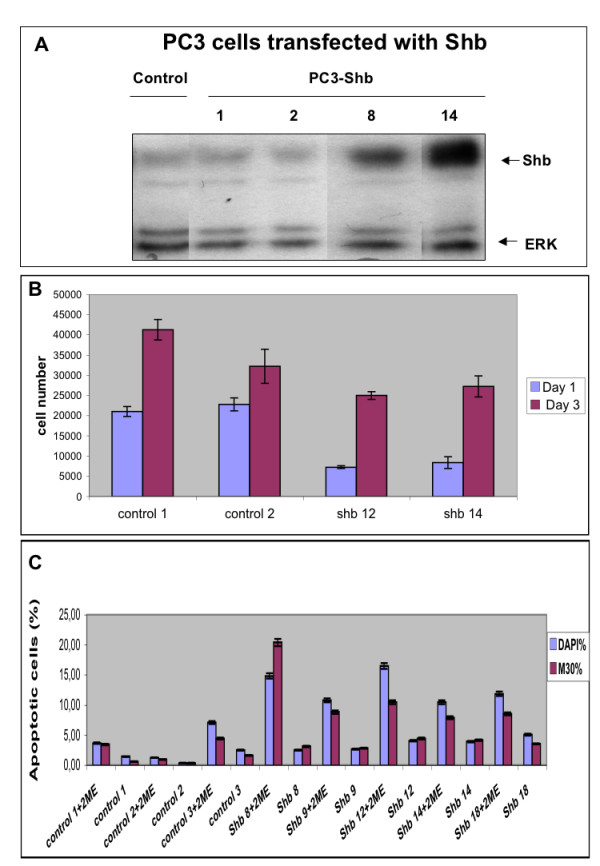
Induction of apoptosis is one strategy for treatment of prostate cancer. The Shb adapter protein has been found to regulate apoptosis in various cell types and consequently human prostate cancer 3 (PC3) cells were transfected to obtain cells overexpressing Shb in order to increase our understanding of the mechanisms regulating PC3 cell apoptosis.
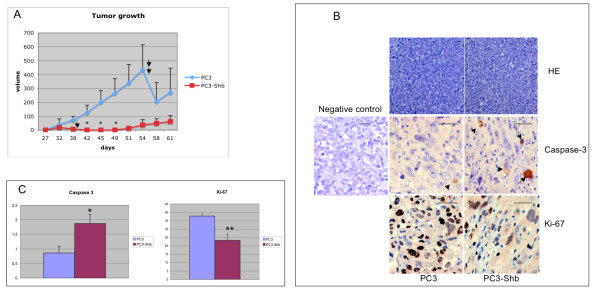
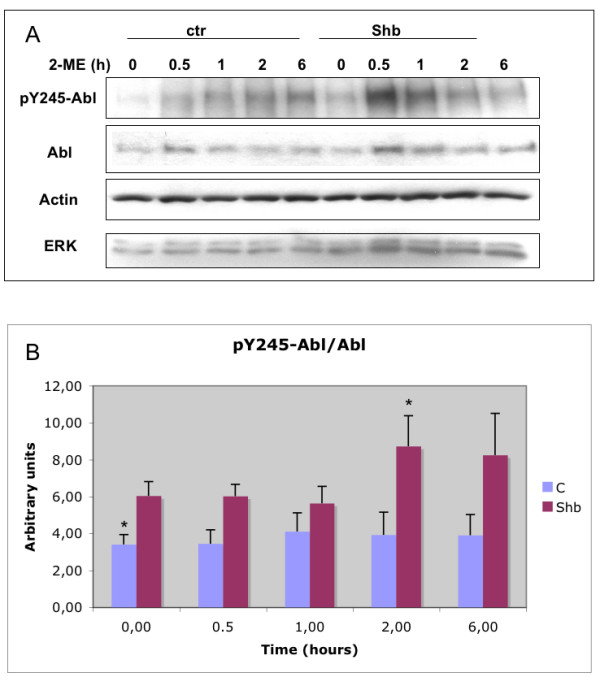
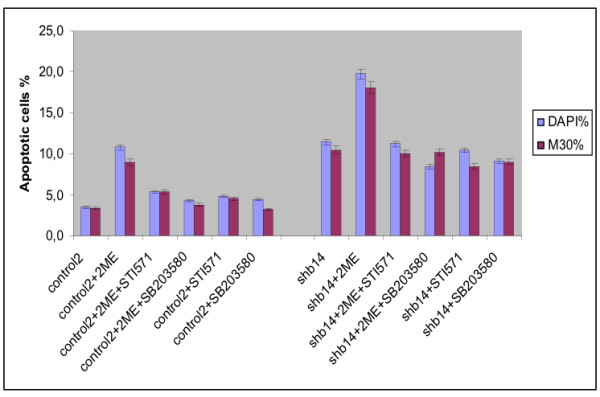
Human prostate cancer cells (PC3) were transfected with control vector or a vector containing the Shb cDNA. Clones overexpressing Shb were studied with respect to apoptosis (Dapi, M30) and c-Abl activation (Western blot for pY-245-Abl). The cells were exposed to the anti-tumor agent 2-methoxyestradiol (2-ME) and the p38 MAPK and c-Abl inhibitors SB203580 and STI-571, respectively, after which cell death was determined. In vivo tumor growth and tumor cell proliferation (Ki-67 staining) or apoptosis (active caspase 3 staining) were also determined in nude mice.
PC3 cells overexpressing Shb exhibited increased rates of apoptosis in the presence of the anti-tumor agent 2-ME. The Shb cells displayed increased activity of the pro-apoptotic kinase c-Abl. Pre-treatment with p38 MAPK (SB203580) or c-Abl (STI-571) inhibitors completely blocked 2-ME-induced apoptosis, implicating these two pathways in the response. The PC3-Shb cells displayed reduced tumor growth in vivo, an effect occurring as a consequence of increased apoptosis and reduced DNA synthesis.
It is concluded that Shb promotes 2-ME-induced PC3 cell apoptosis by increased pro-apoptotic signaling via the c-Abl pathway and that this causes reduced tumor growth in vivo.
诱导细胞凋亡是治疗前列腺癌的一种策略。已发现Shb衔接蛋白可调节多种细胞类型中的细胞凋亡,因此转染人前列腺癌3(PC3)细胞以获得过表达Shb的细胞,以便增进我们对调节PC3细胞凋亡机制的理解。
用对照载体或含Shb cDNA的载体转染人前列腺癌细胞(PC3)。研究过表达Shb的克隆的细胞凋亡情况(Dapi、M30)和c-Abl激活情况(pY-245-Abl的蛋白质免疫印迹法)。细胞分别暴露于抗肿瘤药物2-甲氧基雌二醇(2-ME)以及p38丝裂原活化蛋白激酶(MAPK)抑制剂SB203580和c-Abl抑制剂STI-571,之后测定细胞死亡情况。还在裸鼠中测定了体内肿瘤生长以及肿瘤细胞增殖(Ki-67染色)或凋亡(活性半胱天冬酶3染色)情况。
过表达Shb的PC3细胞在存在抗肿瘤药物2-ME的情况下凋亡率增加。Shb细胞显示促凋亡激酶c-Abl的活性增加。用p38 MAPK(SB203580)或c-Abl(STI-571)抑制剂预处理可完全阻断2-ME诱导的细胞凋亡,表明这两条途径参与了该反应。PC3-Shb细胞在体内显示出肿瘤生长减缓,这一效应是细胞凋亡增加和DNA合成减少的结果。
得出结论,Shb通过增强经由c-Abl途径的促凋亡信号传导来促进2-ME诱导的PC3细胞凋亡,且这会导致体内肿瘤生长减缓。