Macias Nayeli, Alemán-Mateo Heliodoro, Esparza-Romero Julián, Valencia Mauro E
Centro de Investigación en Nutrición y Salud, Instituto Nacional de Salud Pública. Universidad 655, Santa Maria Ahuacatitlan, CP 62508, Cuernavaca, México.
Nutr J. 2007 Aug 15;6:18. doi: 10.1186/1475-2891-6-18.
The study of body composition in specific populations by techniques such as bio-impedance analysis (BIA) requires validation based on standard reference methods. The aim of this study was to develop and cross-validate a predictive equation for bioelectrical impedance using air displacement plethysmography (ADP) as standard method to measure body composition in Mexican adult men and women.
This study included 155 male and female subjects from northern Mexico, 20-50 years of age, from low, middle, and upper income levels. Body composition was measured by ADP. Body weight (BW, kg) and height (Ht, cm) were obtained by standard anthropometric techniques. Resistance, R (ohms) and reactance, Xc (ohms) were also measured. A random-split method was used to obtain two samples: one was used to derive the equation by the "all possible regressions" procedure and was cross-validated in the other sample to test predicted versus measured values of fat-free mass (FFM).
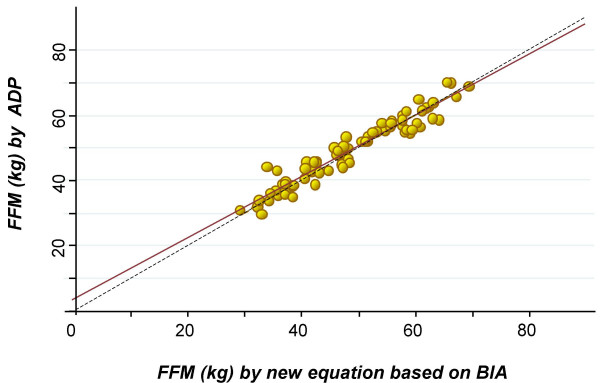
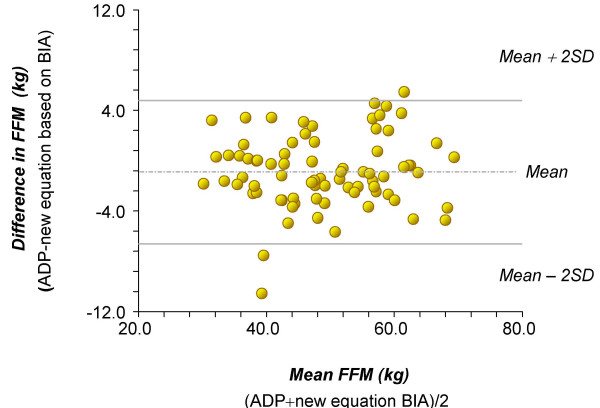
The final model was: FFM (kg) = 0.7374 * (Ht2 /R) + 0.1763 * (BW) - 0.1773 * (Age) + 0.1198 * (Xc) - 2.4658. R2 was 0.97; the square root of the mean square error (SRMSE) was 1.99 kg, and the pure error (PE) was 2.96. There was no difference between FFM predicted by the new equation (48.57 +/- 10.9 kg) and that measured by ADP (48.43 +/- 11.3 kg). The new equation did not differ from the line of identity, had a high R2 and a low SRMSE, and showed no significant bias (0.87 +/- 2.84 kg).
The new bioelectrical impedance equation based on the two-compartment model (2C) was accurate, precise, and free of bias. This equation can be used to assess body composition and nutritional status in populations similar in anthropometric and physical characteristics to this sample.
通过生物电阻抗分析(BIA)等技术对特定人群的身体成分进行研究,需要依据标准参考方法进行验证。本研究的目的是开发并交叉验证一个生物电阻抗预测方程,该方程采用空气置换体积描记法(ADP)作为测量墨西哥成年男性和女性身体成分的标准方法。
本研究纳入了来自墨西哥北部的155名男性和女性受试者,年龄在20至50岁之间,涵盖低收入、中等收入和高收入水平。通过ADP测量身体成分。采用标准人体测量技术获取体重(BW,千克)和身高(Ht,厘米)。同时测量电阻R(欧姆)和电抗Xc(欧姆)。使用随机分割法获得两个样本:一个样本用于通过“所有可能回归”程序推导方程,并在另一个样本中进行交叉验证,以检验预测的去脂体重(FFM)与测量值之间的差异。
最终模型为:FFM(千克)= 0.7374 *(Ht² /R)+ 0.1763 *(BW) - 0.1773 *(年龄)+ 0.1198 *(Xc) - 2.4658。R²为0.97;均方误差平方根(SRMSE)为1.99千克,纯误差(PE)为2.96。新方程预测的FFM(48.57±10.9千克)与ADP测量的FFM(48.43±11.3千克)之间无差异。新方程与恒等线无差异,具有较高的R²和较低的SRMSE,且无显著偏差(0.87±2.84千克)。
基于两室模型(2C)的新生物电阻抗方程准确、精确且无偏差。该方程可用于评估与本样本在人体测量和身体特征方面相似的人群的身体成分和营养状况。