Wu Chun-Shien, Chen Yu-Yawn, Chuang Chih-Lin, Chiang Li-Ming, Dwyer Gregory B, Hsu Ying-Lin, Huang Ai-Chun, Lai Chung-Liang, Hsieh Kuen-Chang
Center for General Education, I-Shou University, No.1 Sec. 1, Syuecheng Rd., Dashu Dist, Kaoshiung City, 84001, Taiwan.
Department of Physical Education, National Taiwan Sport University, No. 16, Sec. 1, Shuang-Shih Road, Taichung City, 404, Taiwan.
Nutr J. 2015 May 19;14:52. doi: 10.1186/s12937-015-0041-0.
The objectives of this study were to develop a regression model for predicting fat-free mass (FFM) in a population of healthy Taiwanese individuals using standing foot-to-foot bioelectrical impedance analysis (BIA) and to test the model's performance in predicting FFM with different body fat percentages (BF%).
We used dual-energy X-ray absorptiometry (DXA) to measure the FFM of 554 healthy Asian subjects (age, 16-75 y; body mass index, 15.8-43.1 kg/m(2)). We also evaluated the validity of the developed multivariate model using a double cross-validation technique and assessed the accuracy of the model in an all-subjects sample and subgroup samples with different body fat levels.
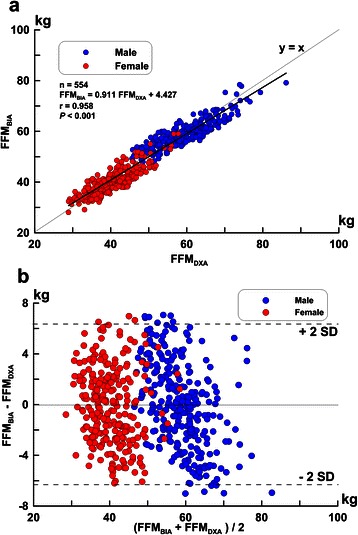
Predictors in the all-subjects multivariate model included height(2)/impedance, weight, year, and sex (FFM = 13.055 + 0.204 weight + 0.394 height(2)/Impedance - 0.136 age + 8.125 sex (sex: Female = 0, Male = 1), r(2) = 0.92, standard error of the estimate = 3.17 kg). The correlation coefficients between predictive FFM by BIA (FFMBIA) and DXA-measured FFM (FFMDXA) in female subjects with a total-subjects BF%DXA of <20 %, 20 %-30 %, 30 %-40 % and >40 % were r = 0.87, 0.90, 0.91, 0.89, and 0.94, respectively, with bias ± 2SD of 0.0 ± 3.0 kg, -2.6 ± 1.7 kg, -1.5 ± 2.8 kg, 0.5 ± 2.7 kg, and 2.0 ± 2.9 kg, respectively. The correlation coefficients between FFMBIA and FFMDXA in male subjects with a total-subjects BF%DXA of <10 %, 10 %-20 %, 20 %-30 %, and >30 % were r = 0.89, 0.89, 0.90, 0.93, and 0.91, respectively, with bias ± 2SD of 0.0 ± 3.2 kg, -2.3 ± 2.5 kg, -0.5 ± 3.2 kg, 0.4 ± 3.1 kg, and 2.1 ± 3.2 kg, respectively.
The standing foot-to-foot BIA method developed in this study can accurately predict FFM in healthy Asian individuals with different levels of body fat.
本研究的目的是建立一个回归模型,用于通过站立式双脚生物电阻抗分析(BIA)预测健康台湾人群的去脂体重(FFM),并测试该模型在预测不同体脂百分比(BF%)人群FFM时的性能。
我们使用双能X线吸收法(DXA)测量了554名健康亚洲受试者(年龄16 - 75岁;体重指数15.8 - 43.1 kg/m²)的FFM。我们还使用双重交叉验证技术评估了所建立的多变量模型的有效性,并在所有受试者样本以及不同体脂水平的亚组样本中评估了该模型的准确性。
所有受试者多变量模型中的预测因子包括身高²/阻抗、体重、年龄和性别(FFM = 13.055 + 0.204体重 + 0.394身高²/阻抗 - 0.136年龄 + 8.125性别(性别:女性 = 0,男性 = 1),r² = 0.92,估计标准误差 = 3.17 kg)。在总体受试者BF%DXA分别<20%、20% - 30%、30% - 40%和>40%的女性受试者中,BIA预测的FFM(FFMBIA)与DXA测量的FFM(FFMDXA)之间的相关系数分别为r = 0.87、0.90、0.91、0.89和0.94,偏差±2SD分别为0.0 ± 3.0 kg、-2.6 ± 1.7 kg、-1.5 ± 2.8 kg、0.5 ± 2.7 kg和2.0 ± 2.9 kg。在总体受试者BF%DXA分别<10%、10% - 20%、20% - 30%和>30%的男性受试者中,FFMBIA与FFMDXA之间的相关系数分别为r = 0.89、0.89、0.90、0.93和0.91,偏差±2SD分别为0.0 ± 3.2 kg、-2.3 ± 2.5 kg、-0.5 ± 3.2 kg、0.4 ± 3.1 kg和2.1 ± 3.2 kg。
本研究中开发的站立式双脚BIA方法能够准确预测不同体脂水平的健康亚洲个体的FFM。