Rapedius Markus, Fowler Philip W, Shang Lijun, Sansom Mark S P, Tucker Stephen J, Baukrowitz Thomas
Institute of Physiology II, Friedrich Schiller University, D-07743 Jena, Germany.
Neuron. 2007 Aug 16;55(4):602-14. doi: 10.1016/j.neuron.2007.07.026.
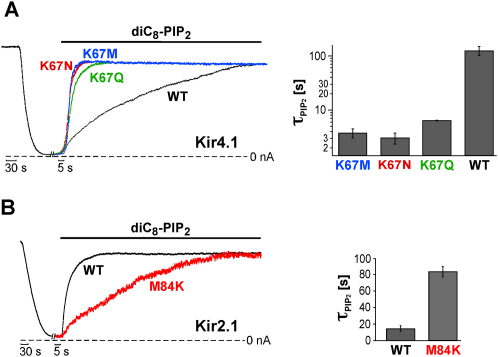
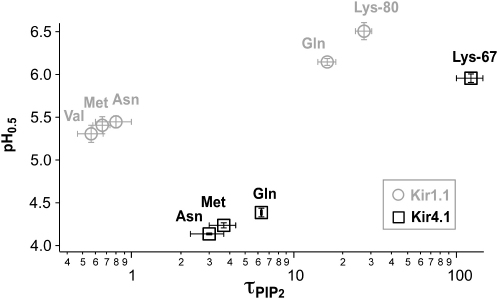
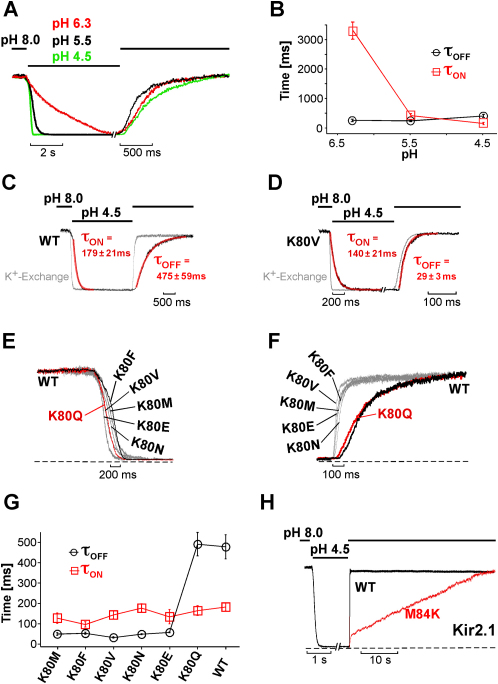
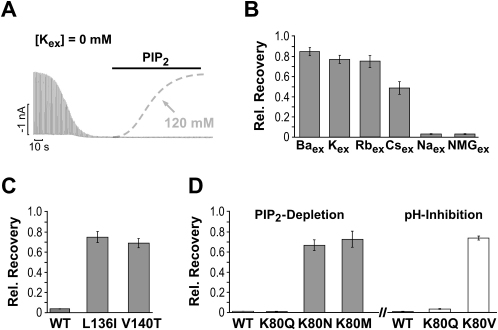
Specific stimuli such as intracellular H+ and phosphoinositides (e.g., PIP2) gate inwardly rectifying potassium (Kir) channels by controlling the reversible transition between the closed and open states. This gating mechanism underlies many aspects of Kir channel physiology and pathophysiology; however, its structural basis is not well understood. Here, we demonstrate that H+ and PIP2 use a conserved gating mechanism defined by similar structural changes in the transmembrane (TM) helices and the selectivity filter. Our data support a model in which the gating motion of the TM helices is controlled by an intrasubunit hydrogen bond between TM1 and TM2 at the helix-bundle crossing, and we show that this defines a common gating motif in the Kir channel superfamily. Furthermore, we show that this proposed H-bonding interaction determines Kir channel pH sensitivity, pH and PIP2 gating kinetics, as well as a K+-dependent inactivation process at the selectivity filter and therefore many of the key regulatory mechanisms of Kir channel physiology.
诸如细胞内氢离子和磷酸肌醇(如磷脂酰肌醇 -4,5-二磷酸,PIP2)等特定刺激,通过控制内向整流钾通道(Kir)在关闭态和开放态之间的可逆转变来使其门控。这种门控机制是Kir通道生理学和病理生理学诸多方面的基础;然而,其结构基础尚未得到很好的理解。在此,我们证明氢离子和PIP2采用一种保守的门控机制,该机制由跨膜(TM)螺旋和选择性过滤器中相似的结构变化所定义。我们的数据支持一个模型,其中TM螺旋的门控运动由螺旋束交叉处TM1和TM2之间的亚基内氢键控制,并且我们表明这在Kir通道超家族中定义了一个共同的门控基序。此外,我们表明这种提出的氢键相互作用决定了Kir通道的pH敏感性、pH和PIP2门控动力学,以及选择性过滤器处的钾离子依赖性失活过程,因此也是Kir通道生理学的许多关键调节机制。