Department of Zoology, Cancer/Genetics Research Complex, University of Florida, Gainesville, Florida, United Sates of America.
PLoS One. 2007 Aug 15;2(8):e754. doi: 10.1371/journal.pone.0000754.
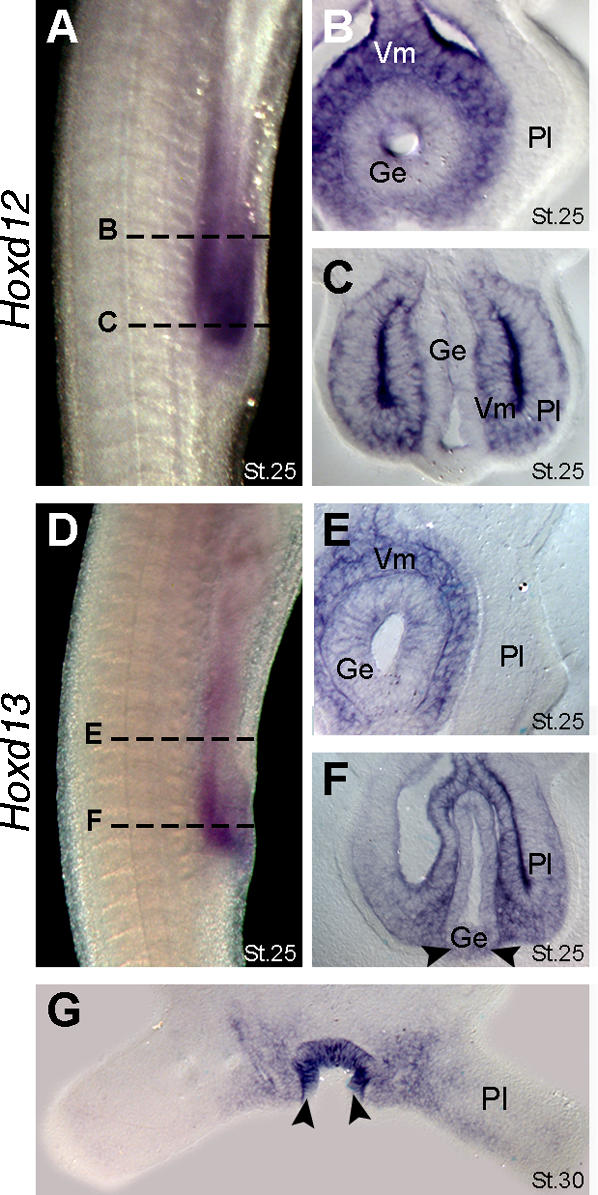
The evolutionary transition of fins to limbs involved development of a new suite of distal skeletal structures, the digits. During tetrapod limb development, genes at the 5' end of the HoxD cluster are expressed in two spatiotemporally distinct phases. In the first phase, Hoxd9-13 are activated sequentially and form nested domains along the anteroposterior axis of the limb. This initial phase patterns the limb from its proximal limit to the middle of the forearm. Later in development, a second wave of transcription results in 5' HoxD gene expression along the distal end of the limb bud, which regulates formation of digits. Studies of zebrafish fins showed that the second phase of Hox expression does not occur, leading to the idea that the origin of digits was driven by addition of the distal Hox expression domain in the earliest tetrapods. Here we test this hypothesis by investigating Hoxd gene expression during paired fin development in the shark Scyliorhinus canicula, a member of the most basal lineage of jawed vertebrates. We report that at early stages, 5'Hoxd genes are expressed in anteroposteriorly nested patterns, consistent with the initial wave of Hoxd transcription in teleost and tetrapod paired appendages. Unexpectedly, a second phase of expression occurs at later stages of shark fin development, in which Hoxd12 and Hoxd13 are re-expressed along the distal margin of the fin buds. This second phase is similar to that observed in tetrapod limbs. The results indicate that a second, distal phase of Hoxd gene expression is not uniquely associated with tetrapod digit development, but is more likely a plesiomorphic condition present the common ancestor of chondrichthyans and osteichthyans. We propose that a temporal extension, rather than de novo activation, of Hoxd expression in the distal part of the fin may have led to the evolution of digits.
鳍到肢的进化转变涉及到一系列新的远端骨骼结构的发育,即指骨。在四足动物肢的发育过程中,HoxD 簇的 5' 端基因在两个时空上不同的阶段表达。在第一阶段,Hoxd9-13 依次被激活,并在肢的前-后轴上形成嵌套的结构域。这个初始阶段从肢体的近端极限到前臂的中间对肢体进行模式化。在发育后期,第二波转录导致 5' HoxD 基因在肢芽的远端表达,从而调节指骨的形成。对斑马鱼鳍的研究表明,Hox 表达的第二阶段不会发生,导致了这样的想法,即最早的四足动物中远端 Hox 表达域的添加驱动了指骨的起源。在这里,我们通过研究鲨鱼 Scyliorhinus canicula 的配对鳍发育过程中的 Hoxd 基因表达来检验这一假说,鲨鱼是有颌脊椎动物最基础谱系的成员。我们报告说,在早期阶段,5' Hoxd 基因以前后嵌套的模式表达,与硬骨鱼和四足动物配对附肢中 Hoxd 转录的初始波一致。出乎意料的是,在鲨鱼鳍发育的后期阶段,会出现第二个表达阶段,其中 Hoxd12 和 Hoxd13 在鳍芽的远端边缘重新表达。这个第二阶段类似于在四足动物肢体中观察到的阶段。结果表明,Hoxd 基因表达的第二个、远端阶段并非与四足动物的指骨发育特有,而是更可能是软骨鱼类和硬骨鱼类的共同祖先所具有的原始状态。我们提出,在鳍的远端部分,Hoxd 表达的时间延长而不是新的激活,可能导致了指骨的进化。