Laboratoire de Microscopie Moléculaire, UMR 8126: Interactions Moléculaires et Cancer, CNRS, Université Paris Sud-Institut de Cancérologie Gustave Roussy, Villejuif, France; Division de Biochimie, UFR des Sciences de la Vie, Université Pierre et Marie Curie-Paris, France.
PLoS One. 2007 Aug 22;2(7):e669. doi: 10.1371/journal.pone.0000669.
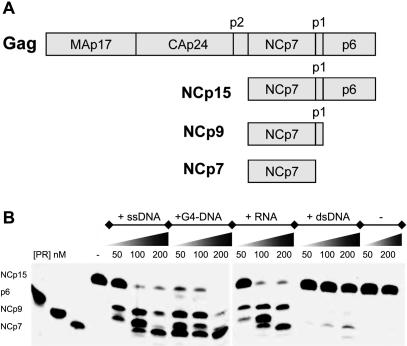
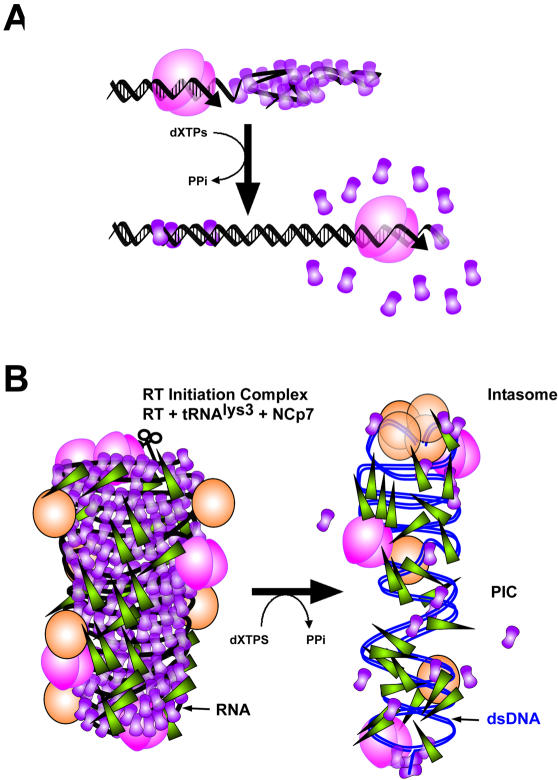
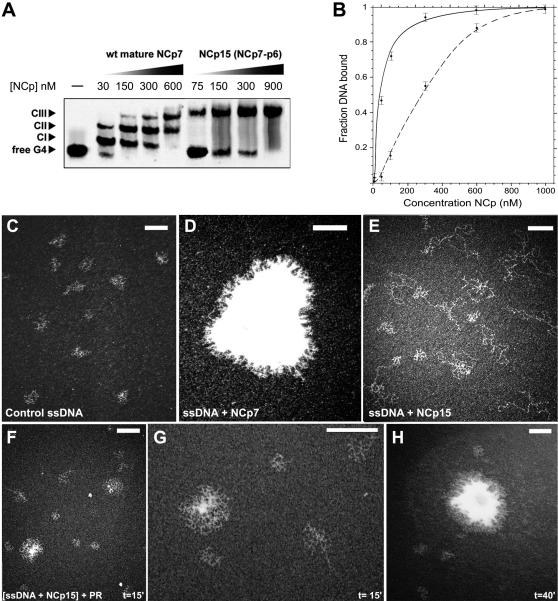
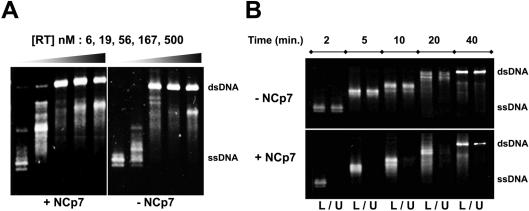
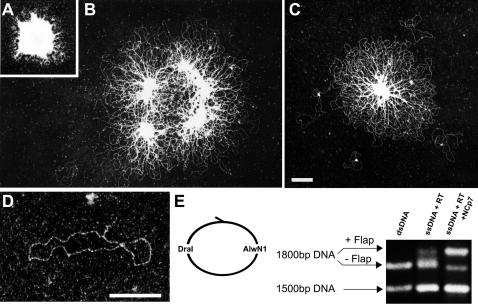
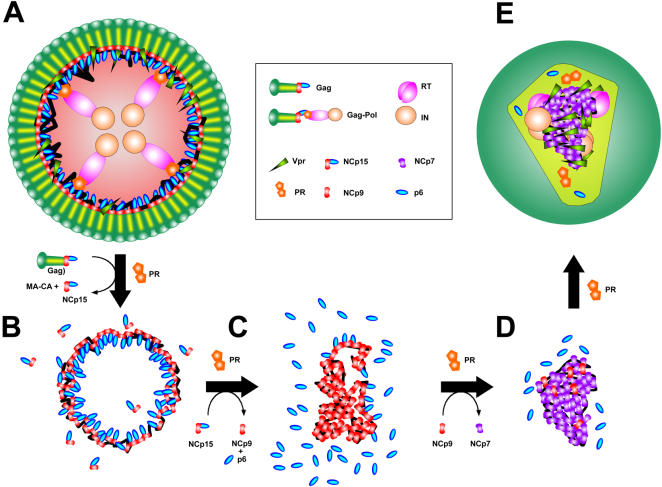
The HIV-1 nucleocapsid is formed during protease (PR)-directed viral maturation, and is transformed into pre-integration complexes following reverse transcription in the cytoplasm of the infected cell. Here, we report a detailed transmission electron microscopy analysis of the impact of HIV-1 PR and reverse transcriptase (RT) on nucleocapsid plasticity, using in vitro reconstitutions. After binding to nucleic acids, NCp15, a proteolytic intermediate of nucleocapsid protein (NC), was processed at its C-terminus by PR, yielding premature NC (NCp9) followed by mature NC (NCp7), through the consecutive removal of p6 and p1. This allowed NC co-aggregation with its single-stranded nucleic-acid substrate. Examination of these co-aggregates for the ability of RT to catalyse reverse transcription showed an effective synthesis of double-stranded DNA that, remarkably, escaped from the aggregates more efficiently with NCp7 than with NCp9. These data offer a compelling explanation for results from previous virological studies that focused on i) Gag processing leading to nucleocapsid condensation, and ii) the disappearance of NCp7 from the HIV-1 pre-integration complexes. We propose that HIV-1 PR and RT, by controlling the nucleocapsid architecture during the steps of condensation and dismantling, engage in a successive nucleoprotein-remodelling process that spatiotemporally coordinates the pre-integration steps of HIV-1. Finally we suggest that nucleoprotein remodelling mechanisms are common features developed by mobile genetic elements to ensure successful replication.
HIV-1 核衣壳是在蛋白酶(PR)指导的病毒成熟过程中形成的,在感染细胞的细胞质中逆转录后转化为整合前复合物。在这里,我们使用体外重建,报告了 HIV-1 PR 和逆转录酶(RT)对核衣壳可塑性影响的详细透射电子显微镜分析。NCp15 与核酸结合后,核衣壳蛋白(NC)的一个蛋白水解中间产物在 PR 的作用下在其 C 末端被加工,产生不成熟的 NC(NCp9),随后是成熟的 NC(NCp7),通过连续去除 p6 和 p1。这使得 NC 与它的单链核酸底物共同聚集。检查这些共聚集物中 RT 催化逆转录的能力表明,双链 DNA 的有效合成,值得注意的是,NCp7 比 NCp9 更有效地从聚集物中逃逸。这些数据为之前的病毒学研究结果提供了一个令人信服的解释,这些研究结果集中在 i)Gag 加工导致核衣壳浓缩,和 ii)NCp7 从 HIV-1 整合前复合物中消失。我们提出,HIV-1 PR 和 RT 通过在浓缩和拆解步骤中控制核衣壳结构,参与了一个连续的核蛋白重塑过程,该过程在时空上协调了 HIV-1 的整合前步骤。最后,我们认为核蛋白重塑机制是移动遗传元件为确保成功复制而开发的共同特征。