Weigelt Sarah, Singer Wolf, Muckli Lars
Department of Neurophysiology, Max Planck Institute for Brain Research, Deutschordenstr, 46, D-60528 Frankfurt am Main, Germany.
BMC Neurosci. 2007 Aug 31;8:70. doi: 10.1186/1471-2202-8-70.
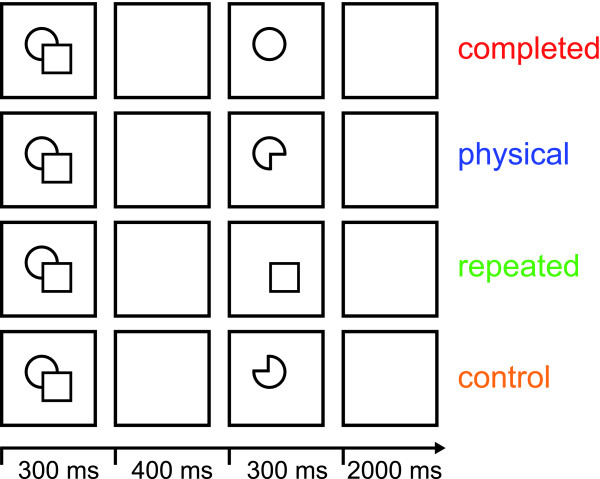
Objects in our environment are often partly occluded, yet we effortlessly perceive them as whole and complete. This phenomenon is called visual amodal completion. Psychophysical investigations suggest that the process of completion starts from a representation of the (visible) physical features of the stimulus and ends with a completed representation of the stimulus. The goal of our study was to investigate both stages of the completion process by localizing both brain regions involved in processing the physical features of the stimulus as well as brain regions representing the completed stimulus.
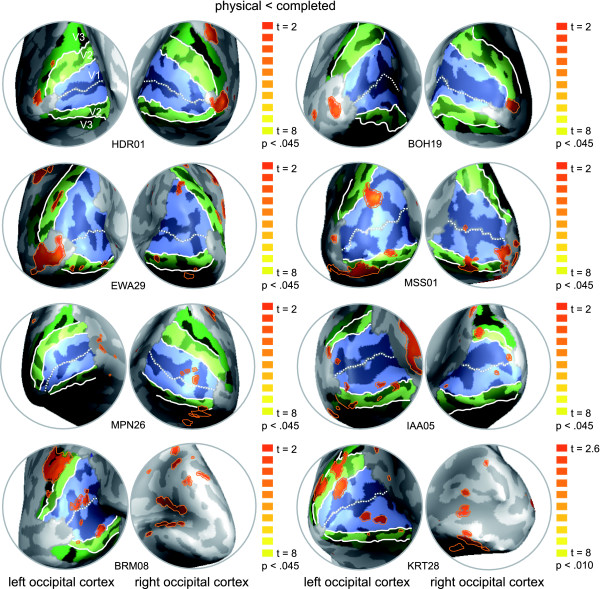
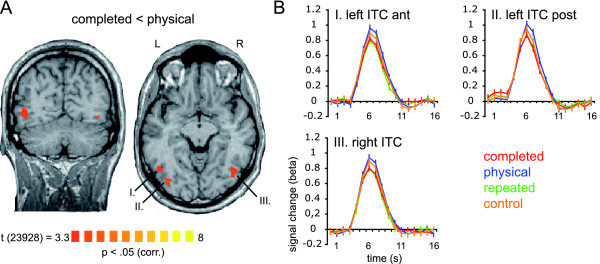
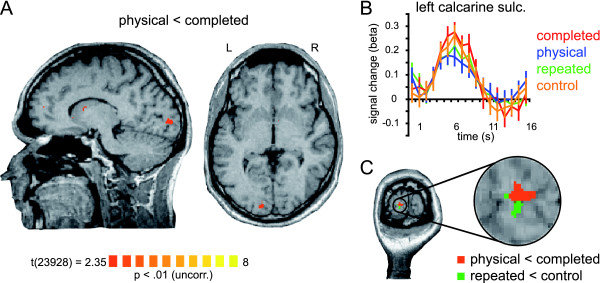
Using fMRI adaptation we reveal clearly distinct regions in the visual cortex of humans involved in processing of amodal completion: early visual cortex - presumably V1 -processes the local contour information of the stimulus whereas regions in the inferior temporal cortex represent the completed shape. Furthermore, our data suggest that at the level of inferior temporal cortex information regarding the original local contour information is not preserved but replaced by the representation of the amodally completed percept.
These findings provide neuroimaging evidence for a multiple step theory of amodal completion and further insights into the neuronal correlates of visual perception.
我们周围环境中的物体常常部分被遮挡,但我们仍能毫不费力地将它们感知为完整的整体。这种现象被称为视觉非模态完成。心理物理学研究表明,完成过程始于对刺激(可见)物理特征的表征,并以对刺激的完整表征结束。我们研究的目的是通过定位参与处理刺激物理特征的脑区以及表征完整刺激的脑区来探究完成过程的两个阶段。
使用功能磁共振成像适应技术,我们在人类视觉皮层中清晰地揭示了参与非模态完成处理的不同区域:早期视觉皮层——大概是V1——处理刺激的局部轮廓信息,而颞下皮层区域则表征完整的形状。此外,我们的数据表明,在颞下皮层水平,关于原始局部轮廓信息的信息并未保留,而是被非模态完成感知的表征所取代。
这些发现为非模态完成的多步骤理论提供了神经影像学证据,并进一步深入了解了视觉感知的神经元相关性。