Feng Weiwei, Shen Lanlan, Wen Sijin, Rosen Daniel G, Jelinek Jaroslav, Hu Xin, Huan Shaoyi, Huang Miao, Liu Jinsong, Sahin Aysegul A, Hunt Kelly K, Bast Robert C, Shen Yu, Issa Jean-Pierre J, Yu Yinhua
Department of Experimental Therapeutics, The University of Texas MD Anderson Cancer Center, 1515 Holcombe Blvd, Houston, TX 77030, USA.
Breast Cancer Res. 2007;9(4):R57. doi: 10.1186/bcr1762.
Aberrant DNA methylation has been found frequently in human breast cancers, associated with the loss of expression of a number of regulatory genes for growth and correlated to clinical outcomes. The present study was undertaken to determine whether methylation of a set of growth-suppressor genes would correlate to the expression of estrogen receptors (ERs) and progesterone receptors (PRs).
We used a pyrosequencing methylation analysis to study the methylation of 12 known growth-suppressor genes in 90 pairs of malignant/normal breast tissues. We also examined the expression of ERs and PRs in those specimens by immunohistochemistry. Mutations of p53 in tumor cells were detected by direct sequencing.
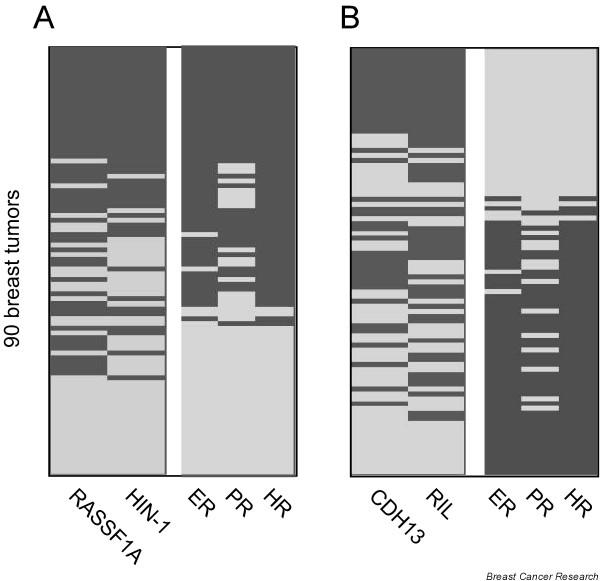
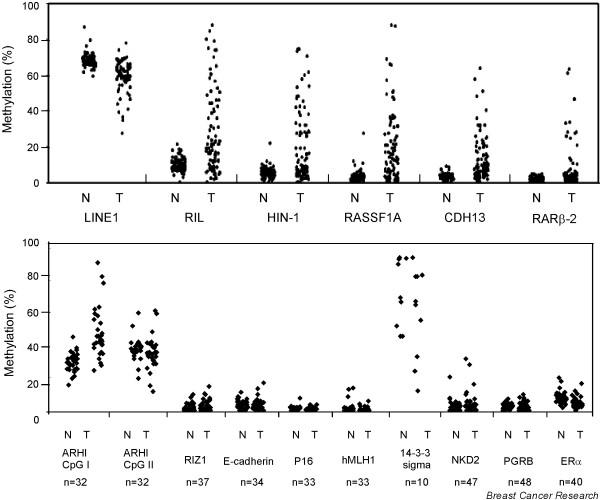
Twelve tumor-suppressor genes: ARHI, RASSF1A, HIN-1, RARbeta2, hMLH1, 14-3-3 sigma, RIZ1, p16, E-cadherin, RIL, CDH13, and NKD2 were selected for this methylation study. Five of them (RIL, HIN-1, RASSF1A, CDH13, and RARbeta2) were frequently methylated in breast cancers (57%, 49%, 58%, 44%, and 17%, respectively) but not the normal breast (0-4%). Two panels of methylation profiles were defined. The methylation of the HIN-1/RASSFIA panel strongly correlated to the expression of ERs, PRs, and hormone receptors (HRs; which were defined as 'positive' if ERs and/or PRs were positive; p < 0.001). Conversely, the methylation of the RIL/CDH13 panel strongly correlated to negative ER, PR, and HR expression (p = 0.001, 0.025, and 0.001, respectively). The subset of triple-negative breast cancers (in other words, those with negative ER, PR, and HER-2/neu status) was positively associated with the methylation of the RIL/CDH13 panel and negatively associated with the HIN-1/RASSF1A panel. Mutations of p53 were found in nine breast tumors (11%), seven of which lacked methylation in both panels.
We have defined two panels (HIN-1/RASSFIA, and RIL/CDH13) of methylation profiles, which correlated, either positively or negatively, to HR status.
异常的DNA甲基化在人类乳腺癌中频繁出现,与许多生长调节基因的表达缺失相关,并与临床结果相关。本研究旨在确定一组生长抑制基因的甲基化是否与雌激素受体(ERs)和孕激素受体(PRs)的表达相关。
我们使用焦磷酸测序甲基化分析来研究90对恶性/正常乳腺组织中12个已知生长抑制基因的甲基化情况。我们还通过免疫组织化学检测了这些标本中ERs和PRs的表达。通过直接测序检测肿瘤细胞中p53的突变。
本甲基化研究选择了12个肿瘤抑制基因:ARHI、RASSF1A、HIN-1、RARbeta2、hMLH1、14-3-3 sigma、RIZ1、p16、E-钙黏蛋白、RIL、CDH13和NKD2。其中5个基因(RIL、HIN-1、RASSF1A、CDH13和RARbeta2)在乳腺癌中频繁发生甲基化(分别为57%、49%、58%、44%和17%),而在正常乳腺中未发生甲基化(0-4%)。定义了两组甲基化谱。HIN-1/RASSFIA组的甲基化与ERs、PRs和激素受体(HRs;如果ERs和/或PRs为阳性则定义为“阳性”)的表达密切相关(p<0.001)。相反,RIL/CDH13组的甲基化与ER、PR和HR的阴性表达密切相关(分别为p = 0.001、0.025和0.001)。三阴性乳腺癌亚组(即ER、PR和HER-2/neu状态均为阴性的乳腺癌)与RIL/CDH13组的甲基化呈正相关,与HIN-1/RASSF1A组的甲基化呈负相关。在9个乳腺肿瘤(11%)中发现了p53突变;其中7个在两组中均未发生甲基化。
我们定义了两组(HIN-1/RASSFIA和RIL/CDH13)甲基化谱,它们与HR状态呈正相关或负相关。