Lee Gui Youn, Yang Woo Ick, Jeung Hei Cheul, Kim Sang Chul, Seo Min Young, Park Chan Hee, Chung Hyun Cheol, Rha Sun Young
Cancer Metastasis Research Center, National Biochip Research Center, Yonsei University College of Medicine, Seoul, Korea.
BMC Genomics. 2007 Sep 3;8:305. doi: 10.1186/1471-2164-8-305.
Thymoma is a heterogeneous group of tumors in biology and clinical behavior. Even though thymoma is divided into five subgroups following the World Health Organization classification, the nature of the disease is mixed within the subgroups.
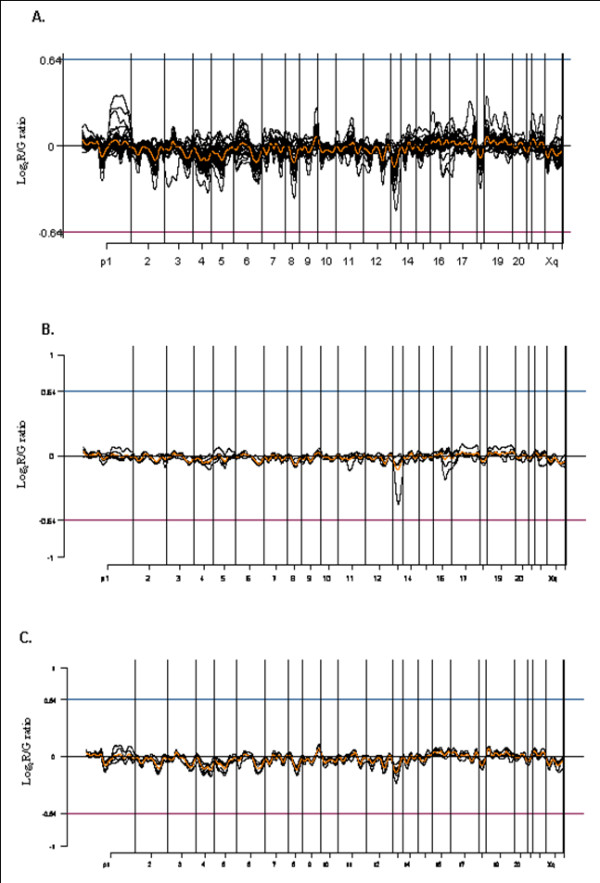
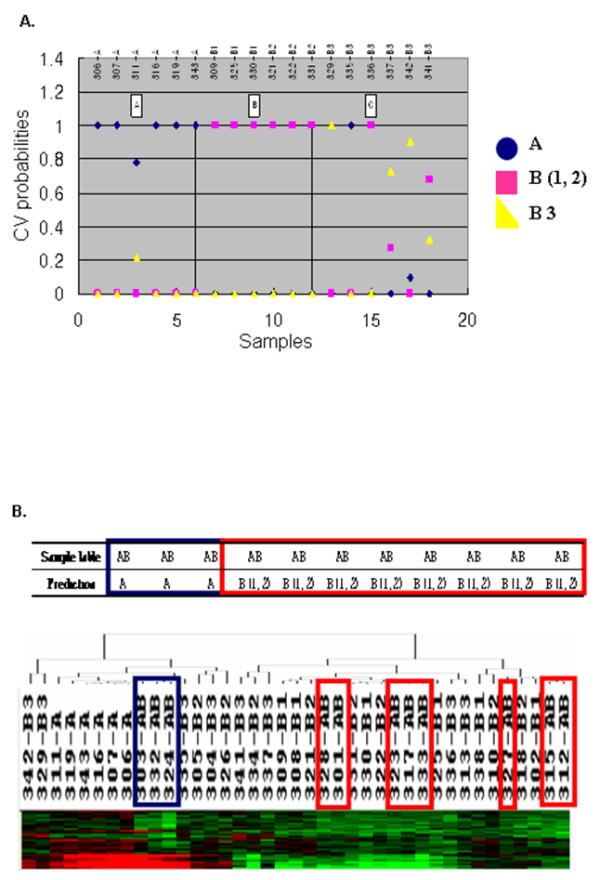
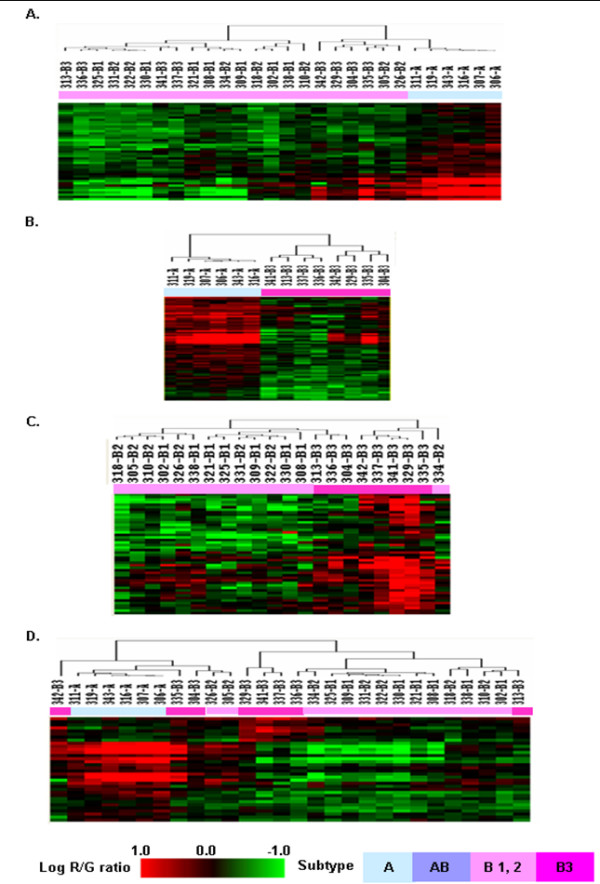
We investigated the molecular characteristics of genetic changes variation of thymoma using cDNA microarray based-comparative genomic hybridization (CGH) with a 17 K cDNA microarray in an indirect, sex-matched design. Genomic DNA from the paraffin embedded 39 thymoma tissues (A 6, AB 11, B1 7, B2 7, B3 8) labeled with Cy-3 was co-hybridized with the reference placenta gDNA labeled with Cy-5. Using the CAMVS software, we investigated the deletions on chromosomes 1, 2, 3, 4, 5, 6, 8, 12, 13 and 18 throughout the thymoma. Then, we evaluated the genetic variations of thymoma based on the subgroups and the clinical behavior. First, the 36 significant genes differentiating five subgroups were selected by Significance Analysis of Microarray. Based on these genes, type AB was suggested to be heterogeneous at the molecular level as well as histologically. Next, we observed that the thymoma was divided into A, B (1, 2) and B3 subgroups with 33 significant genes. In addition, we selected 70 genes differentiating types A and B3, which differ largely in clinical behaviors. Finally, the 11 heterogeneous AB subtypes were able to correctly assign into A and B (1, 2) types based on their genetic characteristics.
In our study, we observed the genome-wide chromosomal aberrations of thymoma and identified significant gene sets with genetic variations related to thymoma subgroups, which might provide useful information for thymoma pathobiology.
胸腺瘤在生物学和临床行为上是一组异质性肿瘤。尽管根据世界卫生组织的分类,胸腺瘤被分为五个亚组,但各亚组内疾病的性质仍存在混杂情况。
我们采用间接的、性别匹配的设计,利用基于17K cDNA微阵列的cDNA微阵列比较基因组杂交(CGH)技术,研究了胸腺瘤基因变化变异的分子特征。用Cy-3标记的来自39例石蜡包埋胸腺瘤组织(A 6例、AB 11例、B1 7例、B2 7例、B3 8例)的基因组DNA与用Cy-5标记的参考胎盘基因组DNA进行共杂交。使用CAMVS软件,我们研究了整个胸腺瘤中1、2、3、4、5、6、8、12、13和18号染色体上的缺失情况。然后,我们根据亚组和临床行为评估了胸腺瘤的基因变异。首先,通过微阵列显著性分析选择了区分五个亚组的36个显著基因。基于这些基因,AB型在分子水平以及组织学上均显示为异质性。接下来,我们观察到胸腺瘤可分为A、B(1、2)和B3亚组,有33个显著基因。此外,我们选择了70个区分A和B3型的基因,这两种类型在临床行为上差异很大。最后,11种异质性AB亚型能够根据其遗传特征正确地分为A和B(1、2)型。
在我们的研究中,我们观察到了胸腺瘤全基因组范围内的染色体畸变,并鉴定出了与胸腺瘤亚组相关的具有基因变异的显著基因集,这可能为胸腺瘤病理生物学提供有用信息。