Hejna James, Philip Sahaayaruban, Ott Jesse, Faulkner Craig, Moses Robb
Oregon Health & Science University, Department of Molecular and Medical Genetics, 3181 SW Sam Jackson Park Road, Mail Code L103, Portland, OR 97239-3098, USA.
Nucleic Acids Res. 2007;35(18):6115-23. doi: 10.1093/nar/gkm530. Epub 2007 Sep 5.
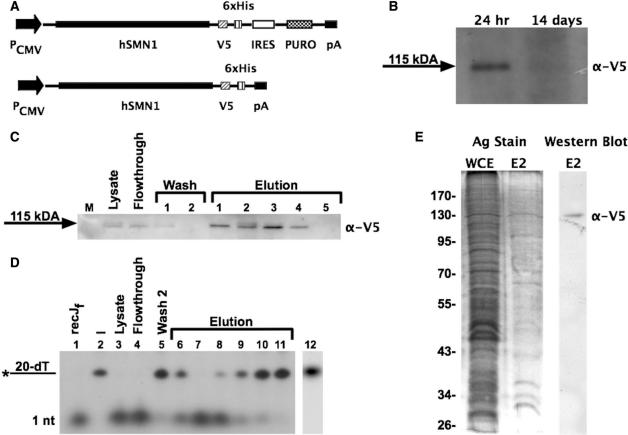
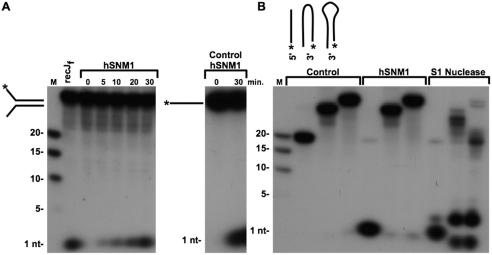
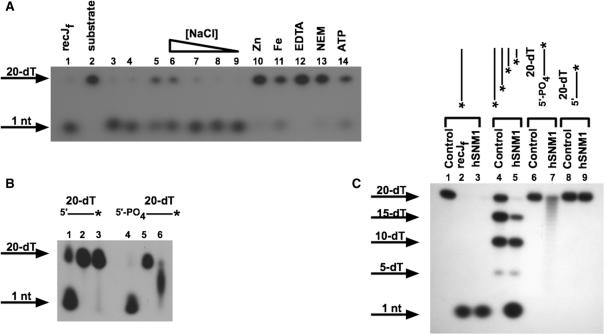
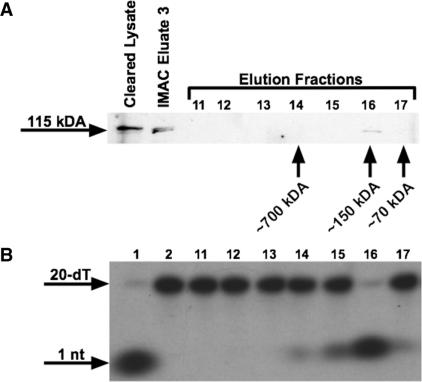
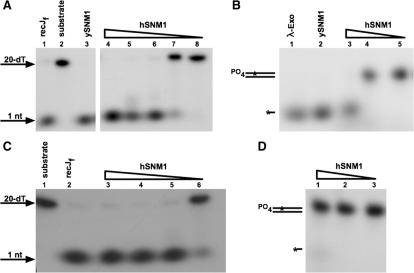
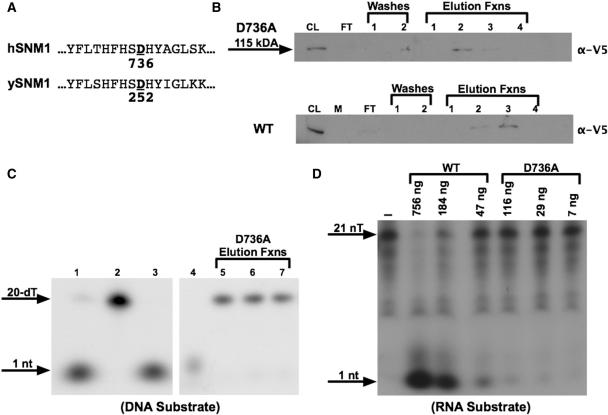
The human SNM1 protein is a member of a highly conserved group of proteins catalyzing the hydrolysis of nucleic acid substrates. Although overproduction is unstable in mammalian cells, we have overproduced a recombinant hSNM1 protein in an insect cell system. The protein is a single-strand 5'-exonuclease, like its yeast homolog. The enzyme utilizes either DNA or RNA substrates, requires a 5'-phosphate moiety, shows very little activity on double-strand substrates, and functions at a size consistent with a monomer. The exonuclease activity requires the conserved beta-lactamase domain; site-directed mutagenesis of a conserved aspartate inactivates the exonuclease.
人类SNM1蛋白是一组高度保守的蛋白质成员,可催化核酸底物的水解。尽管过量表达在哺乳动物细胞中不稳定,但我们已在昆虫细胞系统中过量表达了重组hSNM1蛋白。该蛋白是一种单链5'-外切核酸酶,与其酵母同源物类似。该酶可利用DNA或RNA底物,需要5'-磷酸部分,对双链底物的活性非常低,并且以与单体一致的大小发挥作用。外切核酸酶活性需要保守的β-内酰胺酶结构域;对保守天冬氨酸进行定点诱变会使外切核酸酶失活。