Kim Su Yeon, Pritchard Jonathan K
Department of Statistics, The University of Chicago, Chicago, Illinois, USA.
PLoS Genet. 2007 Sep;3(9):1572-86. doi: 10.1371/journal.pgen.0030147. Epub 2007 Jul 18.
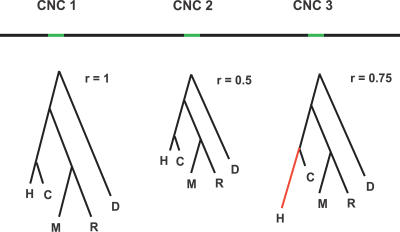
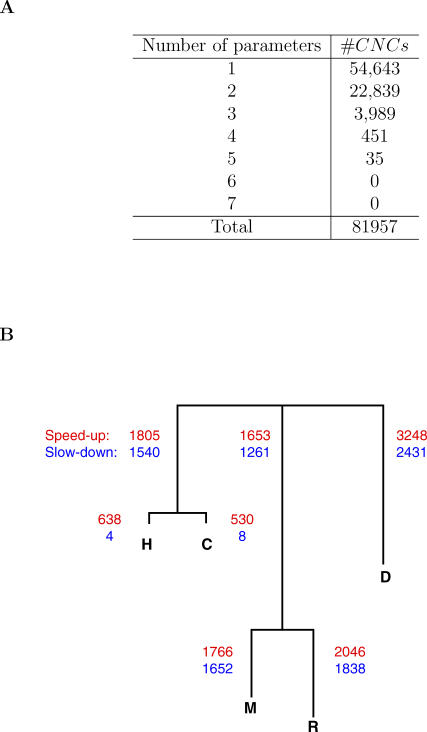
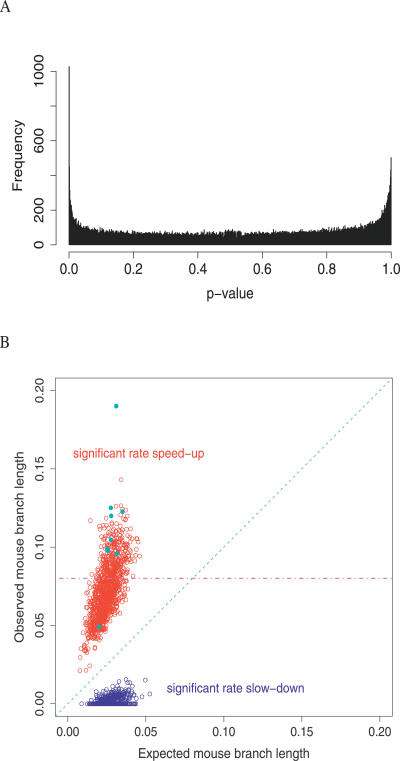
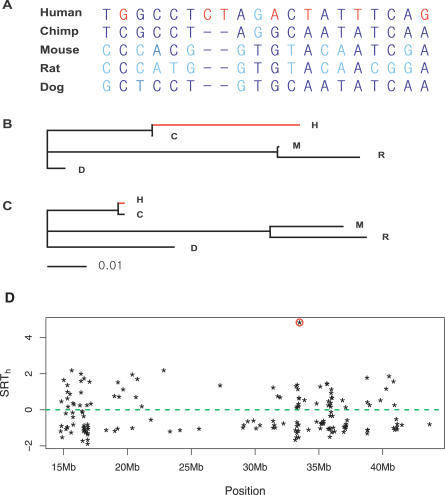
Conserved noncoding elements (CNCs) are an abundant feature of vertebrate genomes. Some CNCs have been shown to act as cis-regulatory modules, but the function of most CNCs remains unclear. To study the evolution of CNCs, we have developed a statistical method called the "shared rates test" to identify CNCs that show significant variation in substitution rates across branches of a phylogenetic tree. We report an application of this method to alignments of 98,910 CNCs from the human, chimpanzee, dog, mouse, and rat genomes. We find that approximately 68% of CNCs evolve according to a null model where, for each CNC, a single parameter models the level of constraint acting throughout the phylogeny linking these five species. The remaining approximately 32% of CNCs show departures from the basic model including speed-ups and slow-downs on particular branches and occasionally multiple rate changes on different branches. We find that a subset of the significant CNCs have evolved significantly faster than the local neutral rate on a particular branch, providing strong evidence for adaptive evolution in these CNCs. The distribution of these signals on the phylogeny suggests that adaptive evolution of CNCs occurs in occasional short bursts of evolution. Our analyses suggest a large set of promising targets for future functional studies of adaptation.
保守非编码元件(CNCs)是脊椎动物基因组的一个丰富特征。一些CNCs已被证明可作为顺式调控模块,但大多数CNCs的功能仍不清楚。为了研究CNCs的进化,我们开发了一种名为“共享速率测试”的统计方法,以识别在系统发育树各分支上显示出显著替代率变化的CNCs。我们报告了该方法在人类、黑猩猩、狗、小鼠和大鼠基因组的98910个CNCs比对中的应用。我们发现,大约68%的CNCs按照零模型进化,即对于每个CNC,单个参数模拟在连接这五个物种的整个系统发育过程中作用的约束水平。其余约32%的CNCs显示出与基本模型的偏差,包括特定分支上的加速和减速,以及偶尔在不同分支上的多次速率变化。我们发现,一部分显著的CNCs在特定分支上的进化速度明显快于局部中性速率,为这些CNCs中的适应性进化提供了有力证据。这些信号在系统发育树上的分布表明,CNCs的适应性进化发生在偶尔的短时间进化爆发中。我们的分析为未来适应性功能研究提出了大量有前景的目标。