Williamson Michelle K, Pirkis Jane, Pfaff Jon J, Tyson Orla, Sim Moira, Kerse Ngaire, Lautenschlager Nicola T, Stocks Nigel P, Almeida Osvaldo P
Centre for Health Policy, Programs and Economics, School of Population Health, University of Melbourne, Australia.
BMC Med Res Methodol. 2007 Sep 18;7:42. doi: 10.1186/1471-2288-7-42.
Recruiting and retaining GPs for research can prove difficult, and may result in sub-optimal patient participation where GPs are required to recruit patients. Low participation rates may affect the validity of research. This paper describes a multi-faceted approach to maximise participation of GPs and their patients in intervention studies, using an Australian randomised controlled trial of a depression/suicidality management intervention as a case study. The paper aims to outline experiences that may be of interest to others considering engaging GPs and/or their patients in primary care studies.
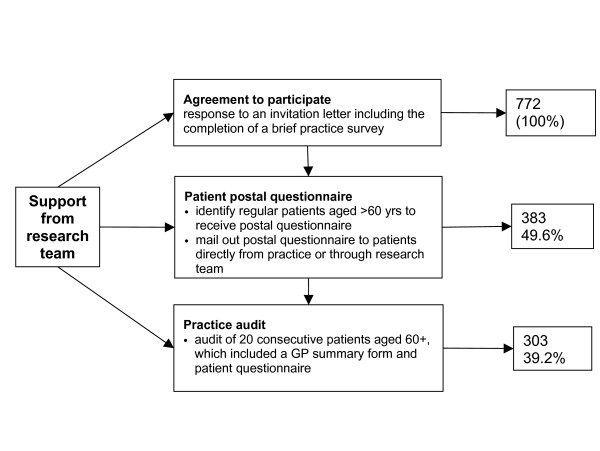
A case study approach is used to describe strategies for: (a) recruiting GPs; (b) encouraging GPs to recruit patients to complete a postal questionnaire; and (c) encouraging GPs to recruit patients as part of a practice audit. Participant retention strategies are discussed in light of reasons for withdrawal.
The strategies described, led to the recruitment of a higher than expected number of GPs (n = 772). Three hundred and eighty three GPs (49.6%) followed through with the intent to participate by sending out a total of 77,820 postal questionnaires, 22,251 (28.6%) of which were returned. Three hundred and three GPs (37.0%) participated in the practice audit, which aimed to recruit 20 patients per participating GP (i.e., a total of 6,060 older adults). In total, 5,143 patients (84.9%) were represented in the audit.
Inexpensive methods were chosen to identify and recruit GPs; these relied on an existing database, minor promotion and a letter of invitation. Anecdotally, participating GPs agreed to be involved because they had an interest in the topic, believed the study would not impinge too greatly on their time, and appreciated the professional recognition afforded by the Continuing Professional Development (CPD) points associated with study participation. The study team established a strong rapport with GPs and their reception staff, offered clear instructions, and were as flexible and helpful as possible to retain GP participants. Nonetheless, we experienced attrition due to GPs' competing demands, eligibility, personnel issues and the perceived impact of the study on patients. A summary of effective and ineffective methods for recruitment and retention is provided.
事实证明,招募和留住全科医生参与研究颇具难度,而且在需要全科医生招募患者的情况下,可能导致患者参与度欠佳。低参与率可能会影响研究的有效性。本文以澳大利亚一项抑郁症/自杀倾向管理干预随机对照试验为例,介绍了一种多方面的方法,以最大限度地提高全科医生及其患者在干预研究中的参与度。本文旨在概述其他考虑让全科医生和/或其患者参与初级保健研究的人可能感兴趣的经验。
采用案例研究方法来描述以下方面的策略:(a)招募全科医生;(b)鼓励全科医生招募患者填写邮政问卷;(c)鼓励全科医生招募患者作为实践审核的一部分。根据退出原因讨论了参与者保留策略。
所描述的策略使招募的全科医生数量高于预期(n = 772)。383名全科医生(49.6%)按计划参与,共发放了77,820份邮政问卷,其中22,251份(28.6%)被退回。303名全科医生(37.0%)参与了实践审核,该审核旨在每位参与的全科医生招募20名患者(即总共6,060名老年人)。审核中总共纳入了5,143名患者(84.9%)。
选择了低成本的方法来识别和招募全科医生;这些方法依赖于现有数据库、少量推广和一封邀请函。据传闻,参与的全科医生同意参与是因为他们对该主题感兴趣,认为该研究不会过多占用他们的时间,并且认可与参与研究相关的持续专业发展(CPD)积分所带来的专业认可。研究团队与全科医生及其接待人员建立了良好的关系,提供了明确的指示,并尽可能灵活且乐于助人以留住全科医生参与者。尽管如此,由于全科医生的其他工作需求、资格问题、人员问题以及该研究对患者的感知影响,我们仍经历了人员流失。本文提供了招募和留住参与者的有效和无效方法的总结。