Mutimura Eugene, Stewart Aimee, Crowther Nigel J
Faculty of Allied Health Sciences & Programs in HIV/AIDS Clinical Research and Community Interventions, Kigali Health Institute, B, P 3286 Kigali, Rwanda.
AIDS Res Ther. 2007 Sep 18;4:19. doi: 10.1186/1742-6405-4-19.
The introduction of HAART has initially improved the quality of life (QoL) of HIV-positive (HIV+) patients, however body fat redistribution (BFR) and metabolic disorders associated with long-term HAART use may attenuate this improvement. As access to treatment improves in sub-Saharan Africa, the disfiguring nature of BFR (peripheral atrophy and/or central adiposity) may deter treatment adherence and initiatives and decrease QoL. We examined the relationship between BFR and domains of QoL in HAART-treated HIV+ African men and women with (HIV+BFR, n = 50) and without (HIV+noBFR, n = 50) BFR in Rwanda.
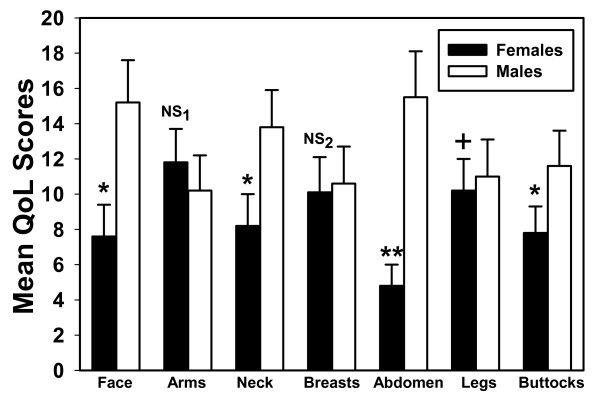
HIV+ subjects with BFR were less satisfied with their body image (4.3 +/- 0.1 versus 1.5 +/- 0.2; p < .001), self-esteem and social life (4.1 +/- 1.4 versus 2.1 +/- 0.3; p = 0.003). HIV+BFR were more ashamed in public (4.5 +/- 1.2 versus 1.1 +/- 1.1), reported less confident about their health (4.6 +/- 1.4 versus 1.5 +/- 1.2) and were frequently embarrassed due to body changes (4.1 +/- 1.1 versus 1.1 +/- 0.9) (p < .001) than HIV+noBFR. HIV+ Rwandan women with BFR reported more dissatisfaction with psychological (8.3 +/- 2.9 versus 13.7 +/- 1.9), social relationships (6.9 +/- 2.3 versus 11.1 +/- 4.1) and HIV HAART-specific domain of wellbeing (3.1 +/- 4.8 versus 6.3 +/- 3.6) (p < .001). Age was associated with independence (r2 = 0.691; p = 0.009) and marital status was associated with psychological (r2 = 0.593; p = 0.019) and social relationships (r2 = 0.493; p = 0.007). CD4 count (r2 = 0.648; p = 0.003) and treatment duration (r2 = 0.453; p = 0.003) were associated with HIV HAART-specific domain of wellbeing. HIV+ Rwandan women with BFR were significantly more affected by abdominal adiposity (p < .001), facial and buttocks atrophy (p < .05) than HIV+ men with BFR.
Body fat alterations negatively affect psychological and social domains of quality of life. These symptoms may result in stigmatization and marginalization mainly in HAART-treated African women, adversely affecting HAART adherence and treatment initiatives. Efforts to evaluate self-perceived body fat changes may improve patients' wellbeing, HAART adherence and treatment outcomes and contribute towards stability in quality of life continuum.
高效抗逆转录病毒疗法(HAART)的引入最初改善了HIV阳性(HIV+)患者的生活质量(QoL),然而,与长期使用HAART相关的体脂重新分布(BFR)和代谢紊乱可能会削弱这种改善。随着撒哈拉以南非洲地区治疗可及性的提高,BFR(外周萎缩和/或中心性肥胖)的毁容性质可能会阻碍治疗依从性和治疗积极性,并降低生活质量。我们在卢旺达对接受HAART治疗的有BFR(HIV+BFR,n = 50)和无BFR(HIV+noBFR,n = 50)的HIV+非洲男性和女性进行了研究,以探讨BFR与生活质量各领域之间的关系。
有BFR的HIV+受试者对自己的身体形象(4.3±0.1对1.5±0.2;p <.001)、自尊和社交生活(4.1±1.4对2.1±0.3;p = 0.003)的满意度较低。与HIV+noBFR相比,HIV+BFR在公共场合更感到羞耻(4.5±1.2对1.1±1.1),对自己的健康信心较低(4.6±1.4对1.5±1.2),并且经常因身体变化而感到尴尬(4.1±1.1对1.1±0.9)(p <.001)。有BFR的卢旺达HIV+女性对心理(8.3±2.9对13.7±1.9)、社会关系(6.9±2.3对11.1±4.1)和HIV HAART特定的健康领域(3.1±4.8对6.3±3.6)的不满程度更高(p <.001)。年龄与独立性相关(r2 = 0.691;p = 0.009),婚姻状况与心理(r2 = 0.593;p = 0.019)和社会关系(r2 = 0.493;p = 0.007)相关。CD4细胞计数(r2 = 0.648;p = 0.003)和治疗持续时间(r2 = 0.453;p = 0.003)与HIV HAART特定的健康领域相关。与有BFR的HIV+男性相比,有BFR的卢旺达HIV+女性受腹部肥胖(p <.001)、面部和臀部萎缩(p <.05)的影响更大。
体脂改变对生活质量的心理和社会领域产生负面影响。这些症状可能主要导致接受HAART治疗的非洲女性受到污名化和边缘化,对HAART依从性和治疗积极性产生不利影响。评估自我感知的体脂变化的努力可能会改善患者的健康状况、HAART依从性和治疗结果,并有助于维持生活质量的连续性。