Green A J, Bazata D D, Fox K M, Grandy S
Midwestern Endocrinology, Overland Park, KS, USA.
Int J Clin Pract. 2007 Nov;61(11):1791-7. doi: 10.1111/j.1742-1241.2007.01588.x. Epub 2007 Sep 20.
The study assessed knowledge, attitudes and behaviours towards health, diabetes, diet and exercise among respondents with type 2 diabetes mellitus and those with cardiometabolic risk factors.
Respondents in the SHIELD study reported their health conditions, exercise, diet and weight loss. Three groups were assessed: (i) type 2 diabetes, (ii) high risk (HR) defined as 3-5 of the following factors: abdominal obesity, BMI > or = 28 kg/m(2), reported diagnosis of dyslipidaemia, hypertension, coronary heart disease or stroke and (iii) low risk (LR) defined as < or = 2 factors. Comparisons across groups were made using analysis of variance.
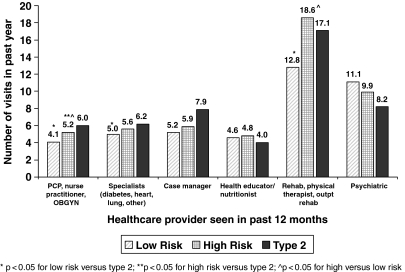
More type 2 diabetes and HR respondents (> 46%) received recommendations to change their lifestyle habits (increase exercise and change eating habits), compared with < 29% of LR respondents, p < 0.0001. Less than 25% of respondents agreed that type 2 diabetes is not as serious as type 1 diabetes and > 85% agreed that obesity can aggravate or contribute to onset of chronic conditions. Mean number of healthcare visits was highest in type 2 diabetes (11.0) than HR (9.4) and LR (6.1) groups, p < 0.05. Type 2 diabetes and HR respondents were least likely to report exercising regularly (26%), compared with LR (37%), p < 0.05. More type 2 diabetes (70%) and HR (72%) respondents reported trying to lose weight vs. LR respondents (55%), p < 0.05.
Type 2 diabetes and HR respondents reported attitudes and knowledge conducive to good health, but the majority of respondents did not translate these positive traits into healthy behaviour with respect to diet, exercise and weight loss.
本研究评估了2型糖尿病患者以及具有心血管代谢危险因素的人群对健康、糖尿病、饮食和运动的知识、态度及行为。
SHIELD研究中的受访者报告了他们的健康状况、运动、饮食和体重减轻情况。评估了三组人群:(i)2型糖尿病患者;(ii)高危(HR)组,定义为具有以下3 - 5项因素:腹型肥胖、BMI≥28kg/m²、报告诊断为血脂异常、高血压、冠心病或中风;(iii)低危(LR)组,定义为具有≤2项因素。采用方差分析对各组进行比较。
与LR组不到29%的受访者相比,更多的2型糖尿病患者和HR组受访者(>46%)收到了改变生活方式习惯(增加运动和改变饮食习惯)的建议,p<0.0001。不到25%的受访者认为2型糖尿病不如1型糖尿病严重,超过85%的受访者认为肥胖会加重或导致慢性病的发生。2型糖尿病组的平均医疗就诊次数最高(11.0次),高于HR组(9.4次)和LR组(6.1次),p<0.05。2型糖尿病患者和HR组受访者定期锻炼的可能性最小(26%),而LR组为37%,p<0.05。更多的2型糖尿病患者(70%)和HR组受访者(72%)报告尝试减肥,而LR组受访者为55%,p<0.05。
2型糖尿病患者和HR组受访者报告了有利于健康的态度和知识,但大多数受访者未将这些积极特征转化为在饮食、运动和减肥方面的健康行为。