Wright P, Smith A, Roberts K, Selby P, Velikova G
Psychosocial and Clinical Practice Research Group, Cancer Research UK, Clinical Centre in Leeds, St James's University Hospital, Leeds LS9 7TF, UK.
Br J Cancer. 2007 Oct 22;97(8):1063-70. doi: 10.1038/sj.bjc.6604006. Epub 2007 Sep 25.
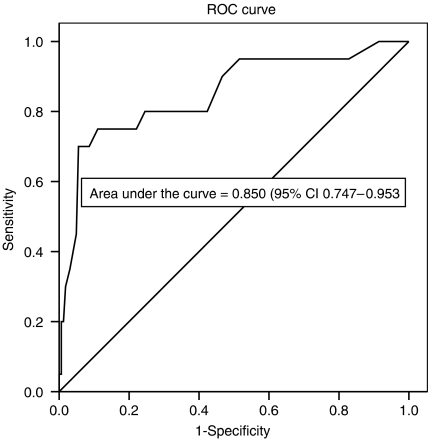
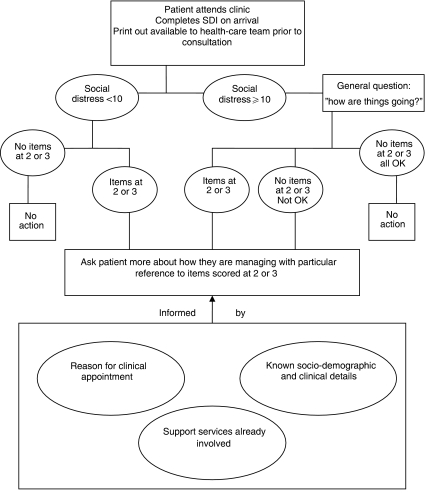
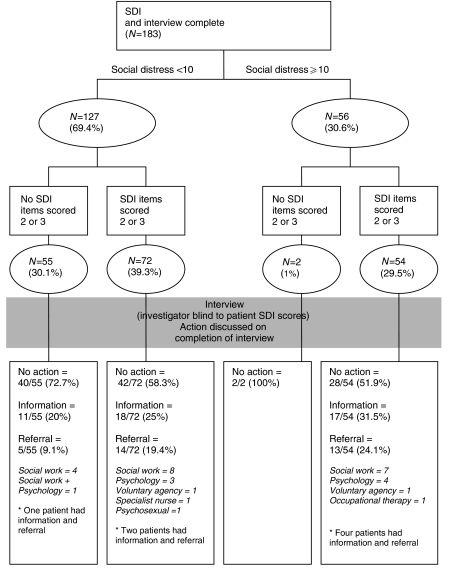
Guidelines for psychosocial support have been developed, but there are no standard approaches in routine oncology practice to identify patients experiencing social difficulties. We have designed and evaluated a Social Difficulties Inventory (SDI) to identify patients requiring further assessment and, where appropriate, referral to support services. The purpose of this study was to develop a clinically meaningful SDI scoring system with guidance for oncology staff. Out of 189 patients, 183 completed the SDI and were interviewed by a social work researcher who scored the SDI independently. Comparison of patient/interviewer assessment was good (intraclass correlation 0.61, 95% confidence interval: 0.51, 0.70). Using top 10% of interviewer social distress (SD) scores to indicate 'SD case', the best 'cut-point' was a patient score of > or =10 (sensitivity=0.80; specificity=0.76; 56 out of 183 'cases'). Out of 127 patients, 72 with SD score <10 had individual SDI item rated at a higher level. Following interview, 32 patients were referred to specialist services, 46 given information and 112 had no action taken. An interpretation algorithm developed includes SD score, individual SDI item rating, and an additional general question, illustrated using four case scenarios. In conclusion, general guidance for interpreting the SDI has been developed to enhance health-care professional/patient consultations with a view to identifying patients who may benefit from support, advice or intervention.
心理社会支持指南已经制定出来,但在肿瘤学常规实践中,尚无标准方法来识别有社会困难的患者。我们设计并评估了一份社会困难量表(SDI),以识别需要进一步评估的患者,并在适当情况下将其转介至支持服务机构。本研究的目的是开发一种具有临床意义的SDI评分系统,并为肿瘤学工作人员提供指导。在189名患者中,183名完成了SDI量表,并由一名社会工作研究人员进行访谈,该研究人员独立对SDI进行评分。患者/访谈者评估的比较结果良好(组内相关系数为0.61,95%置信区间:0.51,0.70)。使用访谈者社会困扰(SD)得分最高的10%来表示“SD病例”,最佳“切点”是患者得分≥10(敏感性=0.80;特异性=0.76;183例“病例”中有56例)。在127名患者中,72名SD得分<10的患者的SDI单项评分更高。访谈后,32名患者被转介至专科服务机构,46名患者获得了信息,112名患者未采取任何行动。开发的一种解读算法包括SD得分、SDI单项评分以及一个额外的一般性问题,并通过四个病例场景进行说明。总之,已制定了关于解读SDI的一般指南,以加强医护人员/患者之间的咨询,从而识别可能从支持、建议或干预中受益的患者。