Klapholz-Brown Zach, Walmsley Graham G, Nusse Ysbrand M, Nusse Roel, Brown Patrick O
Department of Biochemistry, Stanford University School of Medicine, Stanford, California, USA.
PLoS One. 2007 Sep 26;2(9):e945. doi: 10.1371/journal.pone.0000945.
The Wnt signaling system plays key roles in development, regulation of stem cell self-renewal and differentiation, cell polarity, morphogenesis and cancer. Given the multifaceted roles of Wnt signaling in these processes, its transcriptional effects on the stromal cells that make up the scaffold and infrastructure of epithelial tissues are of great interest.
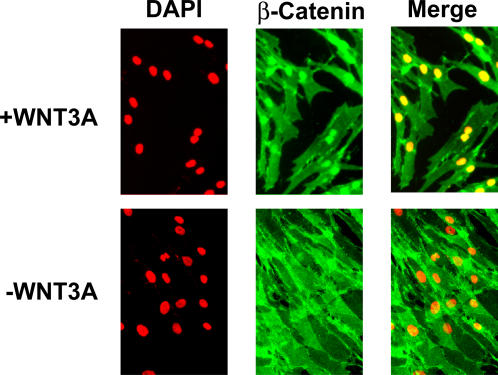
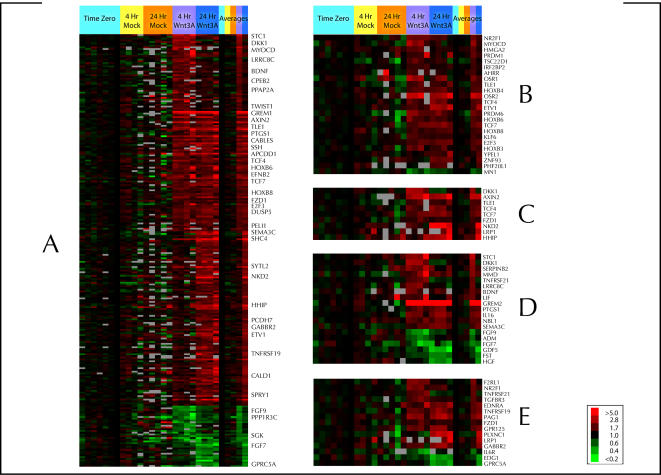
To begin to investigate these effects, we used DNA microarrays to identify transcriptional targets of the Wnt pathway in human lung fibroblasts. Cells were treated with active Wnt3a protein in culture, and RNA was harvested at 4 hours and 24 hours. Nuclear accumulation of ss-Catenin, as shown by immunofluorescence, and induction of AXIN2 demonstrate that fibroblasts are programmed to respond to extracellular Wnt signals. In addition to several known Wnt targets, we found many new Wnt induced genes, including many transcripts encoding regulatory proteins. Transcription factors with important developmental roles, including HOX genes, dominated the early transcriptional response. Furthermore, we found differential expression of several genes that play direct roles in the Wnt signaling pathway, as well as genes involved in other cell signaling pathways including fibroblast growth factor (FGF) and bone morphogenetic protein (BMP) signaling. The gene most highly induced by Wnt3a was GREMLIN2, which encodes a secreted BMP antagonist.
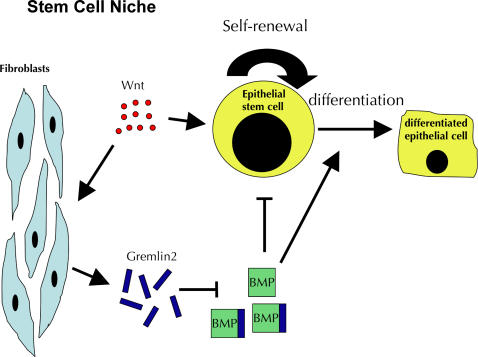
Elevated expression of GREMLIN2 suggests a new role for Wnt signals in the maintenance of stem cell niches, whereby Wnt signals induce nearby fibroblasts to produce a BMP antagonist, inhibiting differentiation and promoting expansion of stem cells in their microenvironment. We suggest that Wnt-induced changes in the gene expression program of local stromal cells may play an important role in the establishment of specialized niches hospitable to the self-renewal of normal or malignant epithelial stem cells in vivo.
Wnt信号系统在发育、干细胞自我更新与分化的调控、细胞极性、形态发生及癌症中发挥着关键作用。鉴于Wnt信号在这些过程中的多方面作用,其对构成上皮组织支架和基础结构的基质细胞的转录影响备受关注。
为了开始研究这些影响,我们使用DNA微阵列来鉴定人肺成纤维细胞中Wnt通路的转录靶点。在培养中用活性Wnt3a蛋白处理细胞,并在4小时和24小时收获RNA。免疫荧光显示的β-连环蛋白核积累以及AXIN2的诱导表明成纤维细胞被编程为对细胞外Wnt信号作出反应。除了几个已知的Wnt靶点外,我们还发现了许多新的Wnt诱导基因,包括许多编码调节蛋白的转录本。具有重要发育作用的转录因子,包括HOX基因,主导了早期转录反应。此外,我们发现了几个在Wnt信号通路中起直接作用的基因以及参与其他细胞信号通路(包括成纤维细胞生长因子(FGF)和骨形态发生蛋白(BMP)信号通路)的基因的差异表达。Wnt3a诱导程度最高的基因是GREMLIN2,它编码一种分泌型BMP拮抗剂。
GREMLIN2表达升高表明Wnt信号在干细胞龛维持中具有新作用,即Wnt信号诱导附近的成纤维细胞产生BMP拮抗剂,抑制分化并促进干细胞在其微环境中的扩增。我们认为Wnt诱导的局部基质细胞基因表达程序变化可能在体内建立有利于正常或恶性上皮干细胞自我更新的特殊龛中起重要作用。