Bloemink M J, Adamek N, Reggiani C, Geeves M A
Protein Science Group, Department of Biosciences, University of Kent, Canterbury, Kent CT2 7NJ, UK.
J Mol Biol. 2007 Nov 9;373(5):1184-97. doi: 10.1016/j.jmb.2007.08.050. Epub 2007 Aug 28.
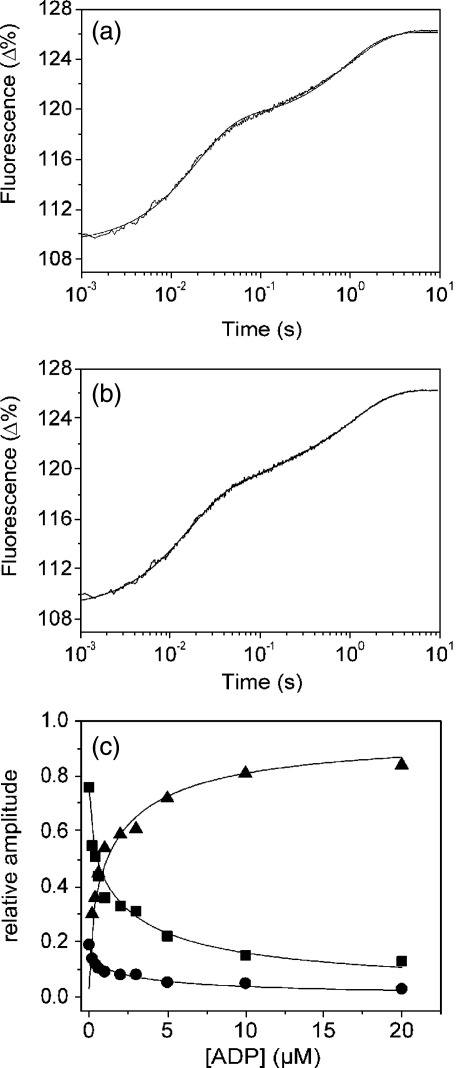
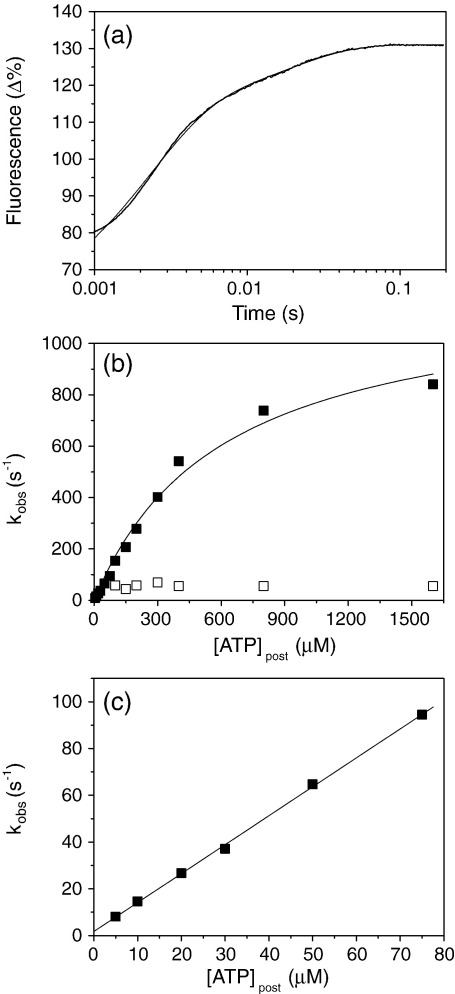
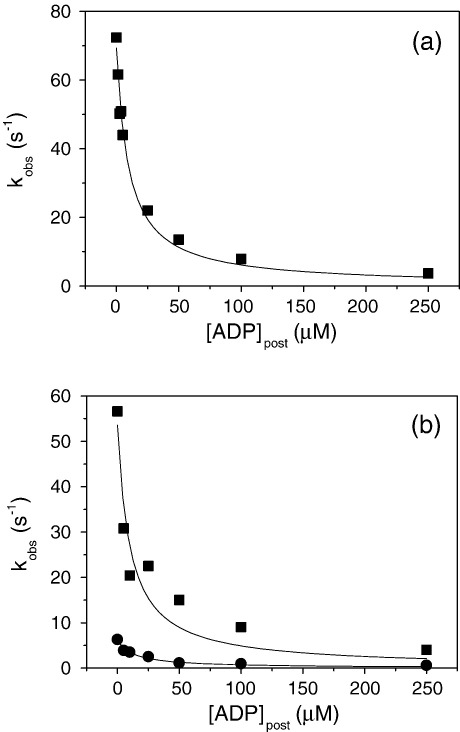
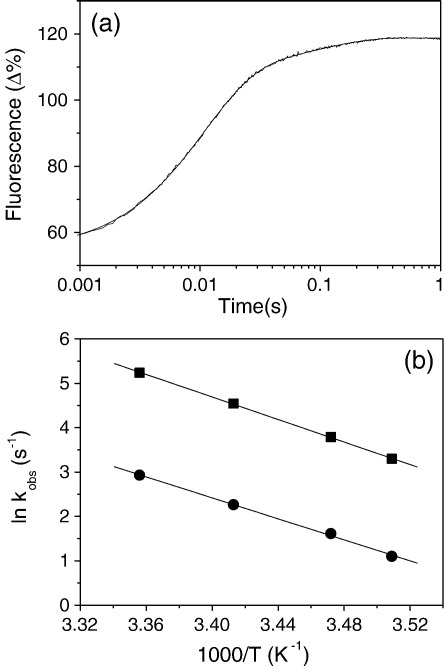
Several heavy chain isoforms of class II myosins are found in muscle fibres and show a large variety of different mechanical activities. Fast myosins (myosin heavy chain (MHC)-II-2) contract at higher velocities than slow myosins (MHC-II-1, also known as beta-myosin) and it has been well established that ADP binding to actomyosin is much tighter for MHC-II-1 than for MHC-II-2. Recently, we reported several other differences between MHC-II isoforms 1 and 2 of the rabbit. Isoform II-1 unlike II-2 gave biphasic dissociation of actomyosin by ATP, the ATP-cleavage step was significantly slower for MHC-II-1 and the slow isoforms showed the presence of multiple actomyosin-ADP complexes. These results are in contrast to published data on MHC-II-1 from bovine left ventricle muscle, which was more similar to the fast skeletal isoform. Bovine MHC-II-1 is the predominant isoform expressed in both the ventricular myocardium and slow skeletal muscle fibres such as the masseter and is an important source of reference work for cardiac muscle physiology. This work examines and extends the kinetics of bovine MHC-II-1. We confirm the primary findings from the work on rabbit soleus MHC-II-1. Of significance is that we show that the affinity of ADP for bovine masseter myosin in the absence of actin (represented by the dissociation constant K(D)) is weaker than originally described for bovine cardiac myosin and thus the thermodynamic coupling between ADP and actin binding to myosin is much smaller (K(AD)/K(D) approximately 5 instead of K(AD)/K(D) approximately 50). This may indicate a distinct type of mechanochemical coupling for this group of myosin motors. We also find that the ATP-hydrolysis rate is much slower for bovine MHC-II-1 (19 s(-1)) than reported previously (138 s(-1)). We discuss how this work fits into a broader characterisation of myosin motors from across the myosin family.
在肌纤维中发现了几种II类肌球蛋白的重链异构体,它们表现出多种多样的不同机械活性。快肌球蛋白(肌球蛋白重链(MHC)-II-2)的收缩速度比慢肌球蛋白(MHC-II-1,也称为β-肌球蛋白)快,并且已经明确,ADP与肌动球蛋白的结合对于MHC-II-1比MHC-II-2紧密得多。最近,我们报道了兔MHC-II异构体1和2之间的其他几个差异。与II-2不同,异构体II-1通过ATP使肌动球蛋白发生双相解离,MHC-II-1的ATP裂解步骤明显较慢,并且慢异构体显示存在多种肌动球蛋白-ADP复合物。这些结果与来自牛左心室肌肉的MHC-II-1的已发表数据形成对比,后者与快速骨骼肌异构体更相似。牛MHC-II-1是在心室心肌和诸如咬肌等慢骨骼肌纤维中表达的主要异构体,并且是心肌生理学参考工作的重要来源。这项工作研究并扩展了牛MHC-II-1的动力学。我们证实了对兔比目鱼肌MHC-II-1研究的主要发现。重要的是,我们表明在没有肌动蛋白的情况下,ADP对牛咬肌肌球蛋白的亲和力(由解离常数K(D)表示)比最初描述的牛心肌肌球蛋白弱,因此ADP与肌动蛋白结合到肌球蛋白之间的热力学偶联要小得多(K(AD)/K(D)约为5而不是K(AD)/K(D)约为50)。这可能表明这组肌球蛋白马达存在一种独特的机械化学偶联类型。我们还发现牛MHC-II-1的ATP水解速率(19 s(-1))比先前报道的(138 s(-1))慢得多。我们讨论了这项工作如何与来自整个肌球蛋白家族的肌球蛋白马达的更广泛表征相契合。