Valenzuela José Ignacio, Arguello Arturo, Cendales Juan Gabriel, Rizo Carlos A
Centro de Educaciön Virtual y Simulaciön e-Health, Divisiön de Educaciön, Fundaciön Santa Fe de Bogotá, Bogotá, Colombia.
J Med Internet Res. 2007 Oct 22;9(4):e33. doi: 10.2196/jmir.9.4.e33.
Fourteen years after the reform to Colombia's health system, the promises of universality, improved equity, efficiency, and better quality of care have not materialized. Remote areas remain underserved and access to care very limited. Recognizing teleconsultation as an effective way to improve access to health care and health information, a noncommercial open-access Web-based application for teleconsultation called Doctor Chat was developed.
The objective was to report the experience of the Center for Virtual Education and Simulation eHealth (Centro de Educación Virtual y Simulación e-Salud) with open-access Web-based asynchronous teleconsultation for consumers in Colombia.
A teleconsultation service in Spanish was developed and implemented in 2006. Teleconsultation requests were classified on three axes: (1) the purpose of the query, (2) the specialty, and (3) the geographic area of the query. Content analysis was performed on the free-text queries submitted to Doctor Chat, and descriptive statistics were gathered for each of the data categories (name, email, city, country, age, and gender).
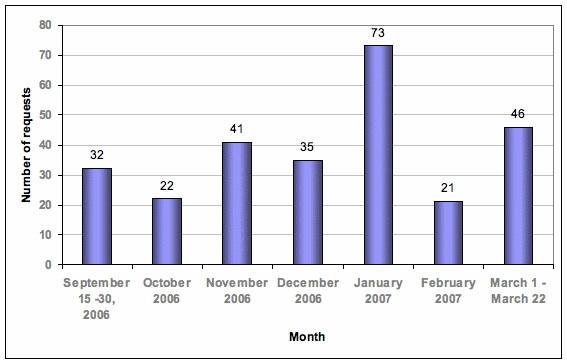
From September 2006 to March 2007, there were 270 asynchronous teleconsultations documented from 102 (37.8%) men and 168 (62.2%) women. On average, 1.4 requests were received per day. By age group, the largest number of requests (n = 80; 30%) were from users 24-29 years, followed by users (n = 66; 24%) 18-23 years. Requests were mainly from Colombia (n = 204; 75.6%) but also from Spain (n = 17; 6.3%), Mexico (n = 11; 4.1%), and other countries. In Colombia, 137 requests (67.2%) originated in Bogotá, the nation's capital, 25 (12.4%) from other main cities of the country, 40 (19.7%) from intermediate cities, and 2 (0.7%) from remote areas. The purpose of the majority of requests was for information about symptoms, health-related problems, or diseases (n = 149; 55.2%) and medications/treatments (n = 70; 25.9%). By specialty, information was most requested for gynecology and obstetrics (n = 71; 26%), dermatology (n = 28; 10%), urology (n = 22; 8%), and gastroenterology (n = 18; 7%), with anesthesiology, critical care, physical medicine and rehabilitation, and pathology being the least requested (n = 0; 0%). Overall, sexual and reproductive health (n = 93; 34%) issues constituted the main query subject. The average time to deliver a response was 120 hours in 2006 and 59 hours in 2007. Only 19 out of 270 users (7%) completed a survey with comments and perceptions about the system, of which 18 out of 19 (95%) corresponded to positive perceptions and 1 out of 19 (5%) expressed dissatisfaction with the service.
The implementation of a Web-based teleconsulting service in Colombia appeared to be an innovative way to improve access to health care and information in the community and encouraged open and explicit discussion. Extending the service to underserved areas could improve access to health services and health information and could potentially improve economic indicators such as waiting times for consultations and the rate of pregnancy among teenagers; however, cultural, infrastructural, and Internet connectivity barriers are to be solved before successful implementation can derive population-wide positive impacts.
在哥伦比亚卫生系统改革14年后,普及医疗、改善公平性、提高效率以及提升医疗质量的承诺并未实现。偏远地区仍然医疗服务不足,获得医疗服务的机会非常有限。认识到远程会诊是改善医疗服务和健康信息获取的有效方式,开发了一款名为“医生聊天”的非商业性基于网络的开放式远程会诊应用程序。
报告虚拟教育与模拟电子健康中心(Centro de Educación Virtual y Simulación e-Salud)为哥伦比亚消费者提供基于网络的开放式异步远程会诊的经验。
2006年开发并实施了一项西班牙语远程会诊服务。远程会诊请求按三个维度分类:(1)查询目的,(2)专业,(3)查询的地理区域。对提交给“医生聊天”的自由文本查询进行内容分析,并收集每个数据类别(姓名、电子邮件、城市、国家、年龄和性别)的描述性统计数据。
2006年9月至2007年3月,记录了270次异步远程会诊,其中男性102例(37.8%),女性168例(62.2%)。平均每天收到1.4个请求。按年龄组划分,请求数量最多的是24 - 29岁的用户(n = 80;30%),其次是18 - 23岁的用户(n = 66;24%)。请求主要来自哥伦比亚(n = 204;75.6%),但也来自西班牙(n = 17;6.3%)、墨西哥(n = 11;4.1%)和其他国家。在哥伦比亚,137个请求(67.2%)来自首都波哥大,25个(12.4%)来自该国其他主要城市,40个(19.7%)来自中等城市,2个(0.7%)来自偏远地区。大多数请求的目的是获取有关症状、健康相关问题或疾病的信息(n = 149;55.2%)以及药物/治疗信息(n = 70;25.9%)。按专业划分,对妇产科(n = 71;26%)、皮肤科(n = 28;10%)、泌尿科(n = 22;8%)和胃肠病学(n = 18;7%)的信息需求最多,而麻醉学、重症监护、物理医学与康复以及病理学的需求最少(n = 0;0%)。总体而言,性健康和生殖健康问题(n = 93;34%)是主要查询主题。2006年回复的平均时间为120小时,2007年为59小时。270名用户中只有19名(7%)完成了关于该系统的评论和看法的调查,其中19名中的18名(95%)给出了积极评价,19名中的1名(5%)对服务表示不满。
在哥伦比亚实施基于网络的远程会诊服务似乎是改善社区医疗服务和信息获取的一种创新方式,并鼓励了开放和明确的讨论。将该服务扩展到医疗服务不足的地区可以改善医疗服务和健康信息的获取,并有可能改善经济指标,如会诊等待时间和青少年怀孕率;然而,在成功实施并产生广泛的积极影响之前,文化、基础设施和互联网连接障碍有待解决。