Cramer J A, Benedict A, Muszbek N, Keskinaslan A, Khan Z M
Yale University School of Medicine, West Haven, CT 06516-2770, USA.
Int J Clin Pract. 2008 Jan;62(1):76-87. doi: 10.1111/j.1742-1241.2007.01630.x. Epub 2007 Nov 5.
To review studies of patient compliance/persistence with cardiovascular or antidiabetic medication published since the year 2000; to compare the methods used to measure compliance/persistence across studies; to compare reported compliance/persistence rates across therapeutic classes and to assess whether compliance/persistence correlates with clinical outcomes.
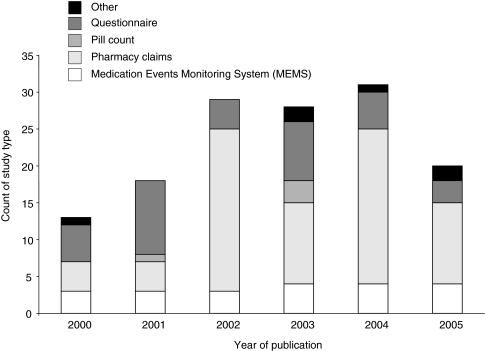
English language papers published between January 2000 and November 2005 investigating patient compliance/persistence with cardiovascular or antidiabetic medication were identified through searches of the MEDLINE and EMBASE databases. Definitions and measurements of compliance/persistence were compared across therapeutic areas using contingency tables.
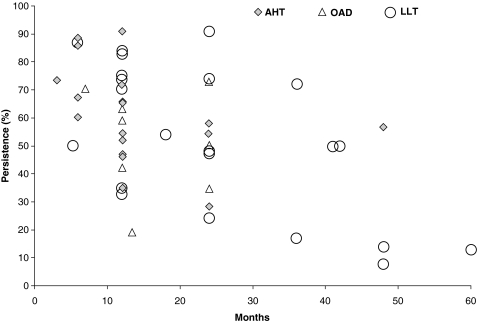
Of the 139 studies analysed, 32% focused on hypertension, 27% on diabetes and 13% on dyslipidaemia. The remainder covered coronary heart disease and cardiovascular disease (CVD) in general. The most frequently reported measure of compliance was the 12-month medication possession ratio (MPR). The overall mean MPR was 72%, and the MPR did not differ significantly between treatment classes (range: 67-76%). The average proportion of patients with an MPR of >80% was 59% overall, 64% for antihypertensives, 58% for oral antidiabetics, 51% for lipid-lowering agents and 69% in studies of multiple treatments, again with no significant difference between treatment classes. The average 12-month persistence rate was 63% and was similar across therapeutic classes. Good compliance had a positive effect on outcome in 73% of the studies examining clinical outcomes.
Non-compliance with cardiovascular and antidiabetic medication is a significant problem, with around 30% of days 'on therapy' not covered by medication and only 59% of patients taking medication for more than 80% of their days 'on therapy' in a year. Good compliance has a positive effect on clinical outcome, suggesting that the management of CVD may be improved by improving patient compliance.
回顾2000年以来发表的关于患者对心血管或抗糖尿病药物依从性/持续性的研究;比较各研究中用于测量依从性/持续性的方法;比较不同治疗类别报告的依从性/持续性率,并评估依从性/持续性是否与临床结果相关。
通过检索MEDLINE和EMBASE数据库,确定2000年1月至2005年11月期间发表的研究患者对心血管或抗糖尿病药物依从性/持续性的英文论文。使用列联表比较不同治疗领域中依从性/持续性的定义和测量方法。
在分析的139项研究中,32%关注高血压,27%关注糖尿病,13%关注血脂异常。其余研究总体涵盖冠心病和心血管疾病(CVD)。最常报告的依从性测量指标是12个月药物持有率(MPR)。总体平均MPR为72%,不同治疗类别之间的MPR无显著差异(范围:67 - 76%)。MPR>80%的患者总体平均比例为59%,抗高血压药物为64%,口服抗糖尿病药物为58%,降脂药物为51%,多种治疗研究中为69%,不同治疗类别之间同样无显著差异。平均12个月持续性率为63%,不同治疗类别相似。在73%的检查临床结果的研究中,良好的依从性对结果有积极影响。
不依从心血管和抗糖尿病药物是一个重大问题,约30%的“治疗日”未用药,且一年中仅59%的患者在超过80%的“治疗日”服用药物。良好的依从性对临床结果有积极影响,表明改善患者依从性可能会改善心血管疾病的管理。