Keppetipola Niroshika, Shuman Stewart
Molecular Biology Program, Sloan-Kettering Institute, New York, NY 10021, USA.
Nucleic Acids Res. 2007;35(22):7721-32. doi: 10.1093/nar/gkm868. Epub 2007 Nov 5.
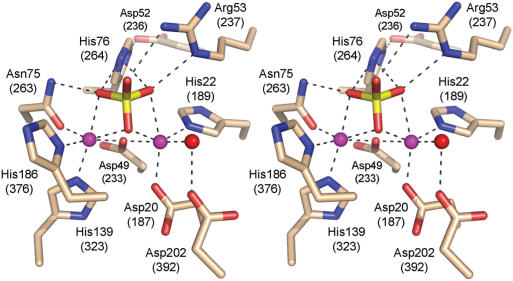
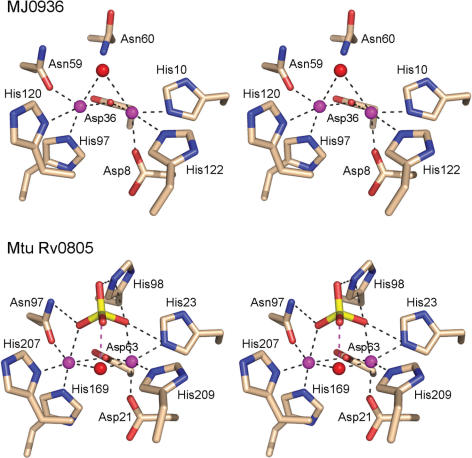
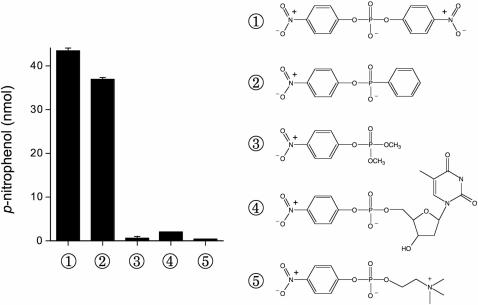
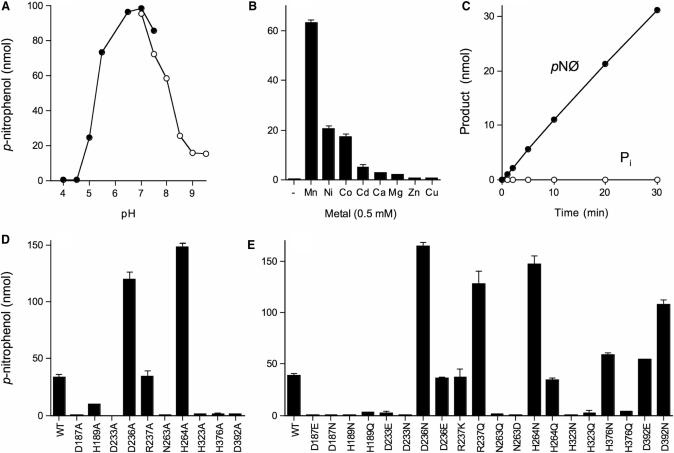
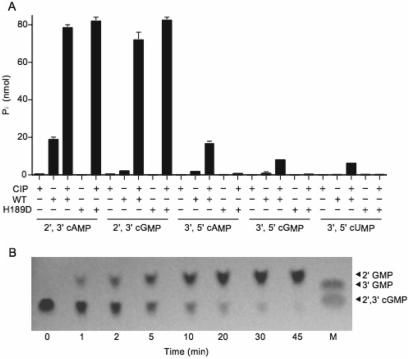
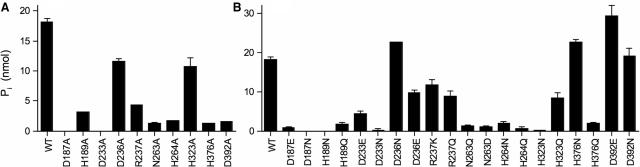
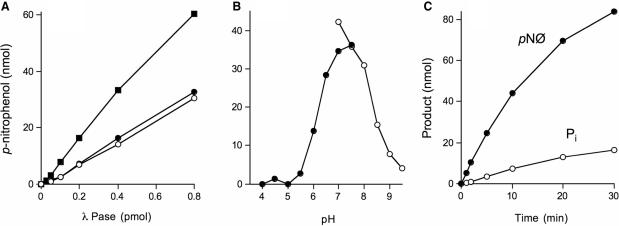
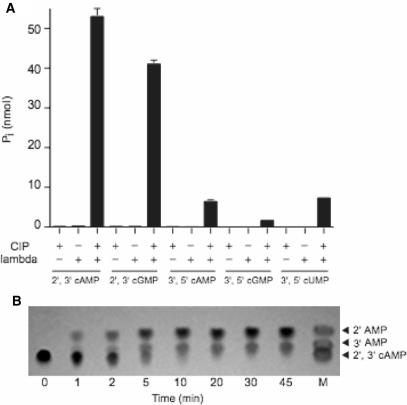
Clostridium thermocellum polynucleotide kinase-phosphatase (CthPnkp) catalyzes 5' and 3' end-healing reactions that prepare broken RNA termini for sealing by RNA ligase. The central phosphatase domain of CthPnkp belongs to the dinuclear metallophosphoesterase superfamily exemplified by bacteriophage lambda phosphatase (lambda-Pase). CthPnkp is a Ni(2+)/Mn(2+)-dependent phosphodiesterase-monoesterase, active on nucleotide and non-nucleotide substrates, that can be transformed toward narrower metal and substrate specificities via mutations of the active site. Here we characterize the Mn(2+)-dependent 2',3' cyclic nucleotide phosphodiesterase activity of CthPnkp, the reaction most relevant to RNA repair pathways. We find that CthPnkp prefers a 2',3' cyclic phosphate to a 3',5' cyclic phosphate. A single H189D mutation imposes strict specificity for a 2',3' cyclic phosphate, which is cleaved to form a single 2'-NMP product. Analysis of the cyclic phosphodiesterase activities of mutated CthPnkp enzymes illuminates the active site and the structural features that affect substrate affinity and k(cat). We also characterize a previously unrecognized phosphodiesterase activity of lambda-Pase, which catalyzes hydrolysis of bis-p-nitrophenyl phosphate. lambda-Pase also has cyclic phosphodiesterase activity with nucleoside 2',3' cyclic phosphates, which it hydrolyzes to yield a mixture of 2'-NMP and 3'-NMP products. We discuss our results in light of available structural and functional data for other phosphodiesterase members of the binuclear metallophosphoesterase family and draw inferences about how differences in active site composition influence catalytic repertoire.
嗜热栖热菌多核苷酸激酶 - 磷酸酶(CthPnkp)催化5'和3'末端修复反应,为RNA连接酶封闭断裂的RNA末端做准备。CthPnkp的中央磷酸酶结构域属于以噬菌体λ磷酸酶(λ-Pase)为代表的双核金属磷酸酯酶超家族。CthPnkp是一种依赖Ni(2+)/Mn(2+)的磷酸二酯酶 - 单酯酶,对核苷酸和非核苷酸底物均有活性,可通过活性位点的突变使其对金属和底物的特异性变窄。在此,我们表征了CthPnkp的Mn(2+)依赖性2',3'环核苷酸磷酸二酯酶活性,该反应与RNA修复途径最为相关。我们发现CthPnkp更倾向于2',3'环磷酸而不是3',5'环磷酸。单个H189D突变对2',3'环磷酸具有严格的特异性,其被切割形成单一的2'-NMP产物。对突变的CthPnkp酶的环磷酸二酯酶活性分析揭示了影响底物亲和力和催化常数(k(cat))的活性位点和结构特征。我们还表征了λ-Pase先前未被识别的磷酸二酯酶活性,其催化双对硝基苯磷酸酯的水解。λ-Pase对核苷2',3'环磷酸也具有环磷酸二酯酶活性,将其水解产生2'-NMP和3'-NMP产物的混合物。我们根据双核金属磷酸酯酶家族其他磷酸二酯酶成员的现有结构和功能数据讨论了我们的结果,并推断活性位点组成的差异如何影响催化功能。