Seiffert Erik R
Department of Anatomical Sciences, Stony Brook University, Stony Brook, New York 11794-8081, USA.
BMC Evol Biol. 2007 Nov 13;7:224. doi: 10.1186/1471-2148-7-224.
The placental mammalian clade Afrotheria is now supported by diverse forms of genomic data, but interordinal relationships within, and morphological support for, the group remains elusive. As a means for addressing these outstanding problems, competing hypotheses of afrotherian interordinal relationships were tested through simultaneous parsimony analysis of a large data set (> 4,590 parsimony informative characters) containing genomic data (> 17 kb of nucleotide data, chromosomal associations, and retroposons) and 400 morphological characters scored across 16 extant and 35 extinct afrotherians.
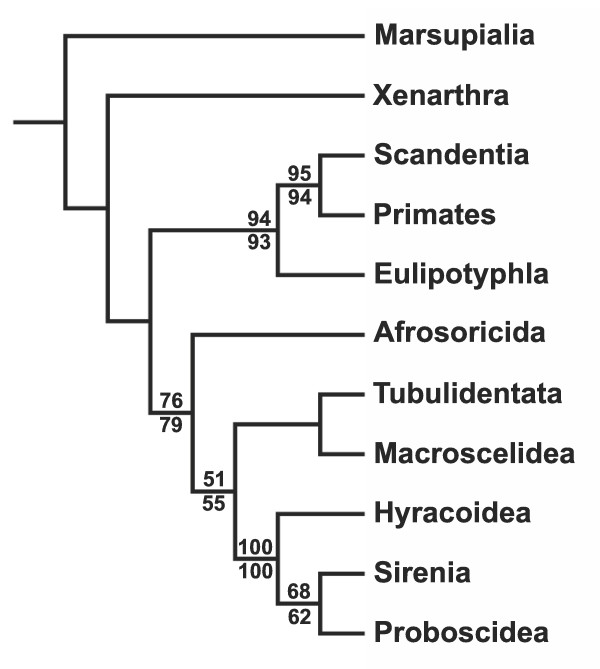
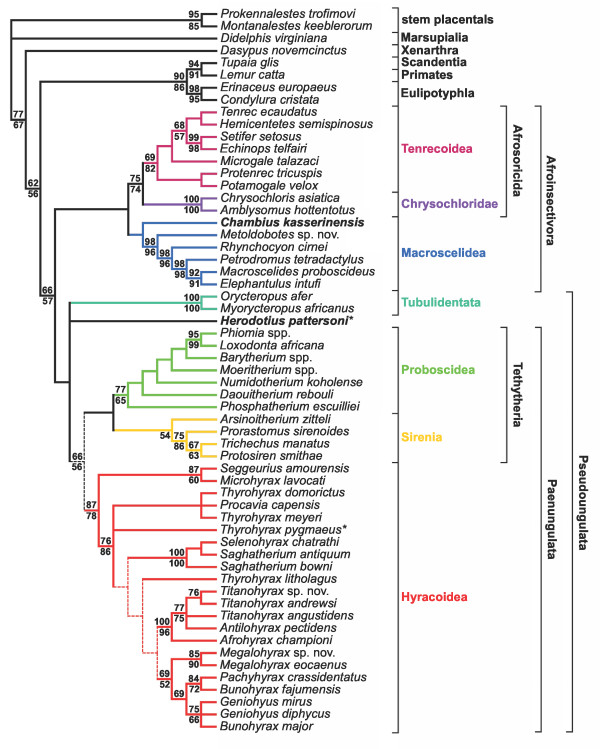
Parsimony analysis of extant taxa alone recovered the interordinal topology (Afrosoricida, ((Macroscelidea, Tubulidentata), (Hyracoidea, (Proboscidea, Sirenia)))). Analysis following addition of extinct taxa instead supported Afroinsectivora (Afrosoricida + Macroscelidea) and Pseudoungulata (Tubulidentata + Paenungulata), as well as Tethytheria (Proboscidea + Sirenia). This latter topology is, however, sensitive to taxon deletion and different placements of the placental root, and numerous alternative interordinal arrangements within Afrotheria could not be statistically rejected. Relationships among extinct stem members of each afrotherian clade were more stable, but one alleged stem macroscelidean (Herodotius) never grouped with that clade and instead consistently joined pseudoungulates or paenungulates. When character transformations were optimized onto a less resolved afrotherian tree that reflects uncertainty about the group's interordinal phylogeny, a total of 21 morphological features were identified as possible synapomorphies of crown Afrotheria, 9 of which optimized unambiguously across all character treatments and optimization methods.
Instability in afrotherian interordinal phylogeny presumably reflects rapid divergences during two pulses of cladogenesis - the first in the Late Cretaceous, at and just after the origin of crown Afrotheria, and the second in the early Cenozoic, with the origin of crown Paenungulata. Morphological evidence for divergences during these two pulses either never existed or has largely been "erased" by subsequent evolution along long ordinal branches. There may, nevertheless, be more morphological character support for crown Afrotheria than is currently assumed; the features identified here as possible afrotherian synapomorphies can be further scrutinized through future phylogenetic analyses with broader taxon sampling, as well as recovery of primitive fossil afrotherians from the Afro-Arabian landmass, where the group is likely to have first diversified.
胎盘哺乳动物分支非洲兽总目如今得到了多种形式的基因组数据的支持,但该类群内部的目间关系以及形态学支持仍然难以捉摸。作为解决这些突出问题的一种方法,通过对一个大型数据集(> 4590个简约信息性状)进行同时简约分析,检验了关于非洲兽总目目间关系的相互竞争的假说,该数据集包含基因组数据(> 17 kb核苷酸数据、染色体关联和反转座子)以及对16种现存和35种已灭绝的非洲兽进行评分的400个形态性状。
仅对现存分类单元进行简约分析得到的目间拓扑结构为(非洲猬目,((象鼩目,管齿目),(蹄兔目,(长鼻目,海牛目))))。加入已灭绝分类单元后的分析反而支持非洲食虫目(非洲猬目 + 象鼩目)和假有蹄类(管齿目 + 准有蹄类),以及非洲兽类(长鼻目 + 海牛目)。然而,后一种拓扑结构对分类单元的删除以及胎盘类根的不同位置很敏感,并且非洲兽总目内部众多其他的目间排列在统计学上无法被排除。每个非洲兽类分支的已灭绝干群成员之间的关系更稳定,但一种所谓的象鼩目干群成员(赫罗多特兽)从未与该分支归为一类,而是始终与假有蹄类或准有蹄类归在一起。当将性状转变优化到一棵解析度较低的非洲兽类树上,该树反映了该类群目间系统发育的不确定性时,总共确定了21个形态特征可能是冠非洲兽类的共有衍征,其中9个在所有性状处理和优化方法中都能明确优化。
非洲兽总目目间系统发育的不稳定性大概反映了在两次分支发生脉冲期间的快速分化——第一次在晚白垩世,在冠非洲兽类起源时及起源后不久,第二次在早新生代,随着冠准有蹄类的起源。这两次脉冲期间分化的形态学证据要么从未存在过,要么已在很大程度上被沿着长的目级分支的后续进化“抹去”。然而,对于冠非洲兽类可能存在比目前所认为的更多的形态性状支持;这里确定为可能的非洲兽类共有衍征的特征可以通过未来更广泛的分类单元采样的系统发育分析,以及从非洲 - 阿拉伯大陆恢复原始的化石非洲兽类来进一步仔细研究,该类群可能最早在那里分化。