Naito M, Komohara Y, Ishihara Y, Noguchi M, Yamashita Y, Shirakusa T, Yamada A, Itoh K, Harada M
Department of Immunology, Kurume University School of Medicine, 67 Asahi-machi, Kurume, Fukuoka 830-0011, Japan.
Br J Cancer. 2007 Dec 17;97(12):1648-54. doi: 10.1038/sj.bjc.6604071. Epub 2007 Nov 27.
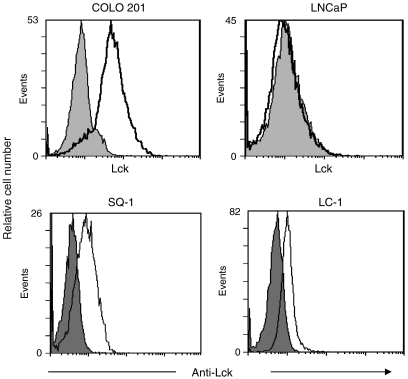
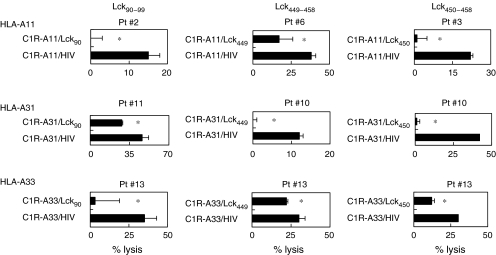
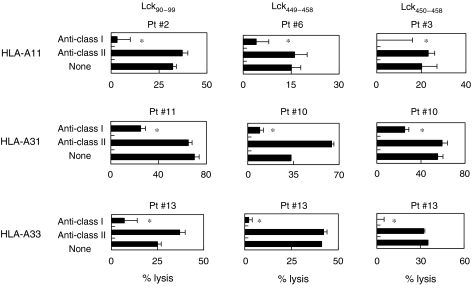
The identification of peptide vaccine candidates to date has been focused on human leukocyte antigen (HLA)-A2 and -A24 alleles. In this study, we attempted to identify cytotoxic T lymphocyte (CTL)-directed Lck-derived peptides applicable to HLA-A11(+), -A31(+), or -A33(+) cancer patients, because these HLA-A alleles share binding motifs, designated HLA-A3 supertype alleles, and because the Lck is preferentially expressed in metastatic cancer. Twenty-one Lck-derived peptides were prepared based on the binding motif to the HLA-A3 supertype alleles. They were first screened for their recognisability by immunoglobulin G (IgG) in the plasma of prostate cancer patients, and the selected candidates were subsequently tested for their potential to induce peptide-specific CTLs from peripheral blood mononuclear cells of HLA-A3 supertype(+) cancer patients. As a result, four Lck peptides were frequently recognised by IgGs, and three of them - Lck(90-99), Lck(449-458), and Lck(450-458) - efficiently induced peptide-specific and cancer-reactive CTLs. Their cytotoxicity towards cancer cells was mainly ascribed to HLA class I-restricted and peptide-specific CD8(+) T cells. These results indicate that these three Lck peptides are applicable to HLA-A3 supertype(+) cancer patients, especially those with metastasis. This information could facilitate the development of peptide-based anti-cancer vaccine for patients with alleles other than HLA-A2 and -A24.
迄今为止,肽疫苗候选物的鉴定主要集中在人类白细胞抗原(HLA)-A2和-A24等位基因上。在本研究中,我们试图鉴定适用于HLA-A11(+)、-A31(+)或-A33(+)癌症患者的细胞毒性T淋巴细胞(CTL)导向的Lck衍生肽,因为这些HLA-A等位基因共享称为HLA-A3超型等位基因的结合基序,并且因为Lck在转移性癌症中优先表达。基于与HLA-A3超型等位基因的结合基序制备了21种Lck衍生肽。首先在前列腺癌患者血浆中通过免疫球蛋白G(IgG)筛选它们的可识别性,随后对选定的候选物进行测试,以检测它们从HLA-A3超型(+)癌症患者外周血单核细胞诱导肽特异性CTL的潜力。结果,四种Lck肽经常被IgG识别,其中三种——Lck(90-99)、Lck(449-458)和Lck(450-458)——有效诱导肽特异性和癌症反应性CTL。它们对癌细胞的细胞毒性主要归因于HLA I类限制性和肽特异性CD8(+) T细胞。这些结果表明,这三种Lck肽适用于HLA-A3超型(+)癌症患者,尤其是那些有转移的患者。这一信息可能有助于开发针对HLA-A2和-A24以外等位基因患者的基于肽的抗癌疫苗。