Mercer Becky A, D'Armiento Jeanine M
Institute of Human Nutrition, Division of Molecular Medicine, Department of Medicine, Columbia University College of Physicians and Surgeons, New York 10032, USA.
Int J Chron Obstruct Pulmon Dis. 2006;1(2):137-50. doi: 10.2147/copd.2006.1.2.137.
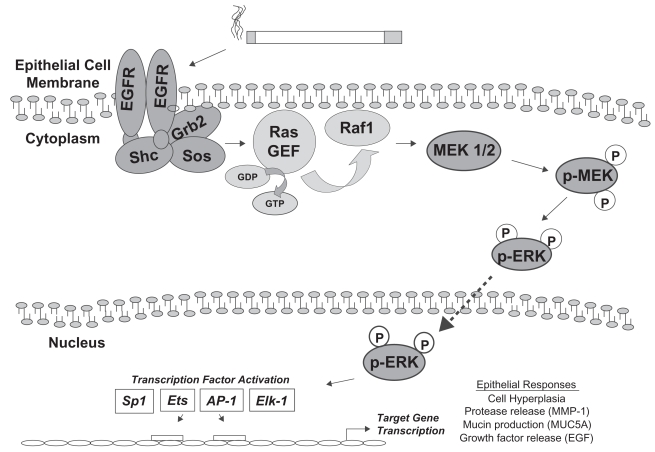
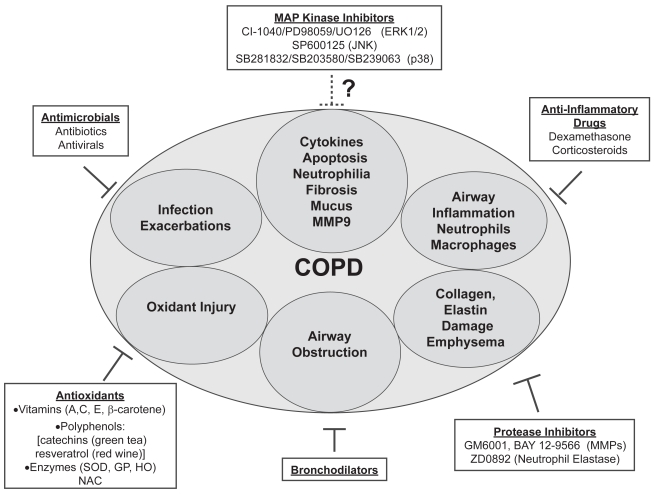
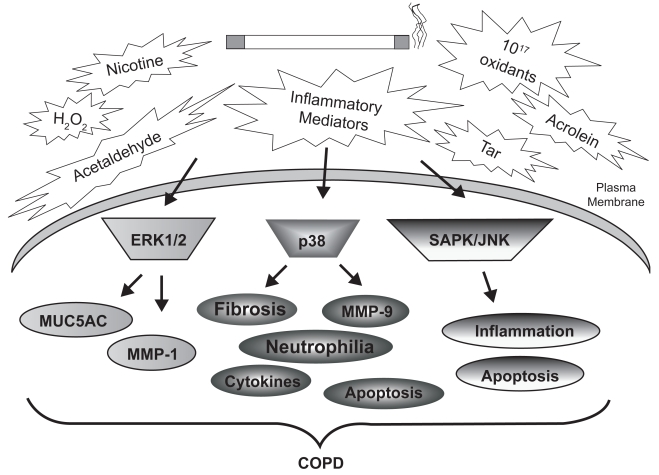
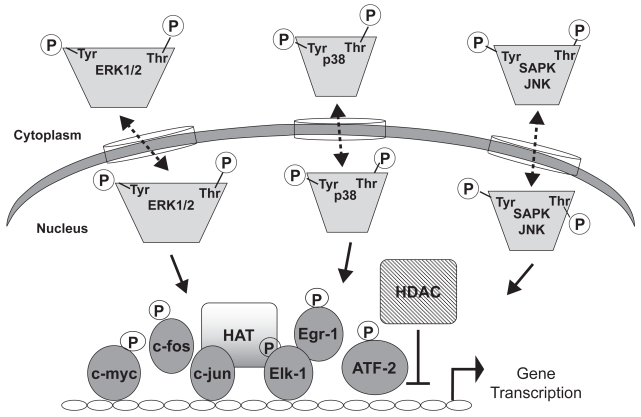
Studies examining the cellular mechanisms of inflammation and protease production in the lung tissue and airways of COPD patients have shed light on the important role of kinase-based signaling cascades. These pathways can be activated by environmental stimuli such as tobacco smoke, and by endogenous signals such as cytokines, growth factors, and inflammation-derived oxidants. The three most widely characterized cascades are those directed by the classical mitogen activated protein (MAP) kinase (ERK1/2), stress activated protein kinase/c-Jun N-terminal protein kinase, and p38 enzymes. These phosphorylation cascades transmit and amplify extracellular, receptor-mediated signals through the cytoplasm of the cell to activate nuclear transcription factors which bind and induce expression of target genes. The result is tight control of diverse cellular events, and rapid responses to external stimuli. However, recent research suggests that constitutive or aberrant activation of MAP kinases contributes to several COPD-associated phenotypes, including mucus overproduction and secretion, inflammation, cytokine expression, apoptosis, T cell activation, matrix metalloproteinase production, and fibrosis. This review explores the biological functions of the MAP kinase pathways in the pathogenesis of COPD, their activation by cigarette smoke, and discusses the potential role of MAP kinase inhibitors in COPD therapy.
对慢性阻塞性肺疾病(COPD)患者肺组织和气道中炎症及蛋白酶产生的细胞机制进行的研究,揭示了基于激酶的信号级联反应的重要作用。这些信号通路可被烟草烟雾等环境刺激以及细胞因子、生长因子和炎症衍生的氧化剂等内源性信号激活。研究最为广泛的三种信号级联反应是由经典的丝裂原活化蛋白(MAP)激酶(ERK1/2)、应激激活蛋白激酶/c-Jun N端蛋白激酶和p38酶所介导的信号级联反应。这些磷酸化级联反应通过细胞胞质传递并放大细胞外受体介导的信号,从而激活核转录因子,这些核转录因子结合并诱导靶基因的表达。其结果是对各种细胞事件进行严格控制,并对外部刺激做出快速反应。然而,最近的研究表明,MAP激酶的组成性或异常激活会导致多种与COPD相关的表型,包括黏液过度产生和分泌、炎症、细胞因子表达、细胞凋亡、T细胞活化、基质金属蛋白酶产生以及纤维化。本综述探讨了MAP激酶信号通路在COPD发病机制中的生物学功能、它们被香烟烟雾激活的情况,并讨论了MAP激酶抑制剂在COPD治疗中的潜在作用。