van der Woude Fokke J, Heinemann Lothar A J, Graf Helmut, Lewis Michael, Moehner Sabine, Assmann Anita, Kühl-Habich Doerthe
Nephrology, 5. Med. Klinik, Klinikum Heidelberg-Mannheim, Theodor-Kutzer-Ufer 1-3, 68167 Mannheim, Germany.
BMC Nephrol. 2007 Dec 5;8:15. doi: 10.1186/1471-2369-8-15.
An ad hoc peer-review committee was jointly appointed by Drug Authorities and Industry in Germany, Austria and Switzerland in 1999/2000 to review the evidence for a causal relation between phenacetin-free analgesics and nephropathy. The committee found the evidence as inconclusive and requested a new case-control study of adequate design.
We performed a population-based case-control study with incident cases of end-stage renal disease (ESRD) under the age of 50 years and four age and sex-matched neighborhood controls in 170 dialysis centers (153 in Germany, and 17 in Austria) from January 1, 2001 to December 31, 2004. Data on lifetime medical history, risk factors, treatment, job exposure and intake of analgesics were obtained in a standardized face-to-face interview using memory aids to enhance accuracy. Study design, study performance, analysis plan, and study report were approved by an independent international advisory committee and by the Drug Authorities involved. Unconditional logistic regression analyses were performed.
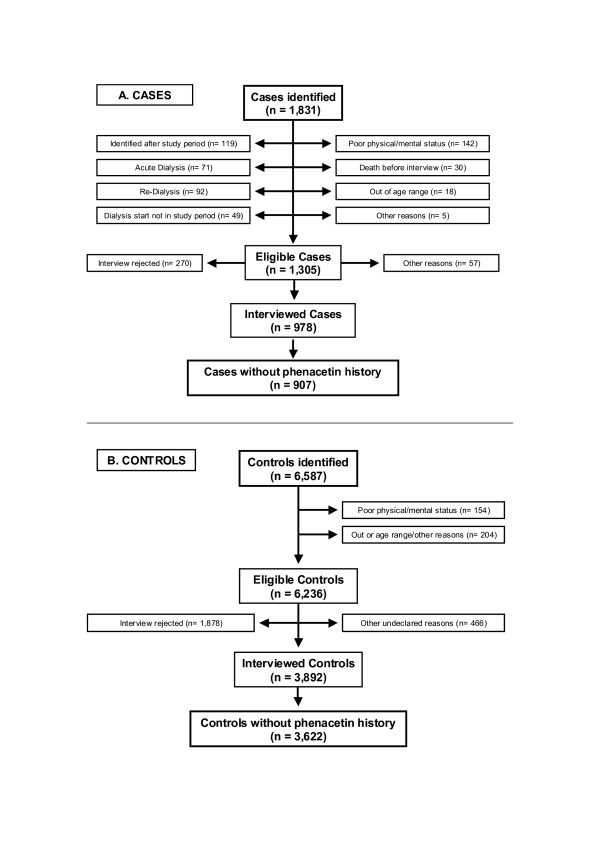
The analysis included 907 cases and 3,622 controls who had never used phenacetin-containing analgesics in their lifetime. The use of high cumulative lifetime dose (3rd tertile) of analgesics in the period up to five years before dialysis was not associated with later ESRD. Adjusted odds ratios with 95% confidence intervals were 0.8 (0.7 - 1.0) and 1.0 (0.8 - 1.3) for ever- compared with no or low use and high use compared with low use, respectively. The same results were found for all analgesics and for mono-, and combination preparations with and without caffeine. No increased risk was shown in analyses stratifying for dose and duration. Dose-response analyses showed that analgesic use was not associated with an increased risk for ESRD up to 3.5 kg cumulative lifetime dose (98 % of the cases with ESRD). While the large subgroup of users with a lifetime dose up to 0.5 kg (278 cases and 1365 controls) showed a significantly decreased risk, a tiny subgroup of extreme users with over 3.5 kg lifetime use (19 cases and 11 controls) showed a significant risk increase. The detailed evaluation of 22 cases and 19 controls with over 2.5 kg lifetime use recommended by the regulatory advisors showed an impressive excess of other conditions than analgesics triggering the evolution of ESRD in cases compared with controls.
We found no clinically meaningful evidence for an increased risk of ESRD associated with use of phenacetin-free analgesics in single or combined formulation. The apparent risk increase shown in a small subgroup with extreme lifetime dose of analgesics is most likely an indirect, non-causal association. This hypothesis, however, cannot be confirmed or refuted within our case-control study. Overall, our results lend support to the mounting evidence that phenacetin-free analgesics do not induce ESRD and that the notion of "analgesic nephropathy" needs to be re-evaluated.
1999/2000年,德国、奥地利和瑞士的药品监管机构与制药行业联合任命了一个特设同行评审委员会,以审查不含非那西丁的镇痛药与肾病之间因果关系的证据。该委员会认为证据不确凿,并要求开展一项设计合理的新病例对照研究。
我们在170个透析中心(德国153个,奥地利17个)开展了一项基于人群的病例对照研究,研究对象为50岁以下终末期肾病(ESRD)的新发病例以及4名年龄和性别匹配的社区对照,研究时间为2001年1月1日至2004年12月31日。通过标准化的面对面访谈获取终生病史、危险因素、治疗情况、职业暴露和镇痛药摄入的数据,并使用记忆辅助工具以提高准确性。研究设计、研究实施、分析计划和研究报告均获得独立国际咨询委员会和相关药品监管机构的批准。进行了无条件逻辑回归分析。
分析纳入了907例病例和3622名对照,他们终生从未使用过含非那西丁的镇痛药。透析前五年内使用高累积终生剂量(第三三分位数)的镇痛药与后期ESRD无关。与未使用或低剂量使用相比,曾经使用过镇痛药与未使用或低剂量使用的调整优势比及95%置信区间分别为0.8(0.7 - 1.0),与低剂量使用相比,高剂量使用的调整优势比及95%置信区间为1.0(0.8 - 1.3)。所有镇痛药以及含或不含咖啡因的单一制剂和复方制剂的结果均相同。按剂量和持续时间分层分析未显示风险增加。剂量反应分析表明,累积终生剂量达3.5千克(98%的ESRD病例)时,镇痛药使用与ESRD风险增加无关。虽然终生剂量达0.5千克的大量使用者亚组(278例病例和1365名对照)显示风险显著降低,但终生使用量超过3.5千克的极小极端使用者亚组(19例病例和11名对照)显示风险显著增加。监管顾问推荐的对终生使用量超过2.5千克的22例病例和19名对照进行的详细评估显示,与对照相比,病例中除镇痛药外引发ESRD进展的其他情况明显过多。
我们未发现临床意义上的证据表明,使用单一或复方不含非那西丁的镇痛药会增加ESRD风险。终生使用镇痛药剂量极高的一个小亚组中显示的明显风险增加很可能是一种间接的非因果关联。然而,在我们的病例对照研究中无法证实或反驳这一假设。总体而言,我们的结果支持越来越多的证据表明,不含非那西丁的镇痛药不会诱发ESRD,“镇痛药性肾病”的概念需要重新评估。
