Venkatramani Ravindra, Radhakrishnan Ravi
Department of Bioengineering, University of Pennsylvania, Philadelphia, Pennsylvania 19104, USA.
Proteins. 2008 May 15;71(3):1360-72. doi: 10.1002/prot.21824.
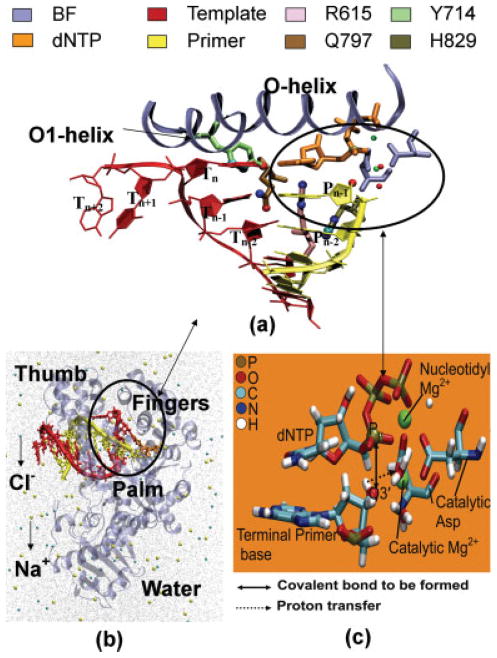
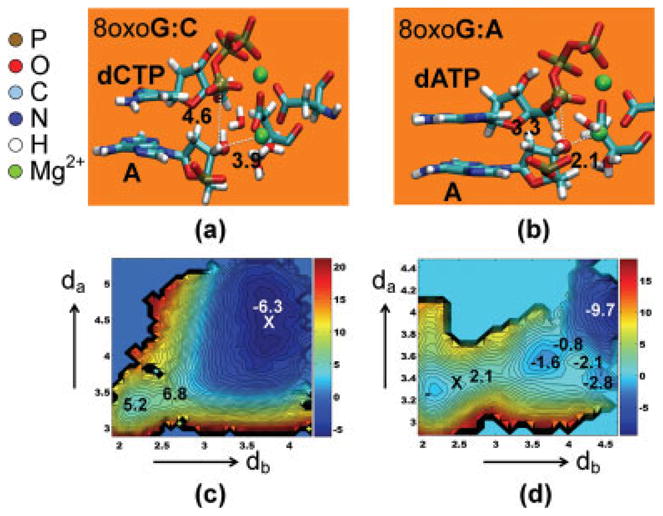
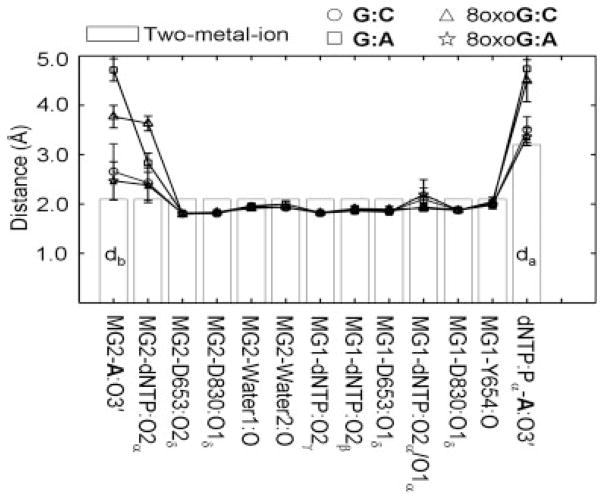
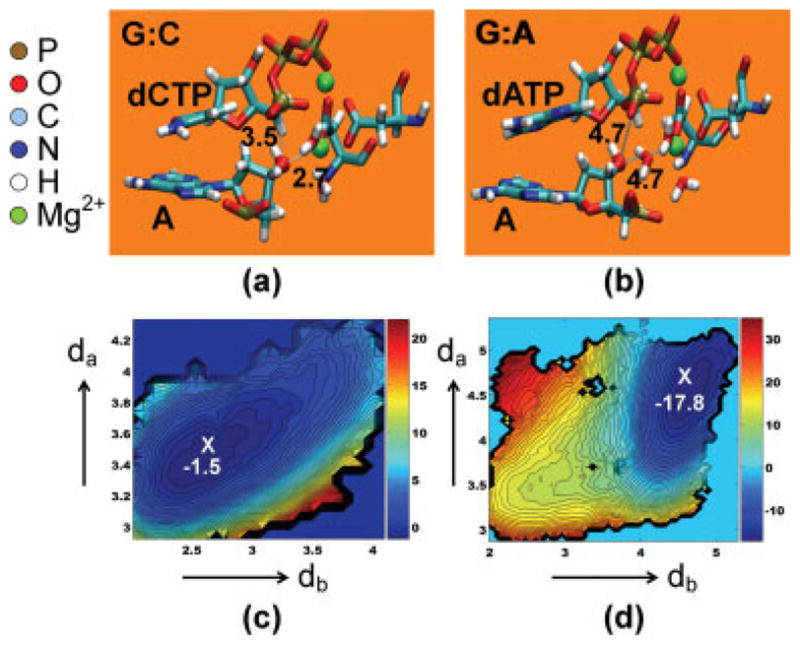
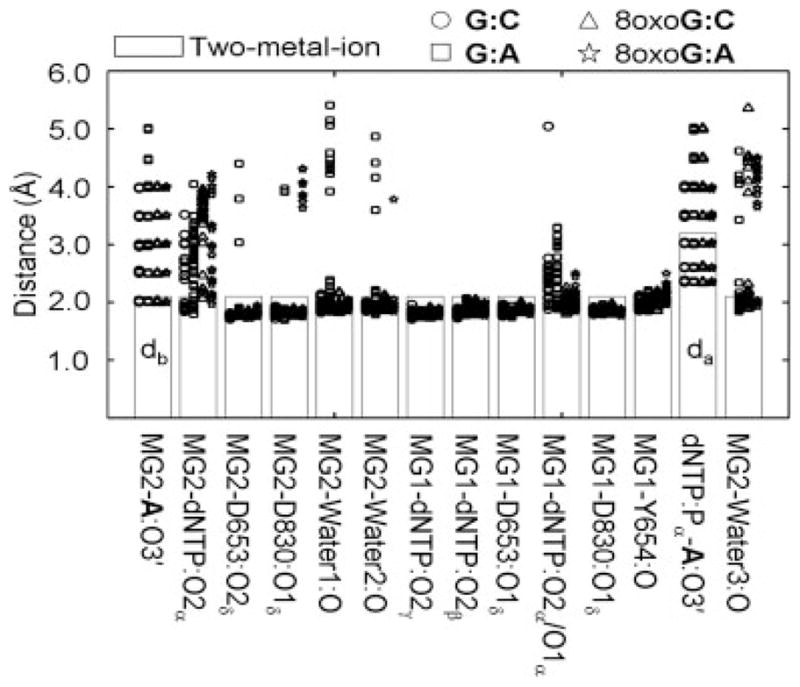
We study the effect of the oxidative lesion 8-oxoguanine (8oxoG) on the preorganization of the active site for DNA replication in the closed (active) state of the Bacillus fragment (BF), a Klenow analog from Bacillus stearothermophilus. Our molecular dynamics and free energy simulations of explicitly solvated model ternary complexes of BF bound to correct dCTP/incorrect dATP opposite guanine (G) and 8oxoG bases in DNA suggest that the lesion introduces structural and energetic changes at the catalytic site to favor dATP insertion. Despite the formation of a stable Watson-Crick pairing in the 8oxoG:dCTP system, the catalytic geometry is severely distorted to possibly slow down catalysis. Indeed, our calculated free energy landscapes associated with active site preorganization suggest additional barriers to assemble an efficient catalytic site, which need to be overcome during dCTP incorporation opposite 8oxoG relative to that opposite undamaged G. In contrast, the catalytic geometry for the Hoogsteen pairing in the 8oxoG:dATP system is highly organized and poised for efficient nucleotide incorporation via the "two-metal-ion" catalyzed phosphoryl transfer mechanism. However, the free energy calculations suggest that the catalytic geometry during dATP incorporation opposite 8oxoG is considerably less plastic than that during dCTP incorporation opposite G despite a very similar, well organized catalytic site for both systems. A correlation analysis of the dynamics trajectories suggests the presence of significant coupling between motions of the polymerase fingers and the primary distance for nucleophilic attack (i.e., between the terminal primer O3' and the dNTP P(alpha.) atoms) during correct dCTP incorporation opposite undamaged G. This coupling is shown to be disrupted during nucleotide incorporation by the polymerase with oxidatively damaged DNA/dNTP substrates. We also suggest that the lesion affects DNA interactions with key polymerase residues, thereby affecting the enzymes ability to discriminate against non-complementary DNA/dNTP substrates. Taken together, our results provide a unified structural, energetic, and dynamic platform to rationalize experimentally observed relative nucleotide incorporation rates for correct dCTP/incorrect dATP insertion opposite an undamaged/oxidatively damaged template G by BF.
我们研究了氧化损伤产物8-氧代鸟嘌呤(8oxoG)对嗜热栖热芽孢杆菌来源的Klenow类似物芽孢杆菌片段(BF)处于封闭(活性)状态时DNA复制活性位点预组织的影响。我们对BF与DNA中鸟嘌呤(G)和8oxoG碱基相对应的正确dCTP/错误dATP结合的明确溶剂化模型三元复合物进行了分子动力学和自由能模拟,结果表明该损伤在催化位点引入了结构和能量变化,有利于dATP的插入。尽管在8oxoG:dCTP系统中形成了稳定的沃森-克里克配对,但催化几何结构严重扭曲,可能会减缓催化作用。实际上,我们计算得到的与活性位点预组织相关的自由能景观表明,相对于未受损的G,在8oxoG相对应位置掺入dCTP时,组装高效催化位点还存在额外的障碍需要克服。相比之下,8oxoG:dATP系统中Hoogsteen配对的催化几何结构高度有序,通过“双金属离子”催化的磷酰转移机制为高效的核苷酸掺入做好了准备。然而,自由能计算表明,尽管两个系统的催化位点非常相似且组织良好,但在8oxoG相对应位置掺入dATP时的催化几何结构比在G相对应位置掺入dCTP时的可塑性要小得多。对动力学轨迹的相关分析表明,在与未受损的G相对应位置正确掺入dCTP的过程中,聚合酶手指的运动与亲核攻击的主要距离(即末端引物O3'与dNTP P(α)原子之间的距离)之间存在显著的耦合。结果表明,在聚合酶与氧化损伤的DNA/dNTP底物进行核苷酸掺入过程中,这种耦合被破坏。我们还认为,该损伤会影响DNA与关键聚合酶残基的相互作用,从而影响酶区分非互补DNA/dNTP底物的能力。综上所述,我们的结果提供了一个统一的结构、能量和动力学平台,以合理解释实验观察到的BF在未受损/氧化损伤的模板G相对应位置正确掺入dCTP/错误掺入dATP的相对核苷酸掺入率。