Lindstedt Sandra, Malmsjö Malin, Ingemansson Richard
Department of Cardiothoracic Surgery, Lund University Hospital, Lund, Sweden.
J Cardiothorac Surg. 2007 Dec 6;2:53. doi: 10.1186/1749-8090-2-53.
Topical negative pressure (TNP), commonly used in wound therapy, has been shown to increase blood flow and stimulate angiogenesis in skeletal muscle. We have previously shown that a myocardial TNP of -50 mmHg significantly increases microvascular blood flow in the myocardium. When TPN is used in wound therapy (on skeletal and subcutaneous tissue) a zone of relative hypoperfusion is seen close to the wound edge. Hypoperfusion induced by TNP is thought to depend on tissue density, distance from the negative pressure source, and the amount negative pressure applied. When applying TNP to the myocardium, a significant, long-standing zone of hypoperfusion could theoretically cause ischemia, and negative effects on the myocardium. The current study was designed to elucidate whether hypoperfusion was produced during myocardial TNP.
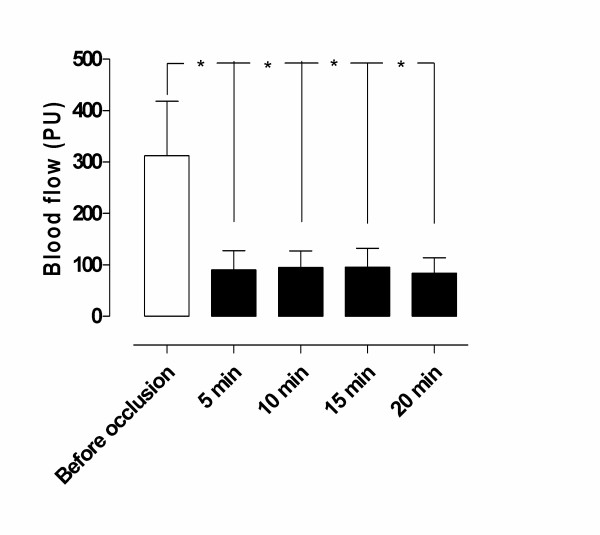
Six pigs underwent median sternotomy. Laser Doppler probes were inserted horizontally into the heart muscle in the LAD area, at depths of approximately, 1-2 mm. The microvascular blood flow was measured before and after the application of a TNP. Analyses were performed before left anterior descending artery (LAD) occlusion (normal myocardium) and after 20 minutes of LAD occlusion (ischemic myocardium).
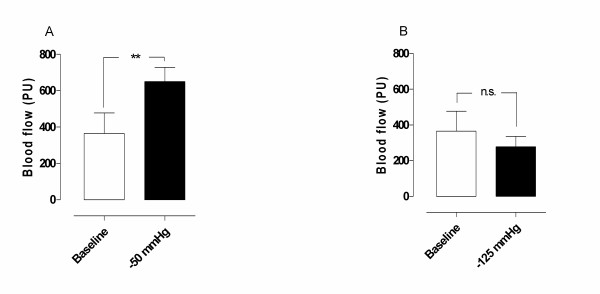
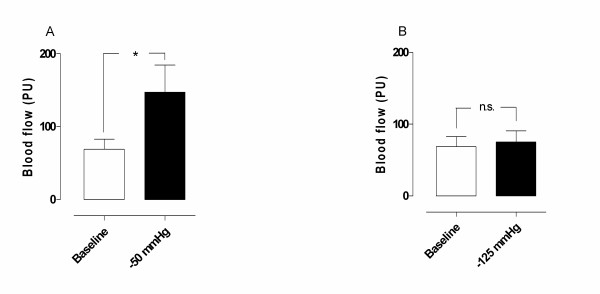
A TNP of -50 mmHg induced a significant increase in microvascular blood flow in normal myocardium (**p = 0.01), while -125 mmHg did not significantly alter the microvascular blood flow. In ischemic myocardium a TNP of -50 mmHg induced a significant increase in microvascular blood flow (*p = 0.04), while -125 mmHg did not significantly alter the microvascular blood flow.
No hypoperfusion could be observed in the epicardium in neither normal nor ischemic myocardium during myocardial TNP.
局部负压(TNP)常用于伤口治疗,已被证明可增加骨骼肌的血流并刺激血管生成。我们之前已经表明,-50 mmHg的心肌TNP可显著增加心肌的微血管血流。当TNP用于伤口治疗(在骨骼肌和皮下组织上)时,在伤口边缘附近会出现相对灌注不足的区域。TNP诱导的灌注不足被认为取决于组织密度、与负压源的距离以及施加的负压量。当将TNP应用于心肌时,理论上一个显著的、长期的灌注不足区域可能会导致心肌缺血和对心肌的负面影响。本研究旨在阐明心肌TNP期间是否会产生灌注不足。
对6头猪进行正中胸骨切开术。将激光多普勒探头水平插入左前降支区域心肌约1 - 2 mm深处。在施加TNP之前和之后测量微血管血流。在左前降支(LAD)闭塞前(正常心肌)和LAD闭塞20分钟后(缺血心肌)进行分析。
-50 mmHg的TNP可使正常心肌的微血管血流显著增加(**p = 0.01),而-125 mmHg对微血管血流无显著影响。在缺血心肌中,-50 mmHg的TNP可使微血管血流显著增加(*p = 0.04),而-125 mmHg对微血管血流无显著影响。
在心肌TNP期间,无论是正常心肌还是缺血心肌的心外膜均未观察到灌注不足。